Frontline Learning Research: Vol. 13 No. 2 (2025)
102 - 121
Special Issue: Perspectives on Momentary Engagement and
Learning Situated in Classroom Contexts
ISSN 2295-3159
1Learning and Educational
Technology Research Lab, Faculty of Education and Psychology,
University of Oulu, Oulu, Finland
2 Research Unit of Population Health, Faculty of
Medicine, University of Oulu, Oulu, Finland
3 Department of Psychology and Human Development, UCL
Institute of Education, London, UK
Article received 30 June 2023 / Article revised 1 September 2023 / Accepted 20 October 2023 / Available online 14 March 2025
Despite recognising momentary challenges while learning, collaborative groups do not necessarily regulate and adapt their learning process according to the demands. Various online measures have recently been explored to unobtrusively study engagement and adaptation in collaborative learning (CL), as it occurs in the classroom. For example, physiological synchrony derived from electrodermal activity (EDA) has been a prominent reflector of momentary engagement in CL. However, how physiological synchrony relates to students’ views about CL, regulation of learning, and performance remains unclear. This study investigates how momentary measures of physiological synchrony, students’ perceived value of CL, and regulation of learning, align and further relate to group performance. The participants were 94 students attending a physics course consisting of four 90-minute lessons and a collaborative exam. Each lesson included a CL task. At the beginning and end of each session, students reported their perceived value of CL. Students’ EDA was recorded to derive physiological synchrony. Co-regulation (CoRL) and socially shared regulation (SSRL) were coded from the video. Results suggest that when groups show higher physiological synchrony, they perceive their CL as less valuable and tend to perform worse in collaborative exams. It seems that self-reports on the value of CL, rather than physiological synchrony, may better reflect the regulation of CL. Interestingly, the association patterns for CoRL and SSRL differed, as frequent CoRL was linked to the less valued CL, while SSRL tended towards a positive relation. The study demonstrates the complex and multidimensional role of momentary engagement in CL.
Keywords: Collaborative learning, Momentary engagement, Socially shared regulation of learning, Physiological synchrony
Collaborative learning (CL) requires students' continuous active participation to form a shared understanding of a problem, which makes student engagement a fundamental prerequisite for successful CL to unfold (Roschelle & Teasley, 1995). Recent research has emphasised the momentary and situated nature of classroom engagement (Symonds et al., 2021). Symonds et al. (2024) define momentary engagement as “the active involvement of an individual in an educational task as the task proceeds across seconds and minutes” (p. 5) involving cognitive, motivational, behavioural, and emotional components. Such temporality and multidimensionality make momentary engagement a complex dynamic system that requires self-regulatory control mechanisms, allowing its self-organisation over time (Symonds et al., 2024).
In CL research, engagement intertwines with self-regulated learning processes, including the active planning, monitoring, and control of learning (Järvelä et al., 2016; Sinha et al., 2015). More specifically, in CL, students can engage in self-regulation (SRL), co-regulation (CoRL), and socially shared regulation of learning (SSRL) according to their situational needs (Hadwin et al., 2018). Where SRL is more about the individual planning, monitoring, and controlling of one’s learning process, SSRL refers to a type of regulation where group members negotiate, transact, and build their regulation upon each other (Järvelä et al., 2021). CoRL, in turn, holds more of a transitional role, switching and activating either the individual’s SRL or the group's SSRL during the learning process. For example, a student in a collaborative group can point out that the task is not progressing as planned, allowing the individual or the group to monitor and control the learning process towards the goal. Though momentary engagement can be considered a broader concept than the regulation of learning, in this study, we see the regulation of collaborative learning as an important proxy for momentary engagement. Prior studies suggest that students’ momentary engagement, SRL, CoRL, and SSRL are challenging to capture, and multiple methods and data channels are needed to study them (Azevedo, 2015; Sobocinski et al., 2020).
Recently, Martin et al. (2023) proposed that engagement, motivation, and learning should be studied with an integrated approach and that physiological measures could offer tools to conduct such research. We argue that this approach is particularly relevant to momentary engagement, as it is a temporal multilevel phenomenon manifesting on different grain sizes (Symonds et al., 2024). Promising results suggest that electrodermal activity (EDA) measures and different dimensions of engagement could be positively linked (Lee et al., 2019; Malmberg et al., 2023; Zhang et al., 2018). Furthermore, EDA measured in collaborative settings allows computation of physiological synchrony: interdependence between group members’ physiological signals. Physiological synchrony has gained interest in revealing the dynamics of collaboration and has been considered potentially a relevant condition for the regulation of CL. Maybe surprisingly, physiological synchrony derived from EDA appears to be higher when the group faces challenges and needs to make an effort to proceed with their task (Dindar et al., 2020; Malmberg et al., 2019). Due to these results, physiological synchrony could be considered a potential measure to indicate momentary engagement during challenging CL events.
The current research views students’ subjective appraisals of collaboration as an important prerequisite for momentary engagement in CL. However, momentary engagement can also be shaped by actualised learning activities, such as adaptation to learning challenges through CoRL and SSRL during the learning process. Therefore, we study how observed CoRL and SSRL relate to students’ situated views about collaboration, physiological activity, and collaborative learning outcomes. Very few studies have empirically investigated how different subjective and objective variables relevant to momentary engagement in CL align. This study explores whether subjective and objective measures recorded from natural classroom learning settings align and further relate to CL outcomes. The present study is also essential in empirically demonstrating the complex system nature that momentary engagement (Symonds et al., 2024) and CL involve (Amon et al., 2019; Ouyang et al., 2023). More specifically, it considers the complexity and temporality of momentary engagement by applying novel nonlinear analysis methods (multidimensional recurrence quantification analysis) and acknowledges the lesson-to-lesson, within-group variation when analysing the relations. The results contribute to a more comprehensive understanding of the dynamics emerging in CL. This holistic view can inform the creation of interventions and tools that promote momentary engagement and help students regulate their learning effectively in group settings.
Being actively involved in a task across seconds and minutes is critical for learning, particularly in complex and dynamic learning environments such as CL (Isohätälä et al., 2017; Järvelä et al., 2016; Symonds et al., 2024). In CL, momentary engagement may not necessarily target only the task content itself but also all the social interactions relevant to carrying out the task. Engaging in these interactions is a fundamental prerequisite for students to build up their reasoning and argumentation with each other (Cohen, 1994) and for supporting momentary engagement in the task (Lai, 2021).
Engagement in learning is inherently multidimensional. This has been acknowledged for individual engagement (Fredricks et al., 2004; Sinatra et al., 2015), collaborative engagement (Rogat et al., 2022; Sinha et al., 2015), and recently also within a momentary engagement framework (Symonds et al., 2021). Rogat et al. (2022) distinguish between behavioural, socioemotional, collaborative, metacognitive, and disciplinary dimensions of engagement in CL. The core of CL is the idea of building a shared understanding of a problem through the contributions of multiple learners (Roschelle & Teasley, 1995). This requires collaborative engagement, that is, the coordination of task and knowledge construction processes, as well as joint and balanced contributions of group members. However, this also requires sustaining learners' joint participation, attention and focus on the task at hand (i.e., behavioural engagement), which can be challenging in group settings (Rogat et al., 2022).
In addition to cognitive processes (e.g. attention), momentary engagement is intertwined with motivational and socio-emotional processes (Rogat et al., 2022; Symonds et al., 2021) that serve as important conditions for students’ willingness to engage in the task at hand (Bakhtiar et al., 2017; Upadyaya et al., 2021). For example, Lai’s (2021) study indicated that interest and utility value are positively associated with students’ behavioural engagement in a group-based flipped learning context. Zschocke et al. (2016) studied individuals’ group work appraisal. They found that appraisals of the cognitive benefits of group work (i.e., the value of collaboration) were a significant predictor of positive activating emotions, considered to promote learning.
However, momentary engagement in CL can also be pivotal in promoting the perceived value of collaboration, starting a positive self-reinforcing feedback loop supporting future engagement (Lai, 2021, Malmberg et al., 2023). This type of interplay manifests, for example, when students engage in discussion, reciprocally offering their ideas and perspectives, which builds a more comprehensive and nuanced understanding of the topic (Vuopala et al., 2019; Zabolotna et al., 2023). This, in turn, can feed back to students perceiving the collaboration as more valuable for their learning and, thus, support their momentary engagement for the continuing learning activities (Kreijns et al., 2003). By actively engaging with each other and sharing their thoughts and ideas, learners can simultaneously build a shared sense of purpose and common ground (Isohätälä et al., 2020). Furthermore, as a result, a positive socio-emotional atmosphere and sense of community among learners can help to foster engagement through its socio-emotional dimension (Järvenoja & Järvelä, 2013; Mänty et al., 2020; Rogat et al., 2022).
From the different dimensions of engagement, the metacognitive dimension appears to be particularly central and strongly connected with other dimensions (Rogat et al., 2022). For example, being actively involved with a task does not necessarily mean the collaboration process unfolds productively (Sinha et al., 2015). This is to say that the group can be momentarily engaged with the task and still struggle to make progress, solve the problem and learn together. Prior research has shown that students need to regulate, that is, to plan, monitor and control their learning process to overcome challenges and succeed (Haataja, Malmberg, et al., 2022; Järvelä & Hadwin, 2013). Regulation demands metacognition, thinking about one’s thinking, adapting and making strategic decisions when facing challenges, all of which ultimately result in better learning (Järvelä et al., 2021). According to Rogat et al. (2022), group use of regulatory strategies indicates metacognitive engagement. In particular, high-quality metacognitive engagement can be characterised by goal-focused, effective SSRL (Rogat et al., 2022). That is, the regulation of learning relies on momentary metacognitive engagement (Isohätälä et al., 2017; Vuorenmaa et al., 2023). For instance, in SRL, momentary engagement allows learners to monitor their level of attention and motivation, judge their performance, and adjust their learning strategies accordingly. In CoRL, momentary engagement enables students to perceive and respond to the actions of their peers, adjust their behaviour to support the group's goals and facilitate the emergence of shared regulation. In SSRL, momentary engagement facilitates the negotiation of shared goals and strategies among group members, the monitoring of obstacles, and the proposals and decisions of shared control. However, the relationship between momentary engagement and regulation is reciprocal: regulation also serves as a means to strategically influence and ensure the self-organisation and maintenance of momentary engagement in the face of challenges (Järvelä et al., 2016; Symonds et al., 2024). For example, CoRL can serve as an invitation to the group as a whole to momentarily engage and negotiate their decision-making regarding learning in the form of SSRL (Ahola et al., 2023), which, however, does not always happen (Törmänen et al., 2021). SSRL, in turn, can mutually support the groups’ engagement in executing the strategic decisions and, importantly, the motivational and socio-emotional atmosphere, maintaining the group's engagement (Törmänen et al., 2021). There is also preliminary evidence suggesting that CoRL and SSRL could relate to better group performance (De Backer et al., 2020; Zheng & Huang, 2016) and individual learning achievement (Haataja, Dindar, et al., 2022; Zheng et al., 2017).
Though the critical roles of engagement and regulation of learning have been acknowledged for some time, the challenge has been to track engagement in situ (Azevedo, 2015). Recently Martin et al., (2023) proposed that engagement, motivation, and learning should be studied with an integrated approach and that biophysiology could offer a framework for such research. Physiological data is particularly interesting for momentary engagement research because it can be traced through seconds and minutes. Although physiological data entered the learning sciences quite recently, studies have demonstrated that autonomic nervous system measures such as heart rate (HR) and electrodermal activity (EDA) are potential channels for studying engagement (Ba & Hu, 2023). More specifically, EDA reflects the sympathetic branch of the autonomic nervous system, traditionally considered to activate in the fight or flight stress response, signalling the anticipated need to act and engage in a situation at hand (Dawson et al., 2017).
Previously, Lee et al. (2019) investigated how EDA measures reflect the momentary engagement of students during a maker movement course. They found a moderate correlation between the EDA measures and cognitive and behavioural engagement. However, emotional engagement did not correlate meaningfully with EDA peaks. The authors suggested that more research would be needed to show the relevancy of EDA measures in studying momentary engagement. Further, Zhang et al. (2021) examined the correlations between EDA indicators of emotional and cognitive engagement, self-reported class engagement, and learning outcomes; and how physiological dynamics differ across students and within students over time with classroom events and observable individual engagement. They found moderate positive correlations between individual-level EDA features and self-reported attention, emotional valence, and knowledge.
The synchrony between the students’ physiological signals is an interesting phenomenon for investigating momentary engagement, particularly in CL. Physiological synchrony refers to any interconnected or associated activity among physiological signals between individuals (Palumbo et al., 2018), often captured by temporal measures to trace the similarity in people's physiological activity patterns, such as EDA responses over time. Considering that shared joint attention is a fundamental prerequisite for CL, one might hypothesise that better collaboration would be reflected as a similar physiological activity between the students and, therefore, as higher synchrony. However, so far, the empirical results regarding physiological synchrony derived from EDA measures seem to be mixed. Some studies have linked higher synchrony with higher learning gains (Pijeira-Díaz et al., 2016) and better collaboration (Montague et al., 2014). In contrast, in our studies, synchrony was higher when the students experienced tasks challenging and demanding more mental effort (Dindar et al., 2020) and in situations where they discussed challenges in their collaboration (Malmberg et al., 2020). Other researchers have found similar results. For example, Sung et al. (2023) recently studied EDA-based physiological synchrony by comparing two pedagogical settings – direct instruction and hands-on learning. They found that some physiological synchrony metrics (SSI and PC) were negatively associated with learning gains. The authors suggest that the relationship between EDA and physiological synchrony to learning gains and behavioural engagement is context-dependent. Physiological synchrony metrics tended to be higher when instructors and learners worked on the same task. Further, previously Schneider et al. (2020) found increasing physiological synchrony to be linked with a lack of consensus in a collaborating group. These results align with our recent qualitative case study (Malmberg et al., 2023), where increased physiological synchrony was related to moments where shared momentary engagement was demanded from the group members, for example, when they aimed to finalise the task. In summary, though physiological synchrony can potentially also occur in situations where EDA is low, preliminary evidence suggests it is likely to increase when the group struggles with the task.
Based on the accumulated evidence, our preliminary hypothesis is that continuous higher physiological synchrony during CL may reflect challenges in collaboration or the task and shared mental effort when the students are trying to move towards the solution. At the same time, these results might be specific for physiological synchrony derived from EDA data, reflecting the sympathetic nervous system activity and a need to act and engage when facing challenges. In the present study, we had a preliminary hypothesis that physiological synchrony derived from EDA could signal that the groups were making a shared effort to solve the challenges. Especially if such challenges continuously persist, this could be seen as higher average physiological synchrony indices for each session. The other measures related to momentary engagement during the collaborative task could potentially reflect these challenges. For example, since SSRL often involves the group adapting in challenging situations strategically (Hadwin et al., 2018), groups lacking such adaptive processes could show higher physiological synchrony on average (Mønster et al., 2016).
To date, most studies have applied these measures for a single session analysing relations based on between-group differences. This study also considers the within-group variation in synchrony throughout the physics course. This is consistent with the momentary engagement framework, where the temporal aspect is central. EDA and physiological synchrony are still novel measures in CL research. Therefore, this exploratory study has the potential to contribute to the development and application of novel temporally intensive online measures in learning sciences.
This study investigated how observed (CoRL and SSRL), self-reported (perceived value of CL), and physiological measures aligned with each other during CL, how they related to students' momentary engagement, and how these momentary measures related to group performance. The research questions were as follows:
RQ1. How do students’ perceived value of CL, observed regulation of learning, and physiological synchrony relate to each other?
RQ2. How do the perceived value of CL, observed regulation of learning, and physiological synchrony relate to performance in a collaborative exam?
A total of 94 seventh-grade students (∼13 years of age, 58 females, 36 males) attended their first secondary school physics course, focused on the topics of light and sound. Participation in the study was voluntary for the students. Each 90-minute lesson involved CL tasks where the students worked in groups of two to four, making 30 groups. Students had prior experience of learning collaboratively. Teachers of the course formed groups intending to make their composition as homogeneous as possible based on prior learning achievement of the students in other STEM courses. The groups remained the same throughout the course, apart from normal student absences (e.g., sick leave) occurring in classrooms. Based on flipped classroom principles, the students independently studied the upcoming topic in their science textbook before each lesson (Järvenoja et al., 2020). At the beginning of each class, the teacher introduced the new topic to the students and ensured that each student had enough knowledge to engage in CL. The introduction was followed by CL tasks to co-construct a more profound and shared understanding of the topic.
Each collaborative task included hands-on scientific experiments. The content and exercises were designed with assistance from science teachers to ensure that they covered the required subjects and content. In one learning task, for example, the task was to perform experiments on light and sight. The groups were provided with four main themes for investigation (1. Illumination, 2. Intensity, 3. Propagation, and 4. Reflection of light). A flashlight, related materials, and instructions were provided to the groups. Before the groups started to work on the task, they were asked to briefly discuss the following prompting questions: “What are the collaborative goals for your group?” and “What will you do to achieve your goals?” After the collaborative tasks, the groups were asked to discuss the question: “Did you achieve your collaborative goals? Why?” This short reflection was followed by a quiz the students took individually. A more detailed context description has been reported in a separate, non-empirical article focused on the study design (Järvenoja et al., 2020). Before and after each collaborative session, students answered situated self-reported statements regarding their CL. The statement regarding the perceived value of collaboration was, “Working in a group helps me to learn”, which the students assessed using a scale of 0-100. The statement was adapted from the Contextualised Saga instrument (Volet, 2001).
At the end of the course, students took a collaborative exam. The collaborative exam was co-designed with the physics teachers of the course, and it focused on the topic the teachers considered the most challenging in the course: the refraction of convex and concave lenses. In the exam, student groups first had twenty minutes to explore a simulation of light refraction with a computer and write notes. After that, they were given seven different refraction cases where the distances of the objects from the refracting lenses varied. In their exam answer, the students were asked to draw the lines of refracting light in each case and define the quality, direction, and size of the refracted image with a short text answer. Overall, there were 28 items to be answered. Physics teachers evaluated the exam using a scale from 4 to 10 with a 0.25-point increment (M = 7.4, SD = 1.2, Min = 5.5, Max = 9.5).
Students’ electrodermal activity was measured with Shimmer GSR3 + sensors. Due to the limited number of sensors, only 27 groups from 30 wore the sensors. The remaining three groups wore another sensor type, which could not be used in further analyses due to differences in the measures. The data were first downsampled from 128 to 16 Hz in the preprocessing phase to accelerate the analysis. Next, based on a visual inspection, the EDA data recordings with missing electrode contact were removed from the data. Furthermore, a Butterworth low-pass filter (frequency 1, order 5) was applied to remove small movement artefacts from the signal (Kelsey et al., 2018). Ledalab software with continuous decomposition analysis was used to differentiate the rapidly changing phasic signal component from the more slowly reacting tonic component (Benedek and Kaernbach, 2010).
The measures of physiological synchrony aimed to grasp the interdependence in physiology between individuals. In line with previous studies (e.g. Mønster et al., 2016), this study used the phasic EDA signal component, further downsampled to 4hz, to calculate the synchrony (Mendes, 2009). To quantify the physiological synchrony, we used multidimensional recurrence quantification analysis (MdRQA; Coco et al., 2021), one of the few suitable methods for more than two signals (Wallot, Roepstorff, et al., 2016). MdRQA is a nonlinear time series analysis method that assesses patterns of synchrony between two or more time series, which do not need to be stationary. The base of MdRQA statistics is a recurrence plot, which graphically displays the temporal dynamics of a multidimensional phase space of a system. For instance, the recurrence rate (RR%) derived from the recurrence plot indicates how many individual elements between the signals are shared (Wallot, Roepstorff, et al., 2016). In this case, the plots and resulting RR% index representing synchrony were calculated separately for each group on each session. Therefore, the resulting values represent the average level of synchrony for each group in each session.
The parameters for running the MdRQA analysis were decided based on suggestions in the RQA literature (Wallot, Mitkidis, et al., 2016). First, the delay (DEL) parameter was estimated using the average mutual information function for each individual EDA signal. Second, the false nearest neighbour function was used for each EDA signal to estimate the embedding dimension parameter. With both functions, the first local minimum was determined for each signal and then averaged and rounded up for all the signals. In this case, the resulting values were divided by two, as the signals were embedded together in the MdRQA. This means that only some of the dimensions had to be reconstructed by time-delayed embedding because they were available as separately measured signals (Wallot, Mitkidis, et al., 2016). As a result, the parameters used were delay = 35 and embedding = 2. The radius parameter was set to 0.2, keeping most RR% values between the suggested 1-10% (Wallot & Leonardi, 2018). For the RR%, outliers more than two standard deviations from the mean were removed before the statistical analysis.
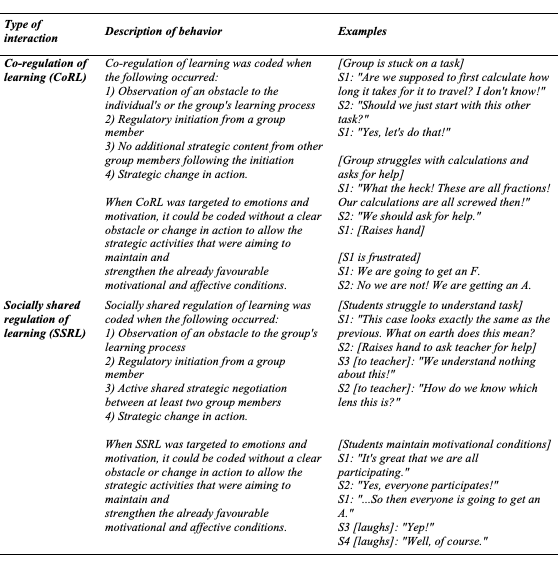
The groups’ collaborative work was videotaped with 360-degree cameras (90 min per session/week = 225 hours). The video data were segmented into 30-second episodes, from which two coders identified the occurrence of CoRL, and SSRL in verbal exchanges during task execution. Both coders were involved in the refinement of the coding system and engaged in qualitative discussions about specific codes, as the coding scheme was clarified with the researchers. The coding reliability was ensured by selecting 10% of the video data to be coded by both coders. What differentiated CoRL and SSRL codes from other group interactions was that, in regulation, students had to clearly express the observation of an obstacle or a challenge in their learning process (e.g., a lack of task understanding) and involve a regulatory initiation/control (e.g., a suggestion to reread the task instruction), which led to a strategic change in the groups’ action (e.g., rereading the task instruction together). CoRL and SSRL codes were mutually exclusive. In CoRL, no additional strategic content from other group members followed the initiation of regulation, which meant that the verbal interactions of CoRL did not build upon each other. In contrast, SSRL involved the reciprocally negotiated participation of several group members in regulatory discussion, where the interaction between group members built upon each other and led to strategic changes in the learning process. In practice, when coded as SSRL, the initiation of regulation needed to be followed by additional strategic content or control attempts from other group members aiming to solve the challenge (e.g., agreeing or articulating the challenge was not enough). When CoRL or SSRL targeted emotions and motivation, it could also be coded without a clear obstacle or change in action, including the strategic activities to maintain or strengthen the already favourable motivational and affective conditions. However, mere emotional or motivational expressions were not coded as regulation. Instead, regulation needed to be strategic and purposefully targeted to alter the emotional and motivational state of the group with appropriate strategies (see e.g., Lobczowski et al., 2021; Mänty et al., 2023). The inter-rater reliability of the regulation coding yielded Cohen’s kappa of 0.79. The frequencies of identified CoRL and SSRL for each group and session were counted.
Only the sessions involving three students were included in further statistical analyses because the number of participants in the interaction was considered to affect group dynamics (Cen et al., 2016), which might have influenced the occurrence of CoRL and SSRL and MdRQA values (Wallot et al., 2016). This restriction resulted in data from 26 groups and 78 students involving 82 recordings with 5576 (2788 minutes) collaboration video segments, from which 244 recordings (122 minutes) included CoRL, and 62 (31 minutes) included SSRL. Because there was variation in the collaboration length (M = 34.0 minutes, SD = 8.9) between the sessions, a proportion of CoRL and SSRL from collaboration for each session was calculated by dividing the CoRL and SSRL frequency by the overall number of segments in that collaborative session (see Table 1.). For the self-reported perceived value of collaboration, group average values were calculated. The resulting data set involved 89 group observations, meaning that 66% of the potential complete data were included in the analysis. Missing data is a limitation in the study but also a reality when collecting momentary data in real classroom settings.
Because the data regarding the first research question involved repeated measures, meaning that the observations were not independent, the relations between variables in the first research question were analysed with repeated measures correlation analysis (Rmcorr R-package; Bakdash & Marusich, 2017). Rmcorr considers the non-independence among repeated observations using analysis of covariance to adjust for inter-individual variability. It fits parallel regression lines with varying intercepts for each cluster (e.g. group), making it conceptually close to the multilevel “random intercept only model” (see Figure 1B). Due to the non-normal distribution of the data, we used bootstrapping (1000 samples) to more robustly estimate the confidence intervals for Rmcorr analysis (Bakdash & Marusich, 2017).
For the second research question, we first calculated course average values for each group for each variable. Regarding the perceived value of collaboration, pre- and post-measures were combined to one average. After that, Spearman's correlational analyses were conducted to investigate the relationships between the averaged variables and group exam scores. The statistical significance for both research questions was adjusted based on the Benjamini–Hochberg procedure (1995) to avoid false discoveries due to multiple comparisons.
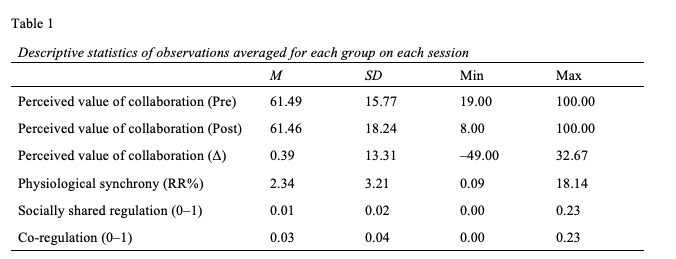
Regarding Research Question 1 we found (see correlogram in Figure 1A.) students’ self-reported perceived value of collaboration after the session to be related to all other variables relevant to the momentary engagement. From these relations, the perceived value of collaboration (post) was moderately negatively linked to physiological synchrony rrm = –.47, CI [–.74, –.03], and CoRL, rrm = –.4, [–.71, –.03]. In contrast, SSRL tended to relate positively with the perceived value of collaboration, but the finding did not remain statistically significant after the adjustment for multiple tests rrm = .25, [–.07, .59]. Figure 1B further demonstrates the importance of session-by-session within-group analysis in the case of the relationship between the perceived value of collaboration (post) and the physiological synchrony, as the intercepts between groups (vertical levels of the coloured lines) differ remarkably. This would imply that just focusing on the between-group differences would not have given a realistic picture of the relationship between the variables.
Overall, the perceived value of collaboration measured before and after the session followed a similar pattern with other variables. However, for the post-measure, the relations tended to be stronger. Also, the relationships between the change in the perceived value of collaboration with other variables followed a similar pattern, though the results did not reach statistical significance. Physiological synchrony showed a negative relation with before and after collaboration self-report but no link with observed CoRL or SSRL. Notably, in repeated measure correlational analysis, CoRL and SSRL were not related to each other rrm = .04, [–.16, .22].
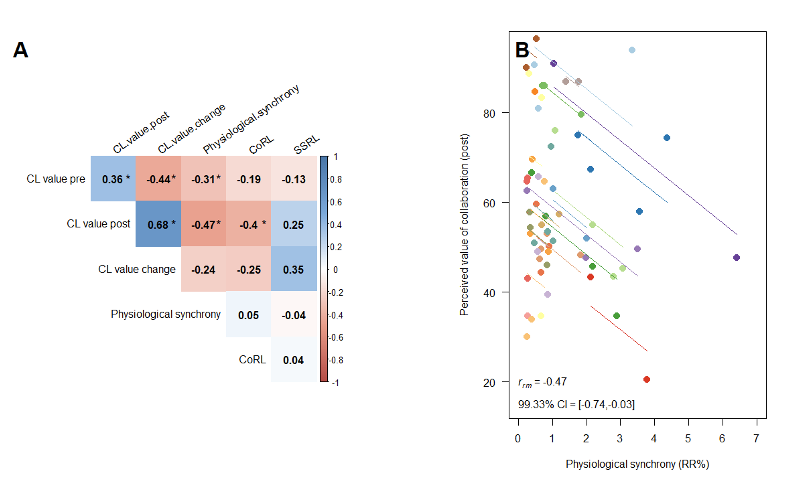
Figure 1. Repeated measures correlations determining the common within-group association for paired variables assessed on multiple lessons for multiple groups (A) and an example of repeated measure correlation plot (B) between the perceived value of collaboration (post) and physiological synchrony. Colours represent groups. * p < .05 (adjusted for multiple tests with Benjamini–Hochberg procedure.)
Regarding Research Question 2, Spearman rank order correlations show (Figure 2) that the average physiological synchrony during the course showed a strong to moderate negative association with a group performance in the collaborative exam, r (24) = –.56, p = .005. No other variables relevant to momentary engagement showed a significant association with group performance. It is, however, also notable that socially shared regulation showed signs of a moderate positive correlation with the group exam score without reaching statistical significance, r (24) = .36, p. = .07. In contrast to the session-based repeated measures analysis, a course level between group analysis showed a tendency of a positive association between CoRL and SSRL r (24) = .45, p. = .02, but after the adjustment of multiple comparisons the finding did not remain statistically significant.
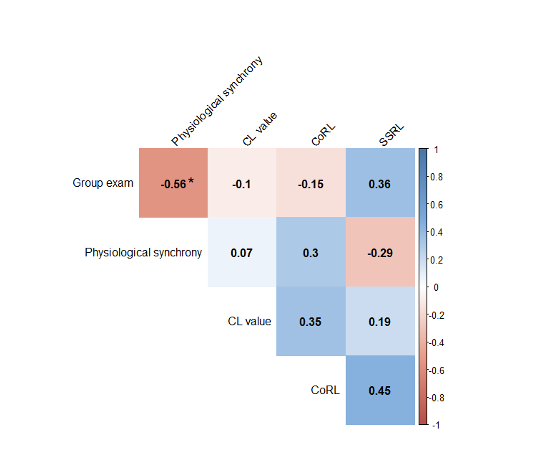
Figure 2. A correlogram presenting Spearman
correlation values between the course average values of each
variable with group exam score.
* p < .05 (adjusted for multiple tests with Benjamini-Hochberg
procedure.)
Despite the large body of literature examining CL and engagement in education (e.g. Fredricks et al., 2004; Järvelä et al., 2016; Rogat et al., 2023; Sinatra et al., 2015), very few studies have examined how different subjective and objective variables relevant to momentary engagement in CL align with each other. This study supports the view that multiple data channels can contribute to a better understanding of the multidimensional nature of momentary engagement in CL settings (Azevedo, 2015). Further, the study demonstrates that although groups show some lesson-to-lesson consistency in their measures, it is important to consider the temporal momentary within-group variation when analysing engagement in CL (Symonds et al., 2024).
One of the major findings of this study is that an important prerequisite of momentary engagement, the students’ perceived value of CL (Salmela-Aro et al., 2021; Upadyaya et al., 2021), relates to other dimensions close to engagement in CL: negatively with physiological synchrony and CoRL and positively with SSRL. This finding implies that students’ situated subjective view about the value of collaboration reflects the overall picture of engagement in CL and should not be ignored as a measure, especially given that it is relatively easy to capture in classroom settings. Temporally, the perceived value measured after the collaboration shows the most robust associations, but the measure before the collaboration seems to follow a similar pattern. This result could imply that students hold expectations about how useful it is to engage in collaboration, which aligns but does not determine the perception after the collaboration. Furthermore, the situated self-report seems to benefit from the analysis and interpretation with the within-group lens, as the between-group approach is likely to miss some of the associations. For example, even though the situated self-report reflected the CL process in other measures, it was not related to the performance in the group exam when averaged to between-group analysis.
Prior research has emphasised the importance of momentary engagement for SRL, CoRL, and SSRL in CL (Järvelä et al., 2016; Malmberg et al., 2023). Notably, for CoRL, the association with the momentary perceived value of collaboration was negative. As conceptualised in this study, the function of CoRL is often to invite the momentary engagement of other members in the group when a challenge is faced, monitored, and when strategic control is needed (Hadwin et al., 2018). Therefore, constant CoRL can imply that SSRL and shared engagement to regulation is not reached (Vuorenmaa et al., 2023). These results regarding CoRL might mean that some group members made repeated attempts to involve their peers in shared regulation without a fruitful result. Previous research suggests that reasons for some members not engaging in regulation in these situations may be due to motivational (Ahola et al., 2023) or emotional factors (Törmänen et al., 2021). Identifying these types of recurring dynamics in groups could allow timely interventions to move the momentary engagement of a group as a complex dynamic system to new types of states (van Eijndhoven et al., 2023) involving, for example, SSRL.
Correspondingly, repeated occurrence of SSRL implied engagement of multiple group members in the regulation and showed a tentative positive association with the higher perceived value of CL. A pattern aligning with this also occurred concerning group performance, as SSRL showed a tentative positive association with the group exam score, whereas the case was the opposite for CoRL. Though, based on these non-significant results, the relationship between SSRL and the perceived value of collaboration remains speculative, we believe it deserves to be studied further. On the one hand, groups that perceive collaboration as valuable for their learning might be more likely to share their regulatory process through engagement in negotiating strategic actions. On the other hand, if the group can, through SSRL, strategically solve the challenges faced, that might make the students perceive CL as more valuable, promoting a positive feedback loop of momentary engagement as a dynamic system (Symonds et al., 2024). Future studies could focus on this potential relationship and further temporally see if it is the reciprocally engaging form of regulation, namely SSRL, that promotes student perception about the value of collaboration, or is it the student’s expectation towards the value of collaboration that results in more SSRL?
The physiological data used in this study paints a complex picture of the engagement indicators in CL. First, as expected, physiological synchrony between group members does not simply imply that the collaboration is progressing well. In fact, in EDA-derived physiological synchrony measures, our results join the prior research findings, suggesting that the case might be the opposite (Haataja, Malmberg et al., 2022) and higher continuous physiological synchrony could reflect higher effort (Dindar et al., 2020) and possible challenges in the group (Malmberg et al., 2023). In this study, higher average synchrony during collaboration was related to students' lower self-reported collaboration value and lower group performance, aligning with other studies regarding physiological synchrony (Sung et al., 2023; Mønster et al., 2016). This negative link could be due to EDA reflecting sympathetic nervous system activity, which has been linked to stress. Previous research has also described cases where the physiological synchrony in CL arises momentarily, especially when joint efforts and engagement to solve the challenge are needed (Malmberg et al., 2023). After the problem is solved, for example, through strategic regulation, the physiological synchrony tends to get back to a lower level (Mønster et al., 2016). With dyads, the cycles between low and high levels of synchrony have been found to be linked with outcome measures (Schneider et al., 2020). Such results, coupled with the current study's findings, suggest that constant high physiological synchrony may indicate the group is engaged in collaboration across seconds and minutes but might struggle with socioemotional or cognitive challenges the group cannot surpass. From a dynamic systems perspective of momentary engagement (Symonds et al., 2024), this could mean that the group is stuck in some unproductive attractor state. Therefore, these groups could also benefit from targeted regulation support. However, it should be acknowledged that physiological synchrony can also occur during positive events and events unrelated to learning (Slovák et al., 2014), and therefore, higher physiological synchrony signalling groups “struggling” could also be partly context-specific. To conclude, it is evident that the relationship between engagement and physiological synchrony is not direct nor straightforward. Physiological synchrony is one potential temporal indicator that must be combined with other situational and temporal indicators, including the group members' subjective premises and appraisals.
Despite the strengths of the current study and its novel approach to examining CL, it also has several limitations. Firstly, the small sample size may limit the generalizability of the study's findings. Secondly, missing data could have reduced the accuracy of the study's findings. Future research should address this by implementing methods to reduce the amount of missing data, such as improving data collection techniques. Thirdly, the non-normal data distribution may affect the validity of the statistical analyses. To overcome this limitation, we utilised methods where such an assumption is not central. Fourthly, a more fine-grained temporal investigation of engagement is needed. Future research should include more frequent and longitudinal measurements of momentary engagement to capture its dynamic nature. This will provide a more comprehensive understanding of how engagement changes over time and what factors might influence this change. Finally, the study would benefit from a more intra-individual and situated approach. Future research should explore individual engagement experiences in a group and the situational factors that may influence these experiences.
This study supports the view that momentary engagement in CL is a complex multidimensional phenomenon that unfolds over time. This form of engagement appears to be shaped by the interaction of various factors, including interpersonal physiology, situated value appraisals of CL, and the regulation of CL. Multiple measures offer a way to explore the (mis)alignment of these dimensions and better understand how the engagement of a group formed by individuals develops over time. Physiological data offers a potential channel, and physiological synchrony is a potential index for studying momentary engagement in CL. However, more research is needed to validate the use of these measures for CL support. The study further highlights a need to consider both within-group and between-group variation when studying momentary engagement in authentic CL settings.
This work was supported by the Academy of Finland [Grant numbers, 297686 (HJ) and 308809 (JM)] and University of Oulu (SJ). LeaF research infrastructure has been used in the data collection of this study.
Ahola, S., Malmberg, J., & Järvenoja, H. (2023). Investigating
the relation of higher education students’ situational
self-efficacy beliefs to participation in group level regulation
of learning during a collaborative task. Cogent Education,
10(1), 2164241.
https://doi.org/10.1080/2331186X.2022.2164241
Amon, M. J., Vrzakova, H., & D’Mello, S. K. (2019). Beyond
dyadic coordination: Multimodal behavioral irregularity in triads
predicts facets of collaborative problem solving.Cognitive
Science,43(10), 1–22.
https://doi.org/10.1111/cogs.12787
Azevedo, R. (2015). Defining and measuring engagement and learning
in science: Conceptual, theoretical, methodological, and
analytical issues. Educational Psychologist, 50(1),
84–94. https://doi.org/10.1080/00461520.2015.1004069
Ba, S., & Hu, X. (2023). Measuring emotions in education using
wearable devices: A systematic review. Computers &
Education, 200 , 104797.
https://doi.org/10.1016/j.compedu.2023.104797
Bakdash, J. Z., & Marusich, L. R. (2017). Repeated measures
correlation. Frontiers in Psychology, 8(MAR),
1–13. https://doi.org/10.3389/fpsyg.2017.00456
Bakhtiar, A., Webster, E. A., & Hadwin, A. F. (2018).
Regulation and socio-emotional interactions in a positive and a
negative group climate. Metacognition and Learning,13(1),
57–90. https://doi.org/10.1007/s11409-017-9178-x
Benedek, M., & Kaernbach, C. (2010). A continuous measure of
phasic electrodermal activity. Journal of Neuroscience
Methods,190(1), 80–91.
https://doi.org/10.1016/j.jneumeth.2010.04.028
Benjamini, Y., & Hochberg, Y. (1995). Controlling the false
discovery rate: A practical and powerful approach to multiple
testing. Journal of the Royal Statistical Society. Series B
(Methodological) ,57(1), 289–300.
https://doi.org/10.1111/j.2517-6161.1995.tb02031.x
Cen, L., Ruta, D., Powell, L., Hirsch, B., & Ng, J. (2016).
Quantitative approach to collaborative learning: Performance
prediction, individual assessment, and group composition.
International Journal of Computer-Supported Collaborative
Learning , 11(2), 187–225.
https://doi.org/10.1007/s11412-016-9234-6
Coco, M. I., Mønster, D., Leonardi, G., Dale, R., & Wallot, S.
(2021). Unidimensional and multidimensional methods for recurrence
quantification analysis with CRQA. The R Journal,13(1),
145–163. https://doi.org/10.32614/RJ-2021-062
Cohen, E. G. (1994). Restructuring the classroom: Conditions for
productive small groups. Review of Educational Research,
64 (1), 1–35.
https://doi.org/10.3102/00346543064001001
Dawson, M. E., Schell, A. M., & Filion, D. L. (2017). The
electrodermal system. In J. T. Cacioppo, L. G. Tassinary, & G.
G. Berntson (Eds.), Handbook of Psychophysiology (pp.
217–243). Cambridge University Press.
https://doi.org/10.1017/9781107415782.010
De Backer, L., Van Keer, H., & Valcke, M. (2020). Variations
in socially shared metacognitive regulation and their relation
with university students’ performance. Metacognition and
Learning, 15(2), 233–259.
https://doi.org/10.1007/s11409-020-09229-5
van Eijndhoven, K., Wiltshire, T. J., Hałgas, E. A., & Gevers,
J. M. P. (2023). A methodological framework to study change in
team cognition under the dynamical hypothesis. Topics in
Cognitive Science. Advance online publication.
https://doi.org/10.1111/tops.12685
Fredricks, J. A., Blumenfeld, P. C., & Paris, A. H. (2004).
School engagement: Potential of the concept, state of the
evidence. Review of Educational Research , 74(1),
59–109. https://doi.org/10.3102/00346543074001059
Haataja, E., Dindar, M., Malmberg, J., & Järvelä, S. (2022).
Individuals in a group: Metacognitive and regulatory predictors of
learning achievement in collaborative learning. Learning and
Individual Differences , 96(May), 102146.
https://doi.org/10.1016/j.lindif.2022.102146
Haataja, E., Malmberg, J., Dindar, M., & Järvelä, S. (2022).
The pivotal role of monitoring for collaborative problem solving
seen in interaction, performance, and interpersonal physiology.
Metacognition and Learning , 17(1), 241–268.
https://doi.org/10.1007/s11409-021-09279-3
Hadwin, A. F., Järvelä, S., & Miller, M. (2018).
Self-regulation, co-regulation and shared regulation in
collaborative learning environments. In D. H. Schunk & J. A.
Greene (Eds.), Handbook of self-regulation of learning and
performance (pp. 83–106). Routledge.
https://doi.org/10.4324/9781315697048-6
Isohätälä, J., Järvenoja, H., & Järvelä, S. (2017). Socially
shared regulation of learning and participation in social
interaction in collaborative learning. International Journal
of Educational Research , 81, 11–24.
https://doi.org/10.1016/j.ijer.2016.10.006
Isohätälä, J., Näykki, P., & Järvelä, S. (2020). Cognitive and
socio-emotional interaction in collaborative learning: Exploring
fluctuations in students’ participation. Scandinavian
Journal of Educational Research , 64(6),
831–851. https://doi.org/10.1080/00313831.2019.1623310
Järvelä, S., & Hadwin, A. F. (2013). New frontiers: Regulating
learning in CSCL. Educational Psychologist, 48(1),
25–39. https://doi.org/10.1080/00461520.2012.748006
Järvelä, S., Järvenoja, H., Malmberg, J., Isohätälä, J., &
Sobocinski, M. (2016). How do types of interaction and phases of
self-regulated learning set a stage for collaborative engagement?
Learning and Instruction , 43, 39–51.
https://doi.org/10.1016/j.learninstruc.2016.01.005
Järvelä, S., Malmberg, J., Sobocinski, M., & Kirschner, P. A.
(2021). Metacognition in collaborative learning. In U. Cress
(Ed.), International Handbook of Computer-Supported
Collaborative Learning (pp. 281–294). Springer
International Publishing.
https://doi.org/10.1007/978-3-030-65291-3_15
Järvenoja, H., Malmberg, J., Törmänen, T., Mänty, K., Haataja, E.,
Ahola, S., & Järvelä, S. (2020). A collaborative learning
design for promoting and analyzing adaptive motivation and emotion
regulation in the science classroom. Frontiers in Education,
5(July). https://doi.org/10.3389/feduc.2020.00111
Järvenoja, H., & Järvelä, S. (2013). Regulating emotions
together for motivated collaboration. In M. Baker, J. Andriessen,
& S. Järvelä (Eds.), Affective Learning Together: Social
and Emotional Dimensions of Collaborative Learning (pp.
162–181). Routledge. https://doi.org/10.4324/9780203069684
Kelsey, M., Akcakaya, M., Kleckner, I. R., Palumbo, R. V.,
Barrett, L. F., Quigley, K. S., & Goodwin, M. S. (2018).
Applications of sparse recovery and dictionary learning to enhance
analysis of ambulatory electrodermal activity data.
Biomedical Signal Processing and Control ,40,
58–70. https://doi.org/10.1016/j.bspc.2017.08.024
Kreijns, K., Kirschner, P. A., & Jochems, W. (2003).
Identifying the pitfalls for social interaction in
computer-supported collaborative learning environments: A review
of the research. Computers in Human Behavior , 19(3),
335–353. https://doi.org/10.1016/S0747-5632(02)00057-2
Lai, H.-M. (2021). Understanding what determines university
students’ behavioral engagement in a group-based flipped learning
context. Computers & Education , 173,
104290. https://doi.org/10.1016/j.compedu.2021.104290
Lee, V. R., Fischback, L., & Cain, R. (2019). A
wearables-based approach to detect and identify momentary
engagement in afterschool makerspace programs. Contemporary
Educational Psychology, 59 (July), 101789.
https://doi.org/10.1016/j.cedpsych.2019.101789
Lobczowski, N. G., Lyons, K., Greene, J. A., & McLaughlin, J.
E. (2021). Socioemotional regulation strategies in a project-based
learning environment. Contemporary Educational Psychology,65(March),
101968. https://doi.org/10.1016/j.cedpsych.2021.101968
Malmberg, J., Haataja, E., Törmänen, T., Järvenoja, H., Zabolotna,
K., & Järvelä, S. (2023). Multimodal measures characterising
collaborative groups’ interaction and engagement in learning. In
V. Kovanovic, R. Azevedo, D. C. Gibson, & D. lfenthaler
(Eds.), Unobtrusive Observations of Learning in Digital
Environments: Examining Behavior, Cognition, Emotion,
Metacognition and Social Processes Using Learning Analytics
(pp. 197–216). Springer International Publishing.
https://doi.org/10.1007/978-3-031-30992-2_12
Malmberg, J., Haataja, E., Seppänen, T., & Järvelä, S. (2019).
Are we together or not? The temporal interplay of monitoring,
physiological arousal and physiological synchrony during a
collaborative exam. International Journal of
Computer-Supported Collaborative Learning , 14(4),
467–490. https://doi.org/10.1007/s11412-019-09311-4
Mendes, W. B. (2009). Assessing autonomic nervous system activity.
In E. Harmon-Jones & J. S. Beer (Eds.), Methods in
social neuroscience (pp. 118–147). Guilford Press.
Martin, A. J., Malmberg, L.-E., Pakarinen, E., Mason, L., &
Mainhard, T. (2023). The potential of biophysiology for
understanding motivation, engagement and learning experiences.
British Journal of Educational Psychology , 93(S1),
1–9. https://doi.org/10.1111/bjep.12584
Montague, E., Xu, J., & Chiou, E. (2014). Shared experiences
of technology and trust: An experimental study of physiological
compliance between active and passive users in technology-mediated
collaborative encounters.IEEE Transactions on Human-Machine
Systems,44(5), 614–624.
https://doi.org/10.1109/THMS.2014.2325859
Mänty, K., Järvenoja, H., & Törmänen, T. (2023). The
sequential composition of collaborative groups’ emotion regulation
in negative socio-emotional interactions. European Journal
of Psychology of Education ,38(1), 203–224.
https://doi.org/10.1007/s10212-021-00589-3
Mänty, K., Järvenoja, H., & Törmänen, T. (2020).
Socio-emotional interaction in collaborative learning: Combining
individual emotional experiences and group-level emotion
regulation. International Journal of Educational Research
, 102(April), 101589.
https://doi.org/10.1016/j.ijer.2020.101589
Mønster, D., Håkonsson, D. D., Eskildsen, J. K., & Wallot, S.
(2016). Physiological evidence of interpersonal dynamics in a
cooperative production task. Physiology & Behavior,
156, 24–34. https://doi.org/10.1016/j.physbeh.2016.01.004
Ouyang, F., Xu, W., & Cukurova, M. (2023). An artificial
intelligence-driven learning analytics method to examine the
collaborative problem-solving process from the complex adaptive
systems perspective. International Journal of
Computer-Supported Collaborative Learning,18(1),
39–66. https://doi.org/10.1007/s11412-023-09387-z
Palumbo, R. V., Marraccini, M. E., Weyandt, L. L., Wilder-Smith,
O., McGee, H. A., Liu, S., & Goodwin, M. S. (2017).
Interpersonal autonomic physiology: A systematic review of the
literature. Personality and Social Psychology Review
,21(2), 99–141. https://doi.org/10.1177/1088868316628405
Pijeira-Díaz, H. J., Drachsler, H., Järvelä, S., & Kirschner,
P. A. (2016). Investigating collaborative learning success with
physiological coupling indices based on electrodermal activity.
Proceedings of the Sixth International Conference on Learning
Analytics & Knowledge - LAK ’16 , 64–73.
https://doi.org/10.1145/2883851.2883897
Rogat, T. K., Hmelo-Silver, C. E., Cheng, B. H., Traynor, A.,
Adeoye, T. F., Gomoll, A., & Downing, B. K. (2022). A
multidimensional framework of collaborative groups’ disciplinary
engagement. Frontline Learning Research , 10(2),
1–21. https://doi.org/10.14786/flr.v10i2.863
Roschelle, J., & Teasley, StephanieD. D. (1995). The
construction of shared knowledge in collaborative problem solving.
In C. O’Malley (Ed.), Computer Supported Collaborative
Learning (Vol. 128, pp. 69–97). Springer Berlin Heidelberg.
https://doi.org/10.1007/978-3-642-85098-1_5
Salmela-Aro, K., Upadyaya, K., Cumsille, P., Lavonen, J., Avalos,
B., & Eccles, J. (2021). Momentary task-values and
expectations predict engagement in science among Finnish and
Chilean secondary school students. International Journal of
Psychology, 56(3), 415–424.
https://doi.org/10.1002/ijop.12719
Schneider, B., Dich, Y., & Radu, I. (2020). Unpacking the
relationship between existing and new measures of physiological
synchrony and collaborative learning: A mixed methods study.
International Journal of Computer-Supported Collaborative
Learning ,15(1), 89–113.
https://doi.org/10.1007/s11412-020-09318-2
Sinatra, G. M., Heddy, B. C., & Lombardi, D. (2015). The
challenges of defining and measuring student engagement in
science. Educational Psychologist , 50(1),
1–13. https://doi.org/10.1080/00461520.2014.1002924
Sinha, S., Rogat, T. K., Adams-Wiggins, K. R., & Hmelo-Silver,
C. E. (2015). Collaborative group engagement in a
computer-supported inquiry learning environment.
International Journal of Computer-Supported Collaborative
Learning , 10(3), 273–307.
https://doi.org/10.1007/s11412-015-9218-y
Slovák, P., Tennent, P., Reeves, S., & Fitzpatrick, G. (2014).
Exploring skin conductance synchronisation in everyday
interactions. Proceedings of the 8th Nordic Conference on
Human-Computer Interaction Fun, Fast, Foundational - NordiCHI
’14 , September 2015, 511–520.
https://doi.org/10.1145/2639189.2639206
Sobocinski, M., Järvelä, S., Malmberg, J., Dindar, M., Isosalo,
A., & Noponen, K. (2020). How does monitoring set the stage
for adaptive regulation or maladaptive behavior in collaborative
learning? Metacognition and Learning , 15(2),
99–127. https://doi.org/10.1007/s11409-020-09224-w
Sung, G., Bhinder, H., Feng, T., & Schneider, B. (2023).
Stressed or engaged? Addressing the mixed significance of
physiological activity during constructivist learning. Computers
& Education, 199, 104784.
https://doi.org/10.1016/j.compedu.2023.104784
Symonds, J. E., Kaplan, A., Upadyaya, K., Aro, K. S., Torsney, B.
M., Skinner, E., & Eccles, J. S. (2024). Momentary student
engagement as a dynamic developmental system. Journal of
Theoretical and Philosophical Psychology .
https://doi.org/10.1037/teo0000288
Symonds, J., Schreiber, J. B., & Torsney, B. M. (2021). Silver
linings and storm clouds: Divergent profiles of student momentary
engagement emerge in response to the same task. Journal of
Educational Psychology, 113(6), 1192–1207.
https://doi.org/10.1037/edu0000605
Törmänen, T., Järvenoja, H., & Mänty, K. (2021). All for one
and one for all – How are students’ affective states and
group-level emotion regulation interconnected in collaborative
learning? International Journal of Educational Research
, 109(September), 101861.
https://doi.org/10.1016/j.ijer.2021.101861
Upadyaya, K., Cumsille, P., Avalos, B., Araneda, S., Lavonen, J.,
& Salmela-Aro, K. (2021). Patterns of situational engagement
and task values in science lessons. The Journal of
Educational Research, 114 (4), 394–403.
https://doi.org/10.1080/00220671.2021.1955651
Volet, S.E. (2001). Significance of cultural and motivational
variables on students' appraisals of group work. In F. Salili,
C.Y. Chiu, & Y.Y. Hong (Eds). Student Motivation: The
Culture and Context of Learning (ch15) (pp. 309-334).
Kluwer Academic / Plenum Publishers. 10.1007/978-1-4615-1273-8_15
Vuopala, E., Näykki, P., Isohätälä, J., & Järvelä, S. (2019).
Knowledge co-construction activities and task-related monitoring
in scripted collaborative learning. Learning, Culture and
Social Interaction, 21(March), 234–249.
https://doi.org/10.1016/j.lcsi.2019.03.011
Vuorenmaa, E., Järvelä, S., Dindar, M., & Järvenoja, H.
(2023). Sequential patterns in social interaction states for
regulation in collaborative learning. Small Group Research,
54(4), 512–550. https://doi.org/10.1177/10464964221137524
Wallot, S., & Leonardi, G. (2018). Analysing multivariate
dynamics using cross-recurrence quantification analysis (CRQA),
diagonal-cross-recurrence profiles (DCRP), and multidimensional
recurrence quantification analysis (MdRQA) – A Tutorial in R.
Frontiers in Psychology , 9(December), 1–21.
https://doi.org/10.3389/fpsyg.2018.02232
Wallot, S., Mitkidis, P., McGraw, J. J., & Roepstorff, A.
(2016). Beyond synchrony: Joint action in a complex production
task reveals beneficial effects of decreased interpersonal
synchrony. PLOS ONE, 11(12), e0168306.
https://doi.org/10.1371/journal.pone.0168306
Wallot, S., Roepstorff, A., & Mønster, D. (2016).
Multidimensional recurrence quantification analysis (MdRQA) for
the analysis of multidimensional time-series: A software
implementation in MATLAB and its application to group-level data
in joint action. Frontiers in Psychology , 7,
1–13. https://doi.org/10.3389/fpsyg.2016.01835
Zabolotna, K., Malmberg, J., & Järvenoja, H. (2023). Examining
the interplay of knowledge construction and group-level regulation
in a computer-supported collaborative learning physics task.
Computers in Human Behavior , 138, 107494.
https://doi.org/10.1016/j.chb.2022.107494
Zhang, Y., Qin, F., Liu, B., Qi, X., Zhao, Y., & Zhang, D.
(2018). Wearable neurophysiological recordings in middle-school
classroom correlate with students’ academic performance.
Frontiers in Human Neuroscience , 12(November),
1–8. https://doi.org/10.3389/fnhum.2018.00457
Zheng, L., & Huang, R. (2016). The effects of sentiments and
co-regulation on group performance in computer supported
collaborative learning. Internet and Higher Education, 28,
59–67. https://doi.org/10.1016/j.iheduc.2015.10.001
Zheng, L., Li, X., & Huang, R. (2017). The effect of socially
shared regulation approach on learning performance in
computer-supported collaborative learning. Educational
Technology & Society, 20, 35–46.
Zschocke, K., Wosnitza, M., & Bürger, K. (2016). Emotions in
group work: Insights from an appraisal-oriented perspective.
European Journal of Psychology of Education , 31(3),
359–384. https://doi.org/10.1007/s10212-015-0278-1
The coding scheme used in the video data analysis