Frontline Learning Research Vol. 13 No. 1 (2025)
45 - 75
ISSN 2295-3159
1 Department of Teacher
Education, University of Turku, Finland
2 Department of Teacher Education, University of
Jyväskylä, Finland
3 Department of Teacher Education, University of Turku,
Finland, Vytautus Magnus University, Lithuania
Article received 13 September 2024/ Article revised 21 December 2024 / Accepted 14 March 2025/ Available online 1 April 2025
Teachers play a key role in promoting flexible mathematical thinking in society. There is a growing need to develop better methods for both pre- and in-service teacher training, but not enough is so far understood about what knowledge and skills teachers use in practical teaching situations. The means for investigating this are few. A new analytic framework was developed using abductive content analysis to investigate signs of script restructuring and construction as they appear in teachers' written reflections reporting their experiences in applying novel methods in their classrooms. Scripts are mental knowledge structures combining formal professional knowledge and the knowledge teachers use in practical situations with representations, assessments, and predictions of different classroom events. Scripts enable teachers to make (rapid) snap decisions to structure their teaching and manage classrooms to facilitate students' attention towards objectives, activities, and information that support learning. In this multiple case qualitative study, six teachers enrolled on the “Flexible and Adaptive Arithmetic Skills in Primary School” course, part of the JoMa (Towards Flexible Mathematics) in-service training program, teaching assignment and end-of-course reflections were investigated in depth. The goal was to advance the application of script theory to the study of teachers' actions and thinking as they engage in teaching intended to promote flexible mathematical thinking. The results suggest that signs of script restructuring and construction can be investigated post-hoc from textual accounts, scripts may have a considerable influence on teachers’ actions and thinking, and by engaging in teaching practice in real-life settings and reflecting on these accumulating experiences, processes leading to script development may be initiated. The results suggest that the analytic framework developed is functional and robust, paving the way for future investigations with larger samples. This study provided a more profound understanding of how online in-service education can support teachers to develop scripts supporting their competences to teach mathematical flexibility.
Keywords: teaching scripts, mathematics teaching, flexibility, teachers’ competences, in-service training.
Teachers have a key role in promoting mathematical thinking across societies (Council of the European Union, 2018; Ministry of Education and Culture, Finland, 2023; Organization for Economic Co-operation and Development, 2023). Research has emphasized the need to promote flexible mathematical thinking (Hickendorff et al., 2022; Verschaffel, 2024), which means having a more profound understanding and awareness of mathematical concepts, relations, strategies, and representations. This enables the consideration of several alternative strategies or ideas and the adaptive use of those that correspond to the situation at hand (Hickendorff et al., 2022; Verschaffel, 2024). However, teachers’ competencies to promote this thinking may vary widely. Teachers' understanding of the subject may be limited; they may teach math in a highly procedural and restricted fashion and hold beliefs that inhibit their ability to promote students' flexible mathematical thinking (Blömeke et al., 2011; Brunner & Star, 2024; Kaiser & Blömeke, 2013; Star et al., 2015). In Finland, many aspiring preservice primary school teachers have weaknesses in basic arithmetic skills and lack a more profound conceptual and structural understanding of mathematical principles and procedures. Many also think of math as a difficult, boring, and rule-based subject mastered largely through learning by rote and memorization (Ohtonen et al., 2023; Tossavainen & Leppäaho, 2018).
There is a growing need to develop better methods for both pre- and in-service teacher training to advance teachers' understanding and appreciation of mathematics and their ability to promote mathematical thinking. In recent decades, a lot of information and models have been proposed for the competencies that math teachers need in order to promote their students' mathematical understanding as well as their strategic, creative, and adaptive use (e.g., Ball et al., 2005; Döhrmann et al., 2011; Shulman, 1986; Stigler & Miller, 2018). There is a lack of well-developed theoretical models of the knowledge which teachers use in complex classroom situations where events take place quickly and require fast (re)actions from teachers (Blömeke et al., 2015; Star et al., 2015).
In this study, we explore how the script theory, which was first developed in the field of medicine to provide insight into how doctors established and used mental knowledge structures to assess patients’ illnesses using cues and event representations (Charlin et al., 2000), could be applied to study teachers' knowledge structures. Specifically, we investigate how teachers’ formal professional knowledge and the knowledge teachers use in practical situations were affected when they participated in intensive in-service training aiming to advance their understanding of flexible mathematical thinking and competencies to promote it.
Scripts are mental knowledge structures combining the formal professional and practical knowledge needed for high-quality teaching in a readily accessible form. Scripts influence what the teachers notice as they teach, how the noticed events are presented in the teachers’ minds, and how the teachers interpret and respond to these events. Scripts provide teachers with a framework to make rapid assessments and decisions to manage their classes and structure their teaching (Wolff et al., 2021).
There are currently no empirical studies that have explored teachers’ scripts as they reflect their practical teaching experiences. This is the first scientific inquiry into how the theory can be applied to study scripts of teachers who participated in in-service training aiming to promote their competence in teaching flexible mathematical thinking. The goal is to investigate signs of script restructuring and construction as they appear in teachers’ written teaching assignment- and end-of-course reflections. These reflections were provided during the course Flexible and Adaptive Arithmetic Skills in Primary School (2022–2023). The course was a part of the JoMa (Towards Flexible Mathematics) program, the first large-scale online in-service program implemented in Finland intended to support early childhood education, pre-primary, primary, lower-secondary, and high school teachers to develop competencies to teach flexible mathematical thinking. This study furthers script theory from conceptual towards practical, paving the way for future investigations into how scripts affect teachers’ actions and thinking as they aim to teach flexible mathematical thinking and how in-service programs like JoMa could encourage teachers to engage in script restructuring and construction.
Research has increasingly shown that differences in intelligence (e.g. general cognitive ability) or initial skill and knowledge levels play a smaller role in students' becoming flexible mathematical thinkers than do contextual, sociocultural, and demographic factors as well as students' and teachers' beliefs and mindsets (Boaler & Dweck, 2015; Boaler et al., 2021; Star et al., 2015; Verschaffel, 2024). Becoming a flexible mathematical thinker is a process that takes time and effort but nevertheless one that all students can engage in and improve at if provided with high-quality education by skilled and competent teachers (Brunner & Verschaffel, 2024; Newton et al., 2010; Rittle-Johnson et al., 2012).
Flexible mathematical thinkers have a more profound conceptual understanding of mathematical principles and procedures (Hickendorff et al., 2022), a stronger sense of mathematical agency, and more positive beliefs about their self-efficacy (Bui et al., 2023). They focus on mathematical aspects not only in specific math tasks but also spontaneously in non-mathematical task contexts (McMullen et al., 2020), have more adaptive knowledge about numbers and symbols (McMullen et al., 2016), and are more inclined to approach math with curiosity and positivity (Boaler & Dweck, 2015; Boaler et al., 2021). Mathematically flexible thinkers also possess the necessary conceptual and procedural knowledge (e.g., about mathematical strategies) enabling them to apply mathematics regardless of the context in a way that suits them best (Hong, et al., 2023).
Research suggests that competent teachers in advancing mathematical flexibility act proactively and strategically to prevent disruptive events and turning students' attention towards objectives, activities, and information that support flexible mathematical thinking (Depaepe et al., 2020). They provide their students with information about mathematical building blocks (e.g. concepts, procedures, mathematical focusing aspects), challenge them to think about when and how to use these, and encourage students to engage in mathematical exploration and problem-solving in educational settings and real-life situations (Hickendorff et al., 2022; Hong et al., 2023; Lehtinen et al., 2017; Star et al., 2015). They model mathematics using a variety of means (e.g., drawing, diagrams, counting sticks) to illustrate mathematical concepts or procedures thoroughly while also clearly covering their meaning (Boaler et al., 2016; Boaler et al., 2021). Competent teachers aim to cultivate a sense of community, where making mistakes is acceptable, students can share their thinking openly and engage in profound discussions about math and its applications (e.g., talk about the relationship between fractions and decimals, compare multiple strategies) (Hong et al., 2023; Rittle-Johnson et al., 2020).
Hence, to promote flexible mathematical thinking, teachers need to have a general understanding of class management, be familiar with the content covered in math classes, and know how to create clear and well-formulated learning opportunities that enable students to engage with mathematical contents effectively. In this study, we use Shulman's (1986) classic conceptualization of teachers’ knowledge to differentiate between these forms of knowing. According to Shulman (1986), math teachers’ formal professional knowledge base consists of mathematical content knowledge (CK), mathematics pedagogical content knowledge (PCK), and general pedagogical knowledge (GPK) supplemented by personal factors (e.g., traits, beliefs). Mathematical content knowledge refers to knowledge about math facts, theories, principles, constructs etc., that are essential elements of mathematics needed to understand the subject and master its application in practice (Blömeke, 2017). General pedagogical knowledge consists of the know-how about the general means, practices, and strategies teachers can use to manage their classrooms and organize their teaching (e.g. ways of promoting fruitful student-student relationships (Döhrmann et al., 2012). Pedagogical content knowledge is information integrating the mathematical content and pedagogical knowledge needed to teach mathematics effectively and accessibly (Star, 2023). For instance, knowledge about how to apply teaching methods and assessment formats specifically designed to support students' understanding of the mathematical content as well as their engagement and agency, like Number Talks and Math Walks (English et al., 2010; Parker & Humphreys, 2018), qualifies as pedagogical content knowledge.
Teaching, like clinical medicine and -psychology and the practice of law, is a highly social and dynamic profession where contextual factors, such as students' prior knowledge of the taught subjects, national standards and curriculum as well as the physical learning environments have a major impact on teachers' agency and ability to perform (Stigler & Miller, 2018). Although a lot can be learned about these and how they affect teaching formally (e.g., through books, lectures, etc.,) such knowledge may remain disconnected from practice. Formally acquired knowledge lacks information about many subtle cues of things and events that teachers encounter when they work in classrooms with their students (Verloop et al., 2001; Wolff et al., 2021). Most crucially, it is detached from the teacher's subjective world of experience, such as his or her view of class events and actually using pedagogical means, tools, and approaches to support students' learning. These subjective experiences may invoke different affective responses, and they influence how teachers apply formally learned professional knowledge in practice (van Dijk et al., 2022; Verloop et al., 2001; Wolff et al., 2021).
Teachers' formal professional knowledge can be seen as equivalent to doctors' formal biomedical knowledge (e.g., theoretical information about the human cardiovascular system), while knowledge teachers use in practical situations is the counterpart of doctors’ clinical knowledge (e.g., practice-based knowledge about symptoms associated with different diseases, potential treatments, and prognoses of their effects (Boshuizen et al., 2012; Charlin et al., 2000; Jarodzka et al., 2013; Schmidt & Boshuizen, 1993). This practical knowledge is used by the teachers in concrete situations to structure teaching, manage the classroom, and support learning as different events occur (van Dijk et al., 2022: Verloop et al., 2001; Wolff et al., 2015). It includes teachers' understanding of enabling conditions (background factors determining the likelihood of different events occurring) and teachers' mental representations of perceived events (Wolff et al., 2021). It also includes processes and predictions affiliated with the events presented, for instance, assessments of what would happen if auxiliary questioning were used to tackle undesirable events (e.g., students having difficulties initiating small group discussions about the content of the lesson during revision). Teachers accumulate practical knowledge through actual teaching experiences or by investigating the teaching of others e.g., by analyzing teaching cases (Wolff et al., 2015; Wolff et al., 2016; Wolff et al., 2017, 2021). Doctors do the same when they analyze clinical cases and practice medicine (Boshuizen et al., 2012; Charlin et al., 2000; Jarodzka et al., 2013; Schmidt & Boshuizen, 1993), while lawyers accumulate practical knowledge by examining legal cases and practicing law (Boshuizen et al., 2020).
In clinical medicine, encapsulation is a process that leads to the intertwining of biomedical knowledge and practical clinical knowledge into illness scripts (Jarodzka et al., 2013; Schmidt & Boshuizen, 1993). These scripts provide clinicians with a framework to draw upon to make quick assessments and act decisively, for instance, to effectively diagnose illnesses and treat their patients (Boshuizen et al., 2012; Charlin et al., 2000). It has been suggested that teachers' formal professional knowledge and the knowledge teachers use in practical situations may also combine by the means of encapsulation leading to the formation of classroom management and teaching scripts. In these mental knowledge structures, individual pieces of information are organized into scripts (Wolff et al., 2021). For example, information about a specific environmental signal is linked to assessments of its meaning and consequences as well as potential means to tackle it providing the teacher with a fleshed-out model to quickly assess what is happening and respond effectively (Wolff et al., 2021).
Script theory has been used mainly in the medical field to investigate doctors’ expertise and its development (e.g., Boshuizen et al., 2012; Charlin et al., 2000; Jarodzka et al., 2013). However, a few attempts have been made to expand the theory to investigate expertise in other domains, like psychology, business, and law (Boshuizen et al., 2020). Recently, Wolff et al. (2021) expanded the script theory to the realm of education and theorized how it could be used to investigate teachers' teaching.
Looking at the work achieved in these fields we present a detailed theoretical model of the processes teachers engage in to restructure and construct scripts. The model (see Figure 1) has been constructed by carefully analyzing the previous work by Wolff et al. (2021) and synthesizing the core ideas presented in the script literature and the research conducted particularly in the medical field (e.g., Boshuizen et al., 2012; Charlin et al., 2000; Jarodzka et al., 2013; Schmidt & Boshuizen, 1993). Our aim is to describe the various processes associated with script restructuring and construction and how these processes are related. This illustrates how scripts are formed and how teachers' script formation could be supported.
Our theoretical model consists of three distinct processes: formation of event representations (teacher's mental construction of the moment), perception making (focusing of attention to points of interest), and inferring of explanations (making mental actions of interpretation e.g., about why things are happening in class) (Figure 1). These may be initiated by accumulating experiences which are affected by teachers’ formal professional knowledge base and may lead to script restructuring and construction. We will next elaborate on these processes and how reflection may support them.
Figure 1 The processes leading to script restructuring and construction through the encapsulation of formal professional knowledge and knowledge teachers use in practical situations
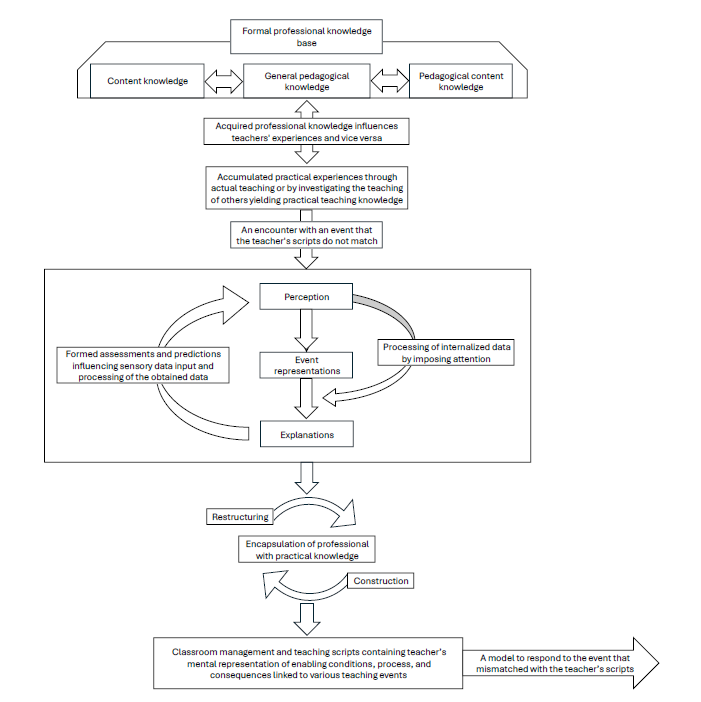
As teachers engage with students in class, different events manifest, for instance, students may perpetrate disruptive behavior. Learning environments are complex, with many factors, some of which are highly context-dependent (e.g., physical space, students’ prior knowledge) and others less so (teachers' views and beliefs, societal educational goals, etc.) (Stigler & Miller, 2018). An almost endless number of events may occur as teachers teach, multiple events may happen simultaneously, and their boundaries may be blurred (when one event ends and another starts?) (Wolff et al., 2021). Also, not all teachers necessarily view the same events similarly as they may manifest differently in the teachers’ minds.
When different events occur, teachers form event representations (Figure 1). These are teachers’ mental constructions of the events occurring and are formed based on information teachers obtain about their surroundings by using their senses (Wolff et al., 2021). A large body of sensory information is constantly acquired by the teacher. Most of it is irrelevant for constructing a mental presentation of what is actually going on. To construct an event representation, the incoming information needs to be processed (Wolff et al., 2021).
Perception works on two levels: internally and externally. Externally, perception guides how teachers notice behavior and determines what events and associated cues they notice during teaching, influencing the nature and quality of incoming sensory information. Internally, perception determines to what signals of the sensory information attention is paid, affecting the interpretations teachers can make about occurring events (Wolff et al., 2021). We refer to these mental actions of interpretation as explanations which determine if the teacher knows what is happening in class and, more importantly, why things might be happening (e.g., why students did not engage in Number Talk and what role the teacher's actions may have played in this) (Figure 1). Teachers use their explanations to make assessments and predictions about the underlying reasons for events, their consequences, and the effects of responses that could be used to address different events (Wolff et al., 2021). In the medical field, doctors engage in a similar process of reasoning and hypothesis formation when seeking to determine what disease a patient is suffering from, what its root causes are, how the disease can be treated, and what consequences different solutions may have (Boshuizen et al., 2012; Charlin et al., 2000; Jarodzka et al., 2013).
Classroom management and teaching scripts contain teachers’ internal representations of past events (i.e., signals and (potential) sources of problems associated with the event), constructed by directing attention to aspects of the environment and (sensory) information obtained. They include assessments and predictions (process) about the reasons behind presented events (enabling conditions), their outcomes, and the results different responses may have if used to address the events (Wolff et al., 2021). There is a bidirectional relationship between constructed event representations, perceptions made, and explanations inferred. When event representations are formed, they begin to influence teachers' perception, affecting what external signals and cues they observe and to what information obtained through the senses attention is paid. As teachers infer explanations using their event representations, their interpretations begin to guide perception. Hence, teachers’ future event representations are influenced by previously inferred explanations (Wolff et al., 2015; Wolff et al., 2016; Wolff et al., 2017, 2021).
It is crucial to note that event representations, perception, and explanations are also affected by teachers' personal orientations (e.g., views, and attitudes) and formal professional and practical knowledge accumulated through experience (Figure 1; Wolff et al., 2021). For instance, when new information is absorbed into teachers’ formal professional knowledge base, it may begin to influence their behavior, thinking, and attention as they engage in teaching. This engagement leads to the accumulation of experiences yielding practical knowledge potentially impacted by the changes in the teacher’s formal professional knowledge base (Figure 1).
Through experience teachers’ formal professional knowledge and knowledge used in practical situations is structured into scripts. The structured knowledge is also associated with information about the (potentially) occurring event’s enabling conditions, process, and consequences. Hence, when an event matching an established script is encountered it is activated without much conscious effort leading to action (Wolff et al., 2021). If an event that does not match an existing script is encountered during teaching, this may cause teachers to form new event representations using their perception and to infer explanations, for instance, to make assessments and predictions associated with that event. This can lead to the reform of an existing script or to the construction of a new script to meet the demands of the novel event encountered. Such are the procedures of script restructuring and construction leading to merging (by encapsulation) of teachers' formal professional knowledge and knowledge teachers use in practical situations (Figure 1; Wolff et al., 2021).
An important contribution of script theory for analyzing the impact of training that aims to enhance teachers' expertise in supporting flexible mathematical thinking is that merely acquiring formal professional knowledge does not suffice to promote expertise (Wolff et al., 2021). The training should encourage integrating (through encapsulation) formal professional and practical knowledge into teaching scripts. This can be achieved by providing teachers with formal professional knowledge about flexible mathematical thinking and its promotion as well as practical teaching experiences that enable teachers to explore the use of formal knowledge in practice (Wolff et al., 2021). Online in-service programs present a promising accessible, scalable, and cost-effective solution to provide teachers with this knowledge, to implement it in practice, and to reflect on their implementation experiences (Clements & Sarama, 2021; Darling-Hammond et al., 2017; Mulcahy et al., 2021).
The JoMa program (Joustavaan Matematiikkaan – Towards Flexible Mathematics) consists of professional development courses that incorporate features providing a promising arena for investigating teachers’ scripts. The program has been operating since 2018 and consists of an introductory course designed for all participants and courses aimed at teachers working at different levels of the education system. It is Finland's first online in-service training program intended to support teachers’ competences to enhance their ability to teach flexible mathematical thinking. JoMa program provides participants with up-to-date research-based knowledge and practical methods for promoting students’ flexible mathematical thinking and instructions for how to implement these in classrooms, pre-school, or daycare. Course materials include video recorded lectures, discussions and feedback by experts and other participants as well as various exercises, questionnaires, and readings. Discussion forums allow open discussion with course instructors and other participants.
The present study investigates the experiences of teachers who participated voluntarily in the program's Flexible and Adaptive Arithmetic Skills in Primary School course. Teachers’ scripts may have been impacted by the course in several ways: by providing teachers with formal professional and practical knowledge about flexible mathematical thinking and how to teach it, enabling teachers to practice and gain experience of teaching flexible mathematical thinking, and giving them the opportunity to reflect on these experiences.
Firstly, expert video interviews, scientific writings by academics, professorial summaries, and recorded classroom situation examples were used to present formal conceptual knowledge about flexible mathematical thinking and teaching. Guidelines and examples showed teachers how to integrate the "theory" of teaching flexible mathematical thinking into practice. These may have prompted teachers to assimilate new formal professional knowledge leading them in the future to view, assess, and interpret events differently as they teach (Jarodzka et al., 2013; Wolff et al., 2021).
Secondly, the teachers were provided with opportunities to gain teaching practice and experience by conducting five expert-designed teaching assignments. In these, the teachers experimented with Number Talks, which are short, open, and explorative discussions during which students and teachers jointly investigate mathematical concepts, relations, phenomena, etc. (Parker & Humphreys, 2018). They can be used, for instance, to compare multiple strategies or build a class-community supportive of idea sharing and exploration (Parker & Humphreys, 2018; Rittle-Johnson et al., 2020). The teachers also designed and implemented Math Walks, trips to different environments, during which the students were encouraged to pay attention to math in their surroundings (shapes, patterns, numbers, relations, etc.) (English et al., 2010). These provide opportunities to practice everyday mathematical problem-solving and focusing on mathematical aspects (McMullen et al., 2020). During the assignments, the teachers tested multiple math games with their students, like the Number Navigation Game. This game enables students to practice applying arithmetic operations to solve calculations using fractions, percentages, and decimals promoting adaptive number knowledge and rational number sense (Brezovszky et al., 2019; Bui et al., 2022). The teachers also designed new or modified verbal math tasks presented in math textbooks. Using research and practice-based guidelines, the teachers worked to create tasks with sufficiently challenging problems that enabled a step-by-step inquiry with time and thought as well as creative problem-solving (e.g., sequencing the tasks components by drawing) to promote flexible mathematical thinking (Verschaffel et al., 2020; Vicente et al., 2022). Finally, the teachers explored concretizing mathematical operations and concepts using various means of illustration, like drawing and geometric shapes, but also creative means, for instance, rhythmic clapping and music. These provide multiple avenues to investigate mathematical operations, concepts, and their relations, making mathematics education more memorable, functional, and engaging (Boaler et al., 2016; Boaler, 2019).
The expert-designed teaching assignments bridged the gap between theory and practice. They provided the teachers with practical experience of using means, tools, and practices incorporating flexible mathematical thinking teaching principles with their students. Considering earlier script studies (e.g., Boshuizen et al., 2012; Boshuizen, Gruber, & Strasser, 2020; Si, 2022) such experiences may have prompted teachers to construct event representations and infer interpretations (e.g., assessments and predictions associated with the teaching experiences) on their basis. This may have prompted teachers to engage in procedures of script restructuring and construction to form scripts to meet the demands of novel events they may have encountered while implementing teaching assignments.
Thirdly, expert-designed teaching assignments and end-of-course reflections encouraged the teachers to consider the formal professional and practical knowledge provided in relation to their pre-and course time experiences and personal orientations (e.g., values, beliefs). By writing a short report on the course platform after the execution of teaching assignments, the teachers had the opportunity to explore their experiences thoughtfully and with consideration. The teachers described, for instance, how they had implemented different means and practices, what they had observed in their classes, what their explanations for these observations were, and what they did in response to support students’ flexible mathematical thinking. In the end-of-course reflection task, instead of focusing on a particular teaching assignment, the teachers were prompted to delve reflectively into their course experience as a whole. The teachers considered, for instance, what they had done to teach flexible mathematical thinking, thought about their skills and abilities to teach it, and stated which practices and methods they found especially effective for its promotion during the course.
According to studies conducted in medicine (e.g., Boshuizen et al., 2012; Jarodzka et al., 2013; Si, 2022), psychology, business, and law (Boshuizen et al., 2020) as well as education (Wolff et al., 2015; Wolff et al., 2016; Wolff et al., 2017, 2021) such reflective assignments may have influenced teachers’ scripts. They may have prompted teachers to reflect on their teaching and the associated experiences in tandem with the formal professional knowledge the course provided and personal orientations. Such reflections may have acted as a catalyst for script restructuring and construction, for instance, causing a teacher to pay more attention in the future to cues relevant for learning leading to sharper event representations enabling a teacher to make more profound interpretations of what was going on in class and why.
To conclude, the teachers’ teaching assignment and end-of-course reflections during the Flexible and Adaptive Arithmetic Skills in Primary School course are likely from the teachers’ perspective to contain novel information about their course-time experiences, thoughts, and actions. Hence, they provide a data-set unique in its breadth and depth for investigating teachers’ scripts as they aim to teach flexible mathematical thinking.
The goal of this study is to provide in-depth information on how
signs of script restructuring and construction manifest in the
JoMa course participant-teachers’ reflections. Hence, the
participating teachers’ reflections on teaching assignments
designed to promote flexible mathematical thinking and
end-of-course reflections where they consider their course time
experiences as a whole are investigated. Also, from these
reflections the associations between signs of script restructuring
and construction and formal professional knowledge base are
investigated as well as between experiences yielded by the JoMa
course and indications of teachers’ engaging in script formation.
These aims further the understanding of how script theory can be
used to explore the processes teachers engage in to construct
knowledge structures leading to in-class actions affecting
teachers’ ability to teach flexible mathematical thinking.
Additionally, the study shows how signs of script restructuring
and construction can be investigated using an abductive
qualitative approach laying the foundations for future inquiries.
The main research questions are:
1) How do signs of script restructuring and construction manifest
in primary school teachers’ reflections, where they consider the
experiences and knowledge accumulated as well as the thoughts
occurring and actions taken during the course designed to enhance
their flexible mathematical thinking teaching competencies?
2) How are the formal professional and practical knowledge as well
as experiences yielded by JoMa course associated with signs of
teachers’ script restructuring and construction based on their
reflections?
In the present study, the qualitative data consists of teachers’ expert-designed teaching assignments and end-of-course reflections. Six teachers (N = 6) were selected from among the 226 participants who enrolled on the Flexible and Adaptive Arithmetic Skills in Primary School course 2022−2023 and gave their consent to the use of these for research purposes. The course was aimed at primary school teachers who in Finland teach grades 1-6 and work with children typically aged 7-13. The selected teachers are referred to in this article by the aliases Sanni (age range 20−29), Julia (age range 40−46), Anna (age range 20−29), Daniel (age range 40−49), Heikki (age range 50−59) and Alexander (age range 30−39). These teachers were selected because their reflections were particularly rich and detailed. They convey a finetuned image of the teachers' view of the moment as they implemented teaching assignments (what was observed, how students were engaged, what pedagogical methods were used, etc.). They also contain statements, questions, and comments rich in the interpretation of in-class events (e.g. why things unfolded in class as they did), teaching methods (e.g. what effects they had on students’ thinking and learning), and reflective critical thinking (e.g., what the teacher would do differently in future to promote students’ flexible mathematical thinking). In addition, the teachers represent a nicely diverse spectrum of age and teaching experience.
The decision to select these six teachers as objects of inquiry to answer the research questions was preceded by a stage of preliminary investigation, during which systematic sampling was used to select 10% of teaching assignment and end-of-course reflections provided by the 226 course enrollees. These were analyzed sentence by sentence to see if a coding framework could be developed to identify signs of teachers' scripts as they engaged in teaching intended to foster flexible mathematical thinking. This was necessary for identifying teachers whose reflections provided insights into teaching scripts embedded in the wealth and depth of the JoMa data.
There are currently no methods for investigating scripts from written reflections. Hence, we set out to see if an analytic framework could be developed for exploring signs of script construction from reflective textual accounts. The first author relied heavily on script theory as a starting point. Abductive content analysis, a common theory-guided qualitative research method was used due to its well-proven functionality for inquiring in-depth about research subjects’ subjective experiences and internal thoughts (Cohen et al., 2018). Guided by the established theoretical framework (script theory and studies, Shulman’s model, research about flexible mathematical thinking and its teaching), the researcher immersed himself in the data to identify signs (e.g., words, phrases, and statements) indicative of essential script components (event representations, perceptions, and explanations). Since formal professional knowledge and accumulated experiences have important roles in script formation and alteration (e.g., Boshuizen et al., 2012; Jarodzka et al., 2013), references to these were also searched for during the analysis to investigate how they relate to teachers’ scripts in the reflections.
Signs of event representation construction were identified by sorting out reflections where the teachers presented their views of events or situations that had occurred as they taught. These reflections needed to contain information about cues and signals the teachers paid attention to during teaching and include descriptions of what the teachers did “in class” and what transpired as a result of their actions. Also, as event representations are formed by teachers on the basis of information they obtain and attend to using perception, teachers accounts containing signs of event representations construction had to include references to the teachers' points of attention i.e., their perceptions.
We concede that assessing the accuracy of the external perceptions the teachers constructed as they implemented teaching assignments from reflective accounts is not feasible. This would have required monitoring and documenting what really transpired in the classrooms as the teachers taught. Still, any descriptions of detail about what the teachers thought had transpired as they implemented different teaching assignments, for instance, about students’ actions, thinking, and emotions, indicate that the teachers’ attention must have been focused on these as the events occurred. Moreover, if the teachers were recalling such things they must have been deemed worthy of recounting, suggesting the teachers’ attention was also attuned to them during the reflection process.
In the teachers’ reflections there are a lot of references to the content the teachers covered, the pedagogical methods they used, and signs of the interpretations the teachers inferred during the teaching assignments. Based on the aforementioned definition of perception, the teachers must have oriented their attention to these “in the moment” of teaching and during the reflection process. However, since the formal professional knowledge base and explanations categories covered such factors, they were not coded separately as signs of making perceptions. Instead, the focus was kept on students. We wanted to comprehend how the teachers’ perceived students, for instance, when they implemented particular teaching methods or made interpretations about their effectiveness (e.g., how the students engaged with each other, if their learning was impacted and how).
We also had an interest in exploring how the teachers perceived learning environments as they taught (e.g., classrooms, outdoor spaces, public spaces like the library). It is well established that perceptions of the environment impact teachers’ acting and thinking, influencing their scripts in multiple ways (e.g., the quality and content of event representations and explanations inferred from these) (Wolff et al., 2015; Wolff et al., 2016; Wolff et al., 2017, 2021). When developing the coding framework, it was discovered that the teachers' reflections contained hardly any signs of the teachers making perceptions associated with learning environments that afforded insight into how they might have influenced the teachers' actions and thinking. Hence, this avenue was not further pursued.
Based on the theoretical frame, teachers’ statements, questions, and comments rich in inferred explanations (e.g., assessment, and predictions associated with various events) had to be accompanied by references to different events, methods, tools, approaches, or actors (students, parents, co-workers, etc.) to give them context and meaning (Boshuizen et al., 2020; Charlin et al., 2000; Wolff et al., 2021). Hence, signs of teachers constructing event representations, making perceptions, and referencing formal professional knowledge base and accumulated experiences were first identified and then assessed to determine if they included indications of the teachers' mental striving towards inferring explanations. The correctness of these explanations was not of interest, rather the depth and breadth. To be counted as signs of inferring explanations, the teachers had to describe what they thought about the reasons behind classroom events and situations, student behavior and thinking, or affects related to different tools, practices, approaches, etc., used to teach flexible mathematical thinking.
Guided by Shulman’s (1986) conceptualization and the existing research on teachers' professional knowledge (Blömeke, 2017; Döhrmann et al., 2012; Star, 2023), references to teachers’ formal professional knowledge base were identified and sorted according to whether they contained information about content, general pedagogical, or pedagogical content knowledge. Many of the references identified were not so profound, but rather assertive in nature. For instance, a teacher might have reported having explored fractions in class through joint discussion using geometric shapes without providing specifics as to exactly how this was done or to what affect. Also, the teachers’ accounts of exploring mathematical content by pedagogical means, approaches, tools, etc., might not include any indications that the teachers directed their attention to the environment to make perceptions or sought to infer explanatory accounts about the reasons, consequences, or solutions related to the situation.
Identifying references to teachers’ formal professional knowledge base was nevertheless valuable. It enabled us to establish the context for many of the teachers’ remarks. For example, when a teacher was describing using Number Talk to support students’ fundamental understanding about the concept of equality, we were able to code what mathematical content was covered and how. If such a description contained indications that the teachers’ engaged in script restructuring and construction processes (e.g., made perceptions, inferred explanations), these were coded separately. Hence, the depth and meaningfulness of the teachers’ accounts of formal professional knowledge base was determined by the references to script restructuring and construction processes that may or may not have accompanied them.
We were also interested in investigating how the teachers’ course experiences were associated with the signs of script restructuring and construction according to their reflections. Therefore, the teachers’ reflections were scrutinized for phrases and paragraphs containing indications of changes like statements “I now know understanding math profoundly enables adaptivity” or “I have started to use Number Talks daily in my class”. References to experiences pre-dating course participation were not categorized as accumulated experiences resulting from the JoMa course. As indications of change related to course time experiences were discovered, associated references to script restructuring and construction processes and formal professional knowledge base were also coded and grouped. This enabled us to explore how the teachers’ accumulated experiences were related to manifestations of script restructuring and construction as the teachers reflected on teaching flexible mathematical thinking.
During the analysis, it became apparent that, in addition to reflecting on experiences that occurred during the course, the teachers consistently referred in their accounts to the time and experiences preceding the course. For instance, they compared pre-, during-, and post-course teaching experiences and described impacts on their perceptual behavior by comparing what they had done previously and aimed to focus on after the course. Also, some teachers talked about being unable to implement expert-designed teaching assignments. The reasons included that the teachers were currently on maternity leave or working part-time or as special needs educators, so they did not have classes of their own. In their reflections, these teachers often described teaching experiments they had conducted before the course, using methods included in the expert-designed teaching assignments, like Number Talks and Walks. Given these findings, a time dimension was included in the coding framework to try and distinguish between references referring to pre-, during-, and post-course time.
The first author completed multiple cycles of reading and coding establishing numerous main, subcodes, and sub-subcodes. This process of structuring and differentiation led to the emergence of three main- and seven subcategories deriving firmly from the established theoretical framework. The nature and content of the established categories was jointly discussed by the co-authors on multiple occasions. Coloring was used to differentiate units of analysis indicative of information relating to different main and subcategories.
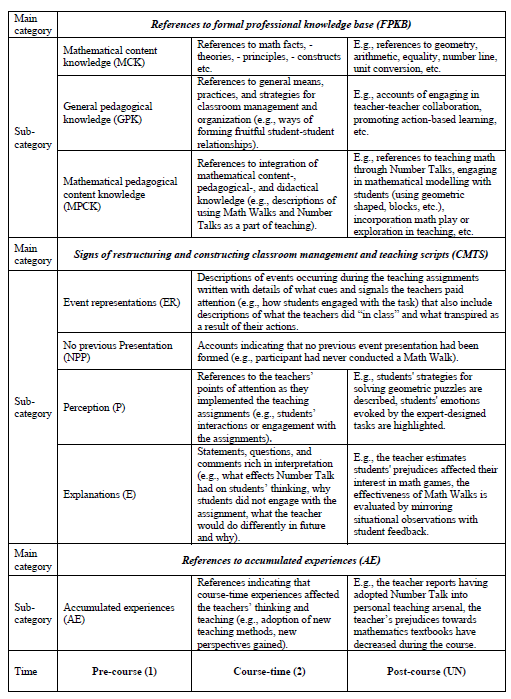
The final version of the coding framework developed consisted of three main codes, seven subcodes, and three time codes, including one for coding references where the time dimension could not be inferred. Instructions were written with multiple examples of when and how to use main and subcodes in tandem with the time codes. Also, coded references were included as illustrative examples for using the codes.
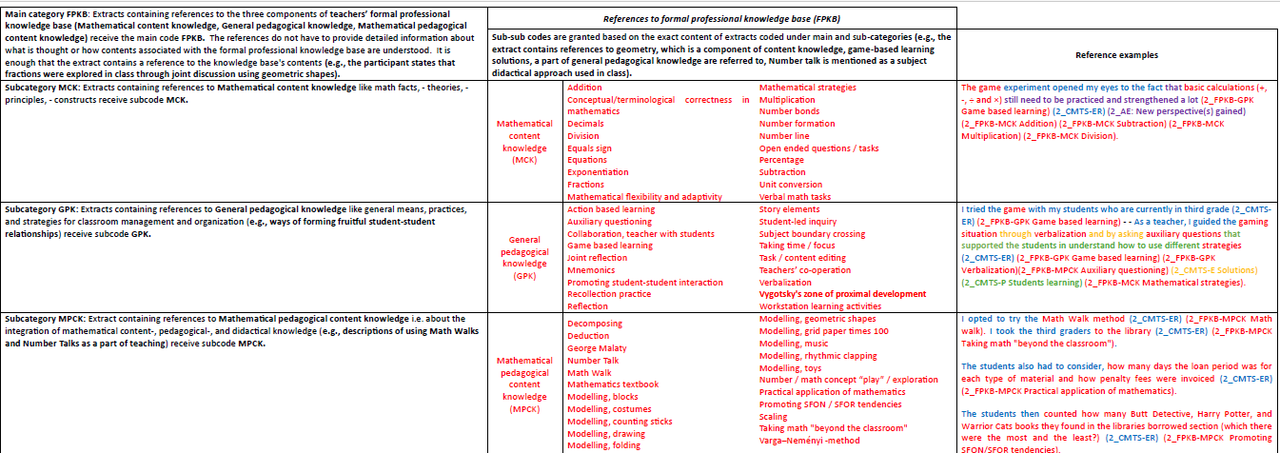
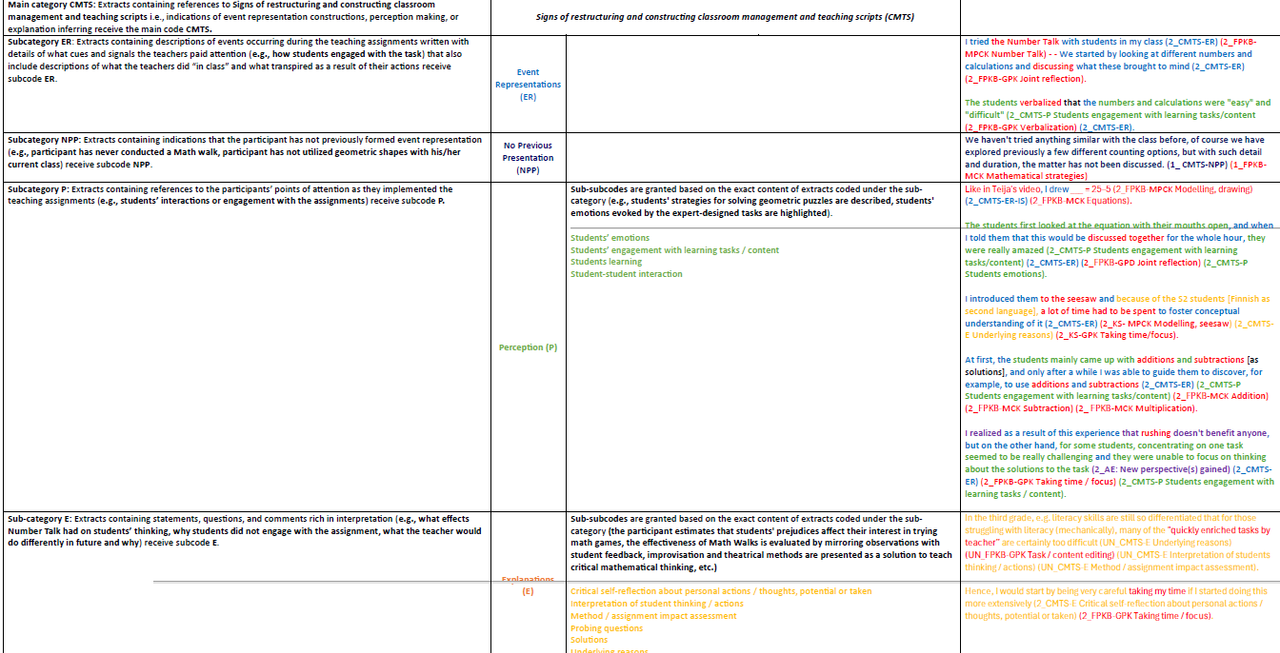
A simplified version of the coding framework developed is presented in Table 1. For the full framework, see Appendix 1.
The following is an extract by Alexander coded using the framework. Colors refer to different sub-categories in this example.

This example shows how a single sentence could contain references to signs of multiple script restructuring and construction processes. In Alexander's reflection, he describes his event representation (ER) formed while engaging with students in a game-based learning session. This event took place during the course. Hence, Time Code 2 precedes other codes used. In the analytical framework, game-based learning is a part of teachers' formal professional knowledge base (FPKB), specifically categorized as a general pedagogical knowledge (GPK) based way of promoting learning. Alexander talks about playing the game with his students, an action also categorized as a part of teachers' general pedagogical arsenal (GPK Collaboration, teacher with students). From Alexander's description, it is possible to infer signs that he paid attention to how his students engaged in gaming and the actions supporting this. Hence, his perception (P) was aimed at students' engagement with learning tasks/content. This signals that Alexander engaged in a process of perception-making associated with restructuring and constructing classroom management and teaching scripts (CMTS) during the implementation of the expert-designed teaching assignment. Also, Alexander used joint discussion, a general pedagogical approach, to support this engagement. Hence, the extract also received codes 2_CMTS-P Students’ engagement with learning tasks/content and 2_FPKB-GPK Joint reflection.
The preliminary investigation on the selected 10% of the data yielded by the 226 course enrollees was conducted rigorously, reflectively, and self-critically to derive results representing signs of the teachers' scripts restructuring and construction and their relations to formal professional knowledge and accumulated experiences as truthfully as possible. The results were discussed collectively on multiple occasions among all co-authors. Based on these discussions, the coding framework was developed, and the data were analyzed repeatedly until a level of consensus was reached. Also, the findings were presented to the members of XXXX research group. The members provided additional comments and suggestions on the coding framework. The preliminary investigation culminated in writing the coding framework presented in Appendix 1.
Next, six teachers, whose reflections were rich and detailed, were selected to show how the coding framework could be used to explore teachers' script restructuring and construction signs in relation to references of formal professional knowledge and accumulated experiences. The first author chose the teachers included in the preliminary investigation best suited for this. These choices were discussed together with all co-authors. He delved into the dataset to find and code the missing teaching assignment and end-of-course reflections for a few of the teachers. These were not included in the preliminary investigation because of the systematic sampling. Complete profiles for the selected teachers were constructed which included all their teaching assignments and end-of-course reflections coded using the established framework. The following section is devoted to exploring these findings.
We begin by describing and presenting in detail with reference examples how signs of script restructuring and construction (event representations construction, making perceptions, and inferring explanations) appeared in the selected teachers’ reflections. Next, we report how references to formal professional knowledge and accumulated experiences manifested in the reflections. We conclude by exploring how references to formal professional knowledge and accumulated experiences were associated with signs of script restructuring and construction in the teachers’ reflections.
In the six teachers’ reflections signs of constructing event representations were descriptive accounts containing information about the teachers’ experiences, observations, and interpretations as they implemented teaching assignments (what was observed, how students were engaged, what pedagogical methods were used etc.). They conveyed these teachers’ recounted views of specific events and situations they had experienced as they engaged in teaching to promote flexible mathematical thinking. These were accompanied by references signaling what perceptions the teachers made during these events and situations. This makes sense as event representations are mental presentations of what is going on and why, constructed on the basis of perception. The following account by Sanni shows how signs of constructing event representations and making perceptions appeared together in the teachers’ reflections. In this assignment, teachers were instructed to explore using Number Talks to investigate equivalence by adding arithmetic sentences on both sides of the equal sign to maintain the equivalence.
I tried the Number Talk method with third graders. I deliberately carried out the experiment very much following Teija's instructions on the video. We haven't tried anything similar with the class before. Of course, we have previously explored a few different counting options, but in such detail and duration, the matter has not been discussed. Like in Teija's video, I drew ___ = 25–5. The students first looked at the equation with their mouths open, and when I told them that this would be discussed together for the whole hour, they were really amazed. I introduced them to the seesaw and because of the S2 students [Finnish as second language], a lot of time had to be spent to foster a conceptual understanding of it. At first, the students mainly came up with additions and subtractions [as solutions], and only after a while was I able to guide them to think, for example, of using multiplication and division. This was a very eye-opening experience - - I realized as a result of this experience that rushing doesn't benefit anyone, but on the other hand, for some students, concentrating on one task seemed to be really challenging and they were unable to focus on thinking about the solutions to the task.
There are a few interesting points that warrant attention in the extract. First, Sanni indicated she had not used the Number Talk method before with the class. This lack of experience is accompanied by a reference to exploring only “a few different counting options”. These accounts indicate that Sanni has not previously formed an event representation, which would correspond to the situation described in the rest of the extract. The novelty of the situation sets a promising premise for Sanni to engage in a new event representation construction by making perceptions and inferring explanations as things evolve. Indeed, Sanni’s depictions of students’ reactions throughout the account are detailed, showing that her perception was tuned towards the students as she was forming her event representation. There are also signs of her inferring explanations on the basis of her experience as she reports realizing that "rushing doesn't benefit anyone". Sanni’s remark at the end that “This was a very eye-opening experience" even suggests that her previously held notions have been impacted by the experience, leaving the door open to the beginnings of a script development. Yet Sanni also shows signs of doubt. She concludes her recollection of the event representation by drawing attention to her perception that some students’ concentration was challenged by the task, and they seemed unable to focus on coming up with solutions.
Of all the processes associated with restructuring and constructing scripts, accounts where the teachers made explicit their inferred explanations gave the most profound information about the reasons, hypotheses, and assumptions the teachers’ related to different events they encountered. They provided a glimpse into what was going on in the informants’ minds at the level of interpretation (e.g., about their evaluations, reflections, and thoughts). To illustrate, we analyze the next quotation by Alexander.
The game [Number Navigation] immediately inspired students to play. There was a desire [among the students] for a little more personality and personalization options when it came to the selection and modification of characters. The students quickly got into the game, once we started playing together from the same stage and discussed how to play the game. At some point, it was difficult [for the students] to perceive the starting and target locations [in the game], so they could have been visually highlighted in a slightly different way. I also wondered if it would have been easier if the "calculator" [tool for giving answers in the game] had been on the right side instead of on the left. Maybe we were left missing that there was a little bit of storytelling in the game too? Yet the game’s idea was good, and the students liked it. I believe this is a good game for both math lessons and as a short waiting exercise.
In the quotation, there are signs that Alexander constructed an event representation on the basis of his perceptions and formed explanations about the gaming method he tested with students. Alexander is recalling his mental representation of the gaming event and describes how the students responded and interacted with the game leading him to state that the students had some difficulties with it. This signals that his perception was attuned to the students’ engagement during the teaching assignment. Next Alexander suggest how to develop the game and even introduces the idea that it could be used not just in math classes but more generally as a “short waiting exercise”. Alexander's assessments, development ideas, and suggestions are explanations of the game’s functionality and potential. He seems to have in part inferred these on the basis of his perceptions of how the students responded and engaged with the game. These signals about Alexander’s explanations and perceptions indicate that this positive experience may have left him open to incorporating the game, which is designed to enhance students’ adaptive number knowledge and rational number sense, into his teaching as a new pedagogical approach. Hence, with time and more practice, Alexander could form scripts into which formal professional knowledge about the Number Navigation game has been integrated with knowledge of using it in practical situations. This teaching assignment at least started to provide him with practical experiences needed for this.
As the two previous examples by Sanni and Alexander illustrated, often teachers seemed to infer explanations as a response to certain events, like the difficulties the students were perceived to have faced during a task. Indeed, accounts of teaching events that were challenging included more signs of forming explanations than those that seemed to go smoothly according to the six teachers’ reflections where they recalled the mental event representations they had constructed. Yet there were cases where the reflective assignments themselves seemed to act as triggers that prompted the teachers to offer explanations unrelated to any specific teaching situations or events. The following account, in which Heikki considers why crafting tasks for students of all ages might be a potential way to support learning, demonstrates this.
In my opinion, you can craft more interesting and challenging tasks for all ages. Even with a very small toddler, you can try to make a tower out of different blocks/items and see how the tower is created and how high it is or even a really long line of small cars can be built that stretches from the front door to the back. What’s important is that the child grasps the idea and that it’s comprehended in a way that’s meaningful to the child. For a long time, my respect for educational resource providers was high, meaning that I had to learn to do things by myself and work together with the students aiming to promote their learning. Vygotsky's theory of the zone of proximal development has been an important part of my approach to learning.
Unlike Alexander, Heikki's explanations for why and when task crafting works are not based on teaching experiences yielded by the course. Yet Heikki’s ideas are signaling that the reflective assignment led him to engage in mental effort and make explicit his explanations for why using toys, blocks, or various items to craft tasks could be an inspiring and engaging way to support student learning. The notions at the end, where Heikki says this is something he has had to learn by himself and that Vygotsky's theory has guided his approach, strengthens the argument that he has arrived at these explanations through past experiences and accumulated knowledge.
Nine times out of ten signs of script restructuring and construction were accompanied by references to the formal professional knowledge base and its subcategories. References to content knowledge provided information on the subject matter the selected teachers covered with their students. Often these also indicated what mathematical concepts they related to a particular content or a teaching method. The teachers used general pedagogical and pedagogical content knowledge to manage the classroom and teach the subject matter covered. For instance, when Anna tried the Number Navigation game with third graders, she recalled being able to support students through verbalization and questioning:
Playing the game and using different strategies seemed difficult for [students] at first. Although they were skilled counters, the game was not easy at first. As a teacher, I guided the gaming situation through verbalization and by asking auxiliary questions that supported the students in understanding how to use different strategies. When the students learned to play the game, all went smoothly, and the game seemed to motivate the students.
As she constructed her event representation, Anna proceeded to assess the situation considering students' mathematical skills and initial difficulties with the game on the basis of her perceptions. Anna’s assessment of the situation seems to have led her to conclude that verbalization and auxiliary questioning were viable means of supporting “the students in understanding how to use different strategies” at that moment. As a result, Anna used them to structure her teaching and manage the situation. This caused her to feel successful in supporting students’ learning and engagement based on her following observations: the students learned to play the game, and they had seemingly smooth and motivating experiences.
To consider utilizing the aforementioned general pedagogical approaches, Anna must have incorporated knowledge about them into her professional knowledge base. However, formal professional knowledge may remain static and unusable if not accompanied by knowledge of how and when to use it in practical situations. This knowledge is formed on the basis of experiences and assessments, predictions, and interpretations associated with these. Through experience, the processes associated with script construction and restructuring (event representations construction, making perceptions, and inferring explanations) may be initiated potentially starting formal professional and practical knowledge to combine and be structured (through encapsulation) in teachers’ minds into scripts. Hence, accumulating experiences is essential for the formation of scripts. To illustrate, here is another example from Anna, where she reflects on her Number Talk implementation experience:
We started by looking at different numbers and calculations and discussing what these brought to mind. The students verbalized that the numbers and calculations were "easy" and "difficult". Next, we took a closer look at the "difficult" numbers and calculations and pondered together if something could be done to make them nicer and easier to calculate. At first, the students couldn't figure out ways to do this. Through joint discussion and auxiliary questions, the breaking down of numbers and calculations slowly started, and the students internalized the idea. I intend to continue these Number Talk discussions, as the students already began to realize that calculations can be solved using different strategies, which turns them into a more easily calculable form. What another great idea to be used in daily work!
In Anna’s remarks there are hints that formal professional knowledge about the Number Talk method has started integrating with practical knowledge of using it because of her experience. Anna’s recollection of her event representation signals the teaching assignment enabled her to gain hands-on practice with the Number Talk method introduced during the course, make assessments of the evolving situation using her perception, and elaborate on the impact of the method on students' thinking and actions. Her explanations about the impacts on students’ learning at the end indicate she believes this experience improved students' comprehension of how multiple strategies can be used to solve calculations. This suggests she may have made a connection that Number Talks can be used to promote flexible mathematical thinking by enabling students to understand that with different strategies numbers and calculations can be turned “into a more easily calculable form” which may be simpler to solve. Anna’s mental representation of what was happening and why as she used the method, which took shape on the basis of her observations and assessments of the situation, seems to reinforce this notion. Anna’s beliefs about the potential of the method and intention to use it more present in the quotation were also evident in her end-of-course reflections:
I feel that the course increased - - my understanding of flexible mathematical thinking and problem-solving and gave me many concrete means of teaching mathematics - - Next year, I want to focus more on using Number Talks - - and foster my students' understanding that mathematics is so much more than book assignments and lessons at school. I will try to add a problem-solving lesson to the weekly program and start almost every lesson with an assignment that supports students' flexible mathematical thinking, like a short math discussion. I feel that I have become enlightened about the potential of mathematics, and I am really excited about it. Thanks to both the educators and my course mates. It's been an amazing journey! :)
Here again Anna’s reactions are quite strong. She uses exclamation marks, words, and expressions that intensely indicate her willingness to change her established thinking and acting patterns because of her course-time experiences. Descriptions of accumulated experiences like Anna’s, which included references to formal professional knowledge and signs of constructing event representations, making perceptions, and inferring explanations, contained the strongest indications that the six teachers’ scripts were affected by their experiences. Yet, even when the formal professional knowledge base was referenced and signs of most script restructuring and construction processes were found, hints of knowledge encapsulation leading to script development did not always manifest in the teachers’ accounts. The next example by Julia shows this well:
I tried the Number Navigation game in my small class. The students were fifth graders, and some had mathematics as a differentiated [the content and objectives of the teaching have been modified to match the student's limited skills and competencies] subject. It quickly became apparent that the game was too challenging for most students. Even understanding the concept of the game was difficult for [the students] because it was so multi-dimensional. Also, the lack of immediate performance awards, like those that students are used to from previous games, reduced the students' interest in the game.
Julia describes how the game was too difficult for the students, some of whom had difficulties in mathematics. She constructed an event representation considering why this was the case explaining how multidimensionality made the game complicated and that lack of immediate rewards, like those the students were accustomed to, reduced their interest. Yet Julia’s perceptions about the students and explanations aiming to infer reasons for their disengagement do not result in clear indications that she altered her behavior or thinking, or that she is more inclined to do so in the future because of the experience.
Encouragingly, in the six teachers’ reflections, there are multiple accounts suggesting that the JoMa course teaching assignments and reflective tasks gave the teachers opportunities to experiment with new teaching methods and take time to contemplate these experiences. Such experiences could lead to the beginnings of knowledge encapsulation, an essential part of script restructuring and construction, of which we already saw hopeful signs in Anna’s case. To demonstrate this further, we look at a few more examples. The next one is from Daniel, who explored fractions with second graders:
We did a lot of practical things: used geometric shapes and coloring, investigated the meaning of sequences and their parts using blocks and by dividing students into groups, and above all, there was a lot of Number Talk and a focus on correct terms. For example, "The denominator names the fraction, it tells how many parts the whole is divided into". My intention was to bring fractions into students' everyday lives and their world of experience. Afterwards, it seemed that this goal was reached by many of the students. That is, they understood what fractions really are about. It remains to be seen what they have really internalized and how well they actually learned the next time we discuss the topic.
In his teaching assignment reflection, Daniel describes using multiple means (e.g., geometric shapes, student grouping) to “bring fractions into students' everyday lives and their world of experience.”. He is guided by an overarching goal of enhancing students’ understanding of “what fractions really are about”. Daniel’s remarks allude that his efforts are based on pedagogical content knowledge, since he seems to think that modeling fractions using multiple means connects them to students’ life-experiences, supporting them to develop a more profound understanding of fractions. Daniel also emphasizes the importance of using the “correct terms” as they explored fractions. This suggests that Daniel considers terminological correctness essential in mathematics and is keen on focusing on it. Interestingly, though Daniel believes his actions lead many of the students towards a more profound understanding of fractions, he also expresses some doubt. This signals that his experience did not entirely convince him that his actions lead to his goals. Daniel does not exactly state why he feels this way. For instance, did he make observations using his perception leading to such doubts as he taught. Still, his slight skepticism hints that this single experience, the event representation he formed, and the assessments and predictions Daniel associated with the experience on the basis of his representation, need further testing and validation. This could mean that more teaching practice may be needed for Daniel to encapsulate formal professional and practical knowledge about teaching fractions with the aforementioned various illustrative means into script(s) aimed at supporting students’ profound fractional understanding as well as using the associated mathematical terms correctly. Daniel seems to be keen to do this in the future according to his end-of-course reflections:
During the course, I noticed that over the years I have reduced the role of practical learning in my teaching for several reasons, though I have always considered it important. Now, I am going to return, for example, to completely practical math lessons. - - One thing that's clearly changed in my thinking is my attitude to solving word problems. Until now, I have insisted on a solution marked with numbers, for instance, for students to receive full marks in exams. In the future, I will be more willing to accept a pictorial or verbal explanation for a task if it reveals the way the student was thinking and how the solution was reached.
At the beginning of the extract, Daniel shows increased awareness of how his teaching has evolved over the years to be less practical. According to his words, this is something he has realized during the JoMa course. Daniel also says he will “return, for example, to completely practical math lessons”. Daniel’s reflections on his course-time experiences strongly suggest that his awareness has increased, and he is more committed to teaching math more practically in the future. In the latter part of the extract, Daniel also states that his views have shifted to be “more willing to accept a pictorial or verbal explanation for a task if it reveals the way the student was thinking and how the solution was reached.”. Considering his previous remarks about exploring fractions practically to promote his students’ better understanding of them, Daniel’s end-of-course reflections suggest that he wants to pursue these aims in the future. Moreover, Daniel shows that he is inclined to do so using pedagogically solid ways proven to promote students’ flexible mathematical thinking: making mathematics education more practical, accepting different types of answers, and emphasizing thinking over correct solutions.
It is also worth considering if Daniel’s hesitation after implementing the teaching assignment could have something to do with his teaching having become less practical over the years. Daniel may have become less familiar with methods combining content and pedagogical knowledge to teach fractions practically. Could this partly be why Daniel felt unsure if he was able to achieve the goals he had set for his teaching? If so, Daniel’s reflections suggest that his course-time experiences have not deterred him further. They may actually have increased his confidence to pursue actions yielding more teaching practice. If Daniel could follow these impulses which the JoMa course seems to have initiated, this could lead him to gain more experience enabling him to form event representations, make perceptions, and infer explanations. These processes could support Daniel in forming scripts into which knowledge used in practical situations and formal professional knowledge has been encapsulated enabling him to teach math more practically in the future.
Here we look at one more example where Alexander describes his creative approach to revising division with his students:
I implemented a game-based session that included expressionist elements with my fifth graders centered on divisions (12 students were present). We had practiced divisions previously and I decided to use this session to review things we had been covering with the students. We established teams, and each team had to make a small play/illustrative presentation of division calculation. The other team had to guess what the team's division was and solve the calculation. For each correct answer, the teams always got a point. The game was played on a best-out-of-five principle. The teams could use role-playing clothes, music, etc., in their plays/representations. In other words, they could be creative. The tasks were, for example, 34.50 euros divided by 4, 76 meters divided by 10 meters, etc. So, the actors also had to be careful about what the calculation was actually about. This was fun for the students. The fifth graders already have quite a lot of trust in each other, so they dare to engage in such activities and express themselves. All the tasks were solved except for one. A lot of thinking was required to create the plays/representations, understand what the divisions were, and solve the calculations. But at least the math became grounded and concrete.
In the teaching assignment reflection, Alexander describes how he used less conventional means of teaching mathematics to support students’ creativity and to promote their engagement in revising division. It seems Alexander also aimed to set up a real-life premise for the students’ plays and representations by combining both team’s calculations into specific topics (e.g., dividing money or lengths). By making divisions and their use more “grounded and concrete” Alexander perhaps hoped to support the students’ understanding that division is something that is needed and encountered in everyday life to advance their flexible mathematical thinking. The experience appears to have been successful on many fronts. According to Alexander's recollection of his event representation and signs included in the extract of his perceptions, the students were having fun, dared to plunge into expressing their creativity, and had to think a lot to create, understand, and solve divisions presented using the aforementioned creative means. When contrasted with Alexander’s end-of-course reflections, his decisions and subsequent actions to emphasize creativity, self-expression, and students’ enjoyment, were based on a continuum of experiences preceding his participation in the JoMa course:
I am a classroom and special education teacher by training, so many things presented during the course were familiar. However, it is important to keep revising and updating my knowledge. Thirty-two years as a teacher have given me experience and [this] is not my first math course. Through Malaty [George Malaty], Varga Nemenyi, other functional courses, and by utilizing Ekapeli [GraphoGame], my mathematics teaching has evolved, and my understanding of learning mathematics has improved. What I think would be important for a young teacher is precisely flexibility in teaching mathematics. One's thinking should not be "locked-in", nor should teaching be textbook-centered drill-and-practice aimed at execution. Assessment should support learning, not just be affirmative. The math culture of the classroom must be created and made joyful and suitable for everyone.
Alexander’s notion that “One's thinking should not be "locked-in", nor should teaching be textbook-centered drill-and-practice aimed at execution” indicates his appreciation for flexibility in teaching mathematics. Also, by highlighting that assessment needs to be less affirmative to support learning Alexander is implying that he is attuned towards using more constructive forms of evaluation. In fact, looking back at his earlier reflection, there is an argument to be made that Alexander aimed partly at this as he implemented the game-based session. Having already practiced divisions with his students, he made a conscious decision to use the session “to review things we had been covering with the students”. Is this one way for Alexander to assess students’ comprehension of divisions that is practical, functional, and elaborative in nature? Finally, the statement at the end about the math culture of the classroom and the need to make it joyful and suitable for all students, suggests that Alexander believes in the power of positivity and joy when it comes to teaching mathematics. This is made quite evident and concrete by his creative approach to revising divisions.
The signs of script restructuring and construction (e.g., Alexander’s perceptions about his students, the causes and effects of the creative teaching methods he used) and references to formal professional knowledge (e.g., grounding mathematics to make it more concreate, promoting students agency through creativity means) contained in both Alexander’s reflections are alluding that he may have formed scripts encapsulating formal professional and practical knowledge enabling him aim at “practicing what he preaches”: to create a positive and accepting classroom culture, to support student agency through joy and practical teaching, and to nurture thinking over fast performance. At least the JoMa course offered him additional practice needed to engage in script restructuring and construction processes needed to form such scripts. Alexander himself recognizes the importance of this by stating that “it is important to keep revising and updating my knowledge" despite feeling that he already has a solid experience and knowledge base because of his long teaching career and systematic efforts to develop his competencies.
This study, which is the first scientific inquiry aimed at analyzing signs of script formation from teachers' reflective textual accounts, aimed to highlight the connections that exist between different processes of script restructuring and construction. Also, references to formal professional knowledge base and accumulated experiences were investigated from selected teachers’ reflections. This enabled us to explore how references to formal professional knowledge and accumulated experiences were associated with signs of script restructuring and construction in teachers' reflections.
The results of this study indicate that signs of teachers constructing event representations, making perceptions, and inferring explanations could be identified from the teachers' textual accounts using the abductively developed coding framework. As expected based on our theoretical framework (e.g., Boshuizen et al., 2012; Jarodzka et al., 2013; Wolff et al., 2021), the six teachers, whose written accounts were studied, recalled event representations they had constructed as they reflected on the teaching assignments, which offered the teachers practical experiences of teaching with methods designed to foster flexible mathematical thinking. Also, as teachers recalled their event representations signs about the perceptions they had made when implementing the course assignments appeared. This is in line with our predictions, since teachers construct their mental representations of events using their perception (Wolff et al., 2021). Signs of explanations the teachers inferred, for instance, about what was happening and why when they were teaching, appeared frequently in the teachers’ reflections. The teachers’ explanations offered insight into the formal professional and practical knowledge they had mustered, and into the nature of the experiences the course provided the teachers. Taken together, these insights enabled us to construct a picture of how accumulating experiences and formal professional knowledge may be related to teachers engaging in script restructuring and construction processes in the JoMa context.
Based on our analysis, when the studied teachers were given the opportunity to explore by teaching the use of different pedagogical tools, approaches, and methods and had freedom and time to reflect on these teaching experiences, the teachers showed indications of knowledge structuring. Their recollections of constructed event representations and signs regarding their perceptions might be accompanied by detailed accounts to inferred explanations. These could lead the teachers to discover new perspectives (e.g., about themselves or their students), assess the functionality of different tools, approaches, and methods, and make predictions about their usability in teaching. Also, according to the teachers’ reflections, teachers’ course-time experiences did frequently foster enthusiasm and commitment in them to use these in the future to promote their students’ flexible mathematical thinking. These findings suggest that accumulating practical teaching experiences can support teachers to engage in script restructuring and construction processes and that reflecting on these experiences may strengthen their effects. Hence, practical teaching experiences may be capable of initiating the encapsulation of formal professional (e.g., about the importance of mathematical modeling with various means) with practical knowledge (e.g., how to conduct Number Talks in an engaging and thought-provoking manner). With time, more practice, and reflection it is possible that these initial steps of encapsulation will continue to grow and lead to more comprehensive knowledge structuring in the form of teaching scripts.
However, gaining more experience may not in itself always be enough to initiate script restructuring and construction potentially leading to knowledge encapsulation in scripts. Many of the teachers’ reflections about course-time experiences remained “superficial” (did not include profound and detailed signs about the teachers constructing event representations, making perception, or inferring explanations). Accumulating experiences must encourage teachers to form event representations, make perceptions, and, most importantly, provoke mental effort that can yield insightful and thought-provoking interpretations of these experiences (Boshuizen et al., 2012; Jarodzka et al., 2013; Wolff et al., 2021). When the teachers’ reflections included hints of these processes, indications that the teachers’ experiences had encouraged script restructuring and construction, possibly leading to knowledge encapsulation, were observed. This highlights just how important it is that the accumulated experiences are of good quality.
The findings of this first explorative study are encouraging. Firstly, they indicate that it is possible to investigate signs of script restructuring and construction post-hoc from teachers’ textual reflections using a coding framework developed abductively. The results obtained with the framework aligned with some of the findings of earlier script studies (Boshuizen et al., 2012; Boshuizen et al., 2020; Si, 2022; Wolff et al., 2021) conducted in multiple fields with methods designed to elicit in-situational thinking and behavior reaffirm notions that scripts are not simple perception-response mental structures. They are amalgamations of teachers’ experiences, formal professional and practical knowledge as well as personal orientations, and script development may well require continued practice, experiences, and conscious deliberation (Wolff et al., 2021).
The teachers whose reflections we have studied only had initial opportunities to gain practical and reflective experiences related to flexible mathematical thinking and its teaching during the JoMa course. Yet we were able to identify signals of script restructuring and construction and references to formal professional knowledge and accumulating experiences that implied they had formed event representations based on their perceptions and inferred explanations leading to assessments and predictions (e.g., about events, tools, approaches, etc., encountered). These signs and references as well as the positivity and commitment teachers expressed in their reflections about their experiences give us hope that the course as a whole may have catalyzed the teachers to work to gain more practical and reflective experience of using pedagogically solid and expertly designed tools, methods, approaches, etc., they were introduced to in order to promote their students’ flexible mathematical thinking. If this is the case, the teachers could be more prepared to embark on a path where they gain additional formal professional knowledge about flexible mathematical thinking and knowledge of how to promote it in practical situations that may be encapsulated into scripts.
The study aimed at testing the applicability of script theory in analyzing impacts of an in-service course on teachers’ knowledge structures with data which has certain limitations. From reflective accounts it’s not possible to be certain that the studied teachers’ recollections of their event representations and perceptions match what actually happened as they taught. The possibility must be acknowledged that certain things may not have been recalled accurately. It is known that humans have a tendency to cognitive biases when recalling past events and to make interpretations of these that could impair the content and accuracy of the teachers’ reflections (Pinker, 2021). Human memory has also been shown to be malleable by contextual and subject-related factors, which at their worst, can even lead to false memories (Loftus, 2005). Still, research also shows that recollections of past events can be far more accurate than might be expected and indicate what the subjects’ points of interest were as these occurred (Bainbridge et al., 2019; Diamond et al., 2020). Most crucially, subjectivity is actually an essential part of scripts. Mental representations formed on the basis of perceptions and the explanations associated with these representations are meant to present teachers’ subjective views of various classroom events and situations (Wolff et al., 2021). Teachers' scripts may not and need not be based on the most realistic depictions of different events. This does not diminish their great influence on teachers' actions and thinking impacting their ability to manage and structure teaching to support flexible mathematical thinking.
Despite the limitations related to the data used in this study, signs of script restructuring and construction could be identified with a comfortable degree of certainty using the novel analytical coding framework. Yet the functionality of the framework needs to be further investigated to assess the validity and reliability of the method. In the future, studies conducted with a more quantitative orientation with larger sample sizes and multiple coders could be used. Investigating interrater reliability between coders by counting kappa values for each established category is recommended.
The causality between the signs of teachers' engaging in processes associated with restructuring and constructing scripts and accumulating experiences yielded by the JoMa course cannot be investigated with cross-sectional studies like this one. This would require longitudinal follow up and intervention studies, which would benefit from incorporating additional research methods capable of inferring teachers’ acting and thinking “in the moment” (e.g., Wolff et al., 2015; Wolff et al., 2016; Wolff et al., 2017). In the future, the findings of this inquiry could be used to design such studies by providing information about what content, assignments, and methods are likely to prompt teachers to engage in script restructuring and construction processes (e.g., guidelines and examples showing how to integrate the "theory" into practice, practical teaching assignments, reflection tasks, etc.). Also, the findings of this study provide researchers with information about which cues and signals are potentially indicative of signs of script restructuring and construction and beginnings of knowledge encapsulation into scripts. This could help future researchers to direct their attention to those aspects which are informative of teachers’ scripts.
It was also beyond the scope of this inquiry to delve deeply into qualitative differences between the JoMa course enrollees’ scripts from the perspective of teaching flexible mathematical thinking. Future studies should examine if teachers' scripts differ in their ability to promote this by contrasting more the exact content of teachers' scripts with knowledge about pedagogical practices shown to support students' flexible mathematical thinking. Through this, categories or groups might be formed to differentiate scripts on the basis of their potential to support or hinder teachers as they aim to teach flexible mathematical thinking and to highlight differences between expert and novice teachers in this regard. The information provided by such inquiries would promote a more profound understanding of the mental knowledge structures that enhance or inhibit teachers' teaching. This knowledge could be used to further develop in-service programs, like JoMa, to support teachers in altering their scripts promoting their ability to teach flexible mathematical thinking.
Ball, D. L., Hill, H.C., & Bass, H.
(2005).Who Knows Mathematics Well Enough to Teach Third
Grade, and How Can We Decide?American Educator 29, (1):
14-17, 20-22, 43-46
Blömeke, S. (2017). Modelling teachers’ professional competence as
a multi-dimensional construct. In Guerriero, S. (ed.),
Pedagogical Knowledge and the Changing Nature of the Teaching
Profession , OECD Publishing, pp. 119–135
https://doi.org/10.1787/9789264270695-7-en
Blömeke, S., Gustafsson, J.-E., &
Shavelson, R. J. (2015). Beyond dichotomies: Competence viewed as
a continuum. Zeitschrift Für Psychologie, 223(1), 3–13.
https://doi.org/10.1027/2151-2604/a000194
Blömeke, S., Suhl, U., & Kaiser, G. (2011). Teacher Education
Effectiveness: Quality and Equity of Future Primary Teachers’
Mathematics and Mathematics Pedagogical Content Knowledge.
Journal of Teacher Education , 62(2), 154–171.
https://doi.org/10.1177/0022487110386798
Boaler, J. (2019). Developing Mathematical Mindsets: The Need to
Interact with Numbers Flexibly and Conceptually. American
Educator, 42 (4), 28-.
Boaler, J., Dieckmann, J. A., LaMar, T., Leshin, M.,
Selbach-Allen, M., & Pérez-Núñez, G. (2021). The
Transformative Impact of a Mathematical Mindset Experience Taught
at Scale. Frontiers in Education (Lausanne) , 6.
https://doi.org/10.3389/feduc.2021.784393
Boaler, J., & Dweck, C. (2015). Mathematical Mindsets:
Unleashing Students’ Potential Through Creative Math, Inspiring
Messages and Innovative Teaching (First edition.). John
Wiley & Sons, Incorporated.
Boaler J, Chen L, Williams C, & Cordero M. (2016). Seeing as
Understanding: The Importance of Visual Mathematics for our Brain
and Learning. Journal of Applied & Computational
Mathematics, 5(5), DOI:
10.4172/2168-9679.1000325
Boshuizen, H. P. A., Gruber, H., & Strasser, J. (2020).
Knowledge restructuring through case processing: The key to
generalise expertise development theory across domains? Educational
Research Review, 29, 100310-.
https://doi.org/10.1016/j.edurev.2020.100310
Boshuizen, H. P. A., van de Wiel, M. W.
J., & Schmidt, H. G. (2012). What and how advanced medical
students learn from reasoning through multiple cases. Instructional
Science, 40(5), 755–768.
https://doi.org/10.1007/s11251-012-9211-z
Bainbridge, W. A., Hall, E. H. & Baker, C. I. (2019). Drawings
of real-world scenes during free recall reveal detailed object and
spatial information in memory. Nat Commun 10,
5.
https://doi.org/10.1038/s41467-018-07830-6
Brezovszky, B., McMullen, J., Veermans, K., Hannula-Sormunen, M.
M., Rodríguez-Aflecht, G., Pongsakdi, N., & Lehtinen, E.
(2019). Effects of a mathematics game-based learning environment
on primary school students’ adaptive number knowledge. Computer
& Education, 128, 63-74.
https://doi.org/10.1016/j.compedu.2018.09.011
Brunner, E., & Star, J. R. (2024).The
quality of mathematics teaching from a mathematics educational
perspective: what do we actually know and which questions are
still open? ZDM, 56(5), 775–787.
https://doi.org/10.1007/s11858-024-01600-z
Bui, P., Hannula-Sormunen, M. M., Brezovszky, B., Lehtinen, E.,
& McMullen, J. (2023). Promoting Adaptive Number Knowledge
Through Deliberate Practice in the Number Navigation Game. In
Kiili, K., Antti, K., de Rosa, F., Dindar, M., Kickmeier-Rust, M.,
& Bellotti, F., Games and Learning Alliance: 11th
International Conference, GALA 2022, Tampere, Finland, November
30 - December 2, 2022, Proceedings (1st ed., Vol. 13647)
, Springer International Publishing, pp. 127–136.
Bui, P., Pongsakdi, N., McMullen, J., Lehtinen, E., &
Hannula-Sormunen, M. M. (2023). A systematic review of mindset
interventions in mathematics classrooms: What works and what does
not? Educational Research Review , 40,
100554-.
https://doi.org/10.1016/j.edurev.2023.100554
Clements, D. H., & Sarama, J. (2021). Sustainable, scalable
professional development in early mathematics: Strategies,
evaluation, and tools. In Li, Y., Howe, R. E., Lewis, W. J.,
Madden, J. J. (eds), Developing Mathematical Proficiency for
Elementary Instruction (pp. 221–238), Springer
International Publishing
Charlin, B., Tardif, J., & Boshuizen,
H. P. (2000). Scripts and medical diagnostic knowledge: theory
and applications for clinical reasoning instruction and
research. Academic Medicine, 75 (2),
182–190.
https://doi.org/10.1097/00001888-200002000-00020
Cohen, L., Manion, L., & Morrison, K. (2018). Research
Methods in Education (Eighth edition., Vol. 1).
Routledge.
https://doi.org/10.4324/9781315456539
Council of the European Union. (2018). Council
Recommendation on Key Competences for Lifelong Learning.
General Secretariat of the Council.
Darling-Hammond, L., Hyler, M. E., & Gardner, M. (2017).
Effective teacher professional development . Learning
Policy Institute.
https://doi.org/10.54300/122.311 .
Depaepe, F., Verschaffel, L., & Star,
J. (2020). Expertise in developing students’ expertise in
mathematics: Bridging teachers’ professional knowledge and
instructional quality. ZDM, 52 (2), 179–192.
https://doi.org/10.1007/s11858-020-01148-8
Diamond, N. B., Armson, M. J., & Levine, B. (2020). The Truth
Is Out There: Accuracy in Recall of Verifiable Real-World Events.
Psychological Science, 31 (12), 1544-1556.
https://doi.org/10.1177/0956797620954812
van Dijk, E. E., Geertsema, J., van der Schaaf, M. F., van
Tartwijk, J., & Kluijtmans, M. (2023). Connecting academics’
disciplinary knowledge to their professional development as
university teachers: a conceptual analysis of teacher expertise
and teacher knowledge. Higher Education , 86(4),
969–984.
https://doi.org/10.1007/s10734-022-00953-2
Döhrmann, M., Kaiser, G., & Blömeke, S. (2012). The
conceptualisation of mathematics competencies in the international
teacher education study TEDS-M. ZDM, 44(3),
325–340.
https://doi.org/10.1007/s11858-012-0432-z
English, L. D., Humble, S., & Barnes, V. E. (2010).
Trailblazers. Teaching Children Mathematics , 16(7),
402–409.
http://www.jstor.org/stable/41199504
Ericsson, K. A. (2018). The differential
influence of experience, practice and deliberate practice on the
development of superior individual performance of experts. In
Ericsson, K. A., Hoffman, R. R., Kozbelt, A., Hoffman, R. R.,
& Williams, A. M. (Eds.), The Cambridge handbook of
expertise and expert performance (2nd ed.), Cambridge
University Press, pp. 745-769
Gravemeijer, K., Stephan, M., Julie, C., Lin, F-L., & Ohtani,
M. (2017). What Mathematics Education May Prepare Students for the
Society of the Future? International Journal of Science and
Mathematics Education , 15, 105–123.
https://doi.org/10.1007/s10763-017-9814-6
Hickendorff, M., McMullen, J., &
Verschaffel, L. (2022). Mathematical flexibility:
Theoretical, methodological, and educational considerations. Journal
of Numerical Cognition, 8(3), 326–334.
https://doi.org/10.5964/jnc.10085
Hong, W., Star, J. R., Liu, R.-D., Jiang, R., & Fu, X. (2023).
A Systematic Review of Mathematical Flexibility: Concepts,
Measurements, and Related Research. Educational Psychology
Review, 35(4), 104-.
https://doi.org/10.1007/s10648-023-09825-2
Jarodzka, H., Boshuizen, H. P. A.,
Kirschner, P. A., & Lanzer, P. (2013). Cognitive Skills in
Medicine. In Catheter-Based Cardiovascular Interventions
(pp. 69–86). Springer Berlin Heidelberg.
https://doi.org/10.1007/978-3-642-27676-7_7
Kaiser, G., & Blömeke, S. (2013). Learning from the Eastern
and the Western debate: the case of mathematics teacher education.
ZDM, 45(1), 7–19.
https://doi.org/10.1007/s11858-013-0490-x
Lehtinen, E., Brezovszky, B., Rodríguez-Aflecht, G., Lehtinen, H.,
Hannula-Sormunen, M. M., McMullen, J., Pongsakdi, N., Veermans,
K., & Jaakkola, T. (n.d.). Number Navigation Game (NNG):
Design Principles and Game Description. In Describing and
Studying Domain-Specific Serious Games (pp. 45–61).
Springer International Publishing.
https://doi.org/10.1007/978-3-319-20276-1_4
Lehtinen, E., Hannula-Sormunen, M.,
McMullen, J., & Gruber, H. (2017). Cultivating
mathematical skills: From drill-and-practice to deliberate
practice. ZDM, 49(4), 625–636.
https://doi.org/10.1007/s11858- 017-0856-6
Loftus E. F. (2005). Planting misinformation in the human mind: a
30-year investigation of the malleability of memory.
Learning & memory (Cold Spring Harbor, N.Y.) , 12(4),
361–366.
https://doi.org/10.1101/lm.94705
Newton, K. J., Star, J. R., & Lynch,
K. (2010). Understanding the Development of Flexibility in
Struggling Algebra Students. Mathematical Thinking and
Learning, 12(4), 282–305.
https://doi.org/10.1080/10986065.2010.482150
Meyer, A., Kleinknecht, M., & Richter, D. (2023). What makes
online professional development effective? The effect of quality
characteristics on teachers’ satisfaction and changes in their
professional practices. Computers and Education, 200,
104805-.
https://doi.org/10.1016/j.compedu.2023.104805
McMullen, J., Brezovszky, B., Rodríguez-Afecht, G., Pongsakdi, N.,
Hannula-Sormunen, M. M., & Lehtinen, E. (2016). Adaptive
number knowledge: Exploring the foundations of adaptivity with
whole-number arithmetic. Learning and Individual Differences,
47, 172–181.
https://doi.org/10. 1016/j.lindif.2016.02.007
McMullen, J., Chan, J. Y.-C., Mazzocco, M. M. M., &
Hannula-Sormunen, M. M. (2019). Spontaneous mathematical focusing
tendencies in mathematical development and education. In Norton,
A., & Alibali, M. W. (Eds.), Constructing Number
(pp. 69–86). Springer International Publishing.
McMullen, J., Verschaffel, L., & Hannula-Sormunen, M. M.
(2020). Spontaneous mathematical focusing tendencies in
mathematical development. Mathematical Thinking and Learning,
22(4), 249–257.
https://doi.org/10.1080/10986065.2020.1818466
Ministry of Education and Culture, Finland. (2023). Finnish
National STEM Strategy and Action Plan: Experts in natural
sciences, technology and mathematics in support of society's
welfare and growth .
http://urn.fi/URN:ISBN:978-952-263-733-8
Mulcahy, C., Day Hess, C. A., Clements, D. H., Ernst, J. R., Pan,
S. E., Mazzocco, M. M. M., & Sarama, J. (2021). Supporting
young children’s development of executive function through early
mathematics. Policy Insights from the Behavioral and Brain
Sciences, 8 (2), 192–199.
https://doi.org/10.1177/23727322211033005
Organisation for Economic Co-operation and Development. (2023).
PISA 2022 Results (Volume I): The State of Learning and Equity
in Education .
https://doi.org/10.1787/53f23881-en
Ohtonen Piuva, A., Mårtensson, E., Röj-Lindberg, A.-S., &
Braskén, M. (2023). Finnish Pre-Service Teachers’ Basic
Mathematical Skills: A Comparison Between 2008 and 2020. FMSERA
Journal.
https://journal.fi/fmsera/article/view/127787
Parker, R., & Humphreys, C. (2018). Digging Deeper:
Making Number Talks Matter Even More, Grades 3-10 (1st
ed.). Routledge.
https://doi.org/10.4324/9781032681016
Pinker, S. (2021). Rationality: What It Is, Why It Seems
Scarce, Why It Matters . Viking.
Rittle-Johnson, B., Star, J. R., & Durkin, K. (2020). How Can
Cognitive-Science Research Help Improve Education? The Case of
Comparing Multiple Strategies to Improve Mathematics Learning and
Teaching. Current Directions in Psychological Science: A
Journal of the American Psychological Society , 29(6),
599–609.
https://doi.org/10.1177/0963721420969365
Rittle-Johnson, B., Star, J. R., & Durkin, K. (2012).
Developing procedural flexibility: Are novices prepared to learn
from comparing procedures? British Journal of Educational
Psychology, 82(3), 436–455.
https://doi.org/10.1111/j.2044-8279.2011.02037.x
Si, J. (2022). Strategies for developing pre-clinical medical
students’ clinical reasoning based on illness script formation: a
systematic review. Korean Journal of Medical Education,
34(1), 49–61.
https://doi.org/10.3946/kjme.2022.219
Star, J. R. (2023). Revisiting the origin of, and reflections on
the future of, pedagogical content knowledge. Asian Journal
for Mathematics Education, 2 (2), 147-160.
https://doi.org/10.1177/27527263231175885
Star, J. R., Newton, K., Pollack, C., Kokka, K., Rittle-Johnson,
B., & Durkin, K. (2015). Student, teacher, and instructional
characteristics related to students’ gains in flexibility.
Contemporary Educational Psychology, 41 , 198–208.
https://doi.org/10.1016/j.cedpsych.2015.03.001
Stigler, J. W, & Miller, K. F. (2018). Expertise and Expert
Performance in Teaching. In Ericsson, K. A., Hoffman, R. R.,
Kozbelt, A., Hoffman, R. R., & Williams, A. M. (Eds.),
The Cambridge handbook of expertise and expert performance
(2nd ed.), Cambridge University Press, pp. 431-452
Shulman L. S. (1986). Those who understand: Knowledge growth in
teaching. Educational Researcher, 15(2), 4–14.
https://doi.org/10.3102/0013189X015002004
Tossavainen, T., & Leppäaho, H. (2018). Matematiikan
opettajien ja opettajaksi opiskelevien matemaattisesta osaamisesta
[About the mathematical competence of mathematics teachers and
student teachers]. In Joutsenlahti, J., Räsänen, P., &
Silfverberg, H. (Eds.), Matematiikan opetus ja oppiminen
, Niilo Mäki Instituutti, pp. 294-.
Verloop, N., Van Driel, J., & Meijer, P. (2001). Teacher
knowledge and the knowledge base of teaching. International
Journal of Educational Research , 35(5),
441–461.
https://doi.org/10.1016/S0883-0355(02)00003-4
Verschaffel, L. (2024). Strategy flexibility in mathematics. ZDM,
56(1), 115–126.
https://doi.org/10.1007/s11858-023-01491-6
Verschaffel, L., Schukajlow, S., Star, J., & Van Dooren, W.
(2020). Word problems in mathematics education: a survey. ZDM,
52 (1), 1–16.
https://doi.org/10.1007/s11858-020-01130-4
Vicente, S., Verschaffel, L., Sánchez, R., & Múñez, D. (2022).
Arithmetic word problem solving. Analysis of Singaporean and
Spanish textbooks. Educational Studies in Mathematics, 111(3),
375–397.
https://doi.org/10.1007/s10649-022-10169-x
Wolff, C. E., van den Bogert, N., Jarodzka, H., & Boshuizen,
H. P. A. (2015). Keeping an Eye on Learning: Differences Between
Expert and Novice Teachers’ Representation of Classroom Management
Events. Journal of Teacher Education , 66(1),
68–85.
https://doi.org/10.1177/0022487114549810
Wolff, C. E., Jarodzka, H., van den Bogert, N., & Boshuizen,
H. P. A. (2016). Teacher vision: expert and novice teachers’
perception of problematic classroom management scenes. Instructional
Science, 44(3), 243–265.
https://doi.org/10.1007/s11251-016-9367-z
Wolff, C. E., Jarodzka, H., & Boshuizen, H. P. A. (2017). See
and tell: Differences between expert and novice teachers’
interpretations of problematic classroom management events.
Teaching and Teacher Education , 66, 295–308.
https://doi.org/10.1016/j.tate.2017.04.015
Wolff, C. E., Jarodzka, H., & Boshuizen, H. P. A. (2021).
Classroom management scripts: A theoretical model contrasting
expert and novice teachers’ knowledge and awareness of classroom
events. Educational Psychology Review, 33 (1),
131–148.
https://doi.org/10.1007/s10648-020-09542-0