
Frontline Learning Research: Vol. 13 No. 2 (2025)
27 -50
Special Issue: Perspectives on Momentary Engagement and
Learning Situated in Classroom Contexts
ISSN 2295-3159
1 University College London, Institute of Education, UK 2 Technical University of Munich, School of Social Sciences and Technology, Germany 3University College Dublin, School of Education, The Republic of Ireland
Article received 27 September 2023 / Article revised 18 October 2024 / Accepted 24 October 2024/ Available online 14 March 2025
Previous research suggests connections
between peer relationships and children’s engagement and
learning within the classroom. However few studies have explored
these connections in detail or considered the possible processes
that may begin to explain the linkages. This study collected
systematic data from different respondents within primary school
settings to help clarify the role of peers in classroom
engagement and learning.
Over 800 pupils based in English primary schools were involved
in a multi-method study. Peer-sociometric questionnaires
provided measures of academic peer relations, informal-social
peer relations, such as being accepted as a work partner and
liked as a person to play with, playground group centrality and
leadership. Self-report questionnaires provided data on school
engagement, disengagement, and disaffection. Science attainment
data were collected at the start and end of the year. Momentary
behavioural engagement was observed in classrooms for a
subsample of pupils who were also rated by their teachers in
terms of their attention and behaviour in class.
Findings revealed small to moderate associations between peer
relations measures, multiple measures of school and classroom
engagement, attainment, and progress. Multiple regressions
examined peer relations measures relative to momentary,
classroom and school engagement and learning outcomes. Findings
highlight important overlaps and differences in the predictors
of different types of engagement. They also highlight the
variety of ways in which peer relationships, whether
academically or socially focused, may have different
implications for engagement at momentary, classroom, and school
levels. Findings indicate that academic peer acceptance is
predictive of engagement at the different levels and science
attainment. However, informal-social peer relations were more
highly connected with class disruption, school disengagement and
disaffection and were negative predictors of attainment and
progress over the year. This suggests different pathways for
children with different types of relationships with peers
relative to engagement and adjustment highlighting complex
connections between social and academic life in school.
Keywords: Peer relationships; momentary engagement; academic engagement; academic progress
Pupil engagement in school has received significant interest from researchers because of its potential to improve outcomes for pupils both in the short and long term (Finn & Zimmer, 2012; Fredricks et al., 2004; Resnick et al., 1997; Reschly & Christenson 2022). Understanding the processes and contexts underpinning engagement and disengagement may enable educators to better support pupils who are struggling or at risk of school exclusion (Fredricks, 2011; Fredricks et al., 2019). There is evidence to suggest that changes to practices in school can lead to changes in engagement and thus offer the means for improving learning and achievement (Gettinger & Walter, 2012; Guthrie et al., 2012; Wang & Fredricks, 2014; Wang & Holcombe, 2010). Existing research demonstrates that measures of engagement have been found to be correlated with subsequent educational attainment (Anderson & Scott, 1978; Finn et al., 1995; Reschly & Christenson, 2022). A central feature of academic engagement is the multiple levels at which it can be conceptualised and measured, ranging, for example, from momentary engagement with individual tasks (Symonds et al., 2024), to a longer-term process of engaging cognitively and behaviourally with schoolwork in classrooms, and affectively towards school (Skinner & Pitzer, 2012).
Children’s relationships with their peers are important for children’s social and academic engagement and learning in school (Ryan et al., 2019; Wentzel et al., 2018; Wang & Hofkins, 2020). Relationships with peers are multifaceted, complex, and varied in their nature. Types of peer relationship include peer liking, social acceptance, leadership, friendships, as well as roles and relationships within peer groups (Blatchford & Baines, 2010) and these may connect with engagement and learning in different ways (Knifesend et al., 2022; Ryan et al., 2019) across the school ecosystem. While a number of studies examine the ways different aspects of peer relations connect with engagement, for example, peer rejection and friendship (Knifesend et al., 2022; Ladd et al., 2008; Ryan et al., 2019), relatively little research has sought to examine the connections between peer relationships as expressed in different sub-settings within school and engagement as expressed at different levels of the school system.
Accordingly, the current study aims to identify the connections between different forms of peer relationship and academic engagement and attainment, using multiple measures and modes of data collection. It provides useful information for researchers wishing to compare, within the same sample, how different peer-relations and engagement forms interrelate. This information will prove useful to educational practitioners who wish to promote school engagement and attainment through peer relationships at school.
Engagement is a complex, multi-faceted construct (Christenson et al., 2012) that can be understood as an individual’s participation in learning activities with the dominant conceptual model distinguishing between affective, cognitive and behavioural engagement (Fredricks et al., 2004). Affective engagement is viewed as a key internal emotional/attitudinal response to school and learning (e.g., enjoyment, interest) that provides the impetus to engage cognitively and behaviourally. Cognitive engagement refers to the extent to which learning strategies, effort to understand, and self-regulatory strategies are utilised. Behavioural engagement refers to attention, participation, conduct, effort and persistence (Finn & Zimmer, 2012; Fredricks et al., 2016).
Engagement has also been described as a multi-level construct (Janosz, 2012; Skinner & Pitzer, 2012; Skinner & Raine, 2022) that can be considered in relation to a range of sub-settings within school (Wang & Hofkens, 2020). However, the term is often used to mean different things by different researchers and these often overlap or are used interchangeably (Fredricks et al., 2016). While some researchers tend to focus on broad and abstract conceptualisations of school engagement (Finn & Zimmer, 2012; Reschly & Christenson, 2012), typically relating to school attendance and involvement in extracurricular activities, others examine the construct at the classroom level, focusing on children’s participation in class, enjoyment of learning, and other class-related behaviours (Furrer et al, 2014; Wang et al., 2014).
Symonds et al. (2024) outline yet another level of engagement. They draw on a dynamic systems approach to conceptualise momentary engagement as a situated process within pupils that ebbs and flows over time relative to an academic activity. Momentary engagement may adjust over the course of a lesson, for example, when the environment is noisy, or when a peer disrupts the class or distracts an individual. As a dynamic system, elements that make up the system co-interact in that they function simultaneously and interdependently according to principles of holism, contextualism, emergence, non-linearity, and self-organisation.
How momentary engagement connects to and overlaps with other engagement constructs, like class and school engagement, is an important question. These engagement constructs may be nested within contexts (Sinatra et al., 2015; Skinner & Raine, 2022; Symonds et al., 2021) with the most situated expression of engagement being momentary engagement with an academic activity, the next level of engagement within the class and then school engagement at a more general level. These levels also vary on a temporal basis and may not simply be the aggregate of engagement at the nested level (Symonds et al., 2024). It makes relatively little sense to talk about school engagement on a momentary basis since the nature and organisation of school is relatively enduring. Considering this level of engagement over a term/semester or full school year may be more appropriate. On the other hand, class engagement may vary from week-to-week, but little over shorter time periods. Whereas task engagement can fluctuate on a momentary basis relative to changing tasks, curriculum areas, local contextual conditions and interactions and relationships with class members.
The extent to which different types and levels of engagement are connected remains under studied. Those children who are highly task engaged in lessons are unlikely to be disengaged from school, however there are cases of pupils who engage with school, by attending, but engage relatively infrequently in lessons and may feel substantially disaffected with school (Golding, 2021; Rogers, 2015). Although types of engagement involve different temporal frames, engagement at all levels includes a sense of commitment and a motivation to act, attend to, sustain, and participate in activities in school settings. As such, there is value in examining different measures of engagement at different levels of granularity relative to each other.
It is important to have a clear conceptualisation of the connection between engagement and context, especially when considering different forms of engagement which may be relevant at different levels within the school system. Although models of engagement acknowledge the notion of context, few studies consider the school as a set of embedded dynamic behavioural settings, as outlined by ecological psychologists (e.g., Barker & Gump, 1964; Doyle, 2013; Heft, 2018), within which engagement in an activity takes place. Momentary engagement within these ‘behaviour settings’ can manifest in different forms. Even within the classroom, engagement during whole-class teaching involves individuals engaged in different behavioural expressions compared to those engaged in collaborative learning or adult-supported group instruction. For example, talking with peers might be regarded as inappropriate during class instruction or individual work settings but is often seen as evidence of active engagement in peer co-learning settings.
Studies have sought to understand factors that may influence engagement and attainment and these are often described as contextual factors (Furrer et al., 2014; Pianta et al., 2012; Skinner et al., 2008; Wang & Hofkens, 2020). These factors are seen as separate from the individual child but may relate to their relationships, or elements of the setting that they are situated in. These include relationships with teachers, teaching assistants, and peers. Researchers have tended to emphasise the importance of teacher-pupil relationships and classroom ethos for fostering engagement (Pianta et al., 2012), yet we know relatively little about the ways peers may influence engagement and attainment in school, in particular in relation to classroom processes (Altermatt, 2012; Ryan et al., 2019; Ryan & Shin, 2018).
From a child’s perspective, schools are principally a site for peer interactions and relationships, serving as a key setting for their development (Blatchford et al., 2015; Gifford-Smith & Brownell, 2003). Contact with peers is an enduring feature of school life with interactions taking place both in settings connected with the academic side of school (e.g., instruction, cooperative learning within class) and in other nested settings in school that are less academically and more socially focused, such as during meal-times and break-times (Baines & Blatchford, 2011, 2023). In class, children sit next to and are more likely to interact with peers than an adult, despite almost all learning activities being directed by adults (Blatchford et al., 2015; Galton et al., 1999). Different expressions of peer relationships may exist across different settings within school. For example, pupils may have different peer preferences depending on whether they are working together on a problem in class, whether they are playing together on the playground, or engaged in conversations in the dining hall (Baines & Blatchford, 2011; Baines & McIntyre, 2022).
Most research on peer relationships tends to be cross-sectional and seldom examines their connections with engagement, especially emotional and cognitive engagement (Ryan et al., 2019). In considering the connections between context and measures of engagement, research has reported associations between peer relations (particularly sociometric acceptance and rejection), and engagement (Ryan et al., 2019). Correlational research tends to find that those children who are accepted or well-liked by peers tend to do well in school, are more likely to be behaviourally engaged, and achieve at higher levels than pupils who are less accepted (Ladd et al., 2012; Lubbers et al., 2006; Wentzel & Caldwell, 1997). A longitudinal study of children in kindergarten suggested that acceptance was related to increased participation in class during primary school (Ladd et al., 2008). On the other hand, pupils who are disliked, rejected or less involved in the peer group tend to be less likely to participate in class than accepted peers and are more likely to withdraw and report feelings of stress and anxiety about school (Buhs & Ladd, 2001; Cillessen & van den Berg, 2012; Ladd, 2005; Wentzel et al., 2012). However, few studies have examined the possible explanations for connections between peer relations and engagement.
Theoretical models suggest that interactions and relationships with peers, and the associated microcultures, may have important implications for engagement and attainment (Kindermann & Skinner, 2012; Knifsend et al., 2022; Ryan et al., 2019). From the perspective of self-system theory, peer relationships are likely to influence the extent to which children feel a sense of relatedness, belonging, and competence within school and thus will influence their engagement (Skinner et al., 2009). For instance, children who are higher in peer acceptance, more centrally involved in peer groups, and considered to be leaders of groups are likely to be more engaged than children who are less accepted and less involved in peer groups (Kindermann & Gest, 2018). Children who are less accepted by peers are likely to be more disruptive, feel less emotionally engaged, and more disaffected than more accepted peers (Ryan et al., 2019). However, studies often examine peer relations in a general sense and are not sensitive to variations across different settings and activities within school. The reasons for acceptance may vary between children, for example they might relate to who is enjoyable to play with at breaktime or who is liked to work with in class. Children who are particularly liked in one setting may be less popular in another setting (Baines & MacIntyre, 2022; Pinto et al., 2019).
One understudied distinction relates to peer preferences as expressed in the classroom as opposed to more informal settings, such as preferred social/play partners on the playground. At an intuitive level, children seem aware of the peers who are good to work with, and those who are not. They seem to know who might get them into trouble and which peers are likely to offer the most informal cooperation, support and fun (Nuthall, 2007). Peer relationships in different settings may connect with modes of engagement, performance, and progress in different ways. In a review of studies, Zajac and Hartup (1997) found that friends, as opposed to non-friends, were supportive of classroom-based peer co-learning but at other times could be distracting. It is likely that there are other specific ways in which peer relations in school settings have implications for engagement and learning (Wentzel et al. 2018). Academically accepted children are more likely to be engaged, while peers who are valued as social playmates may be more likely to actively draw peers off task. Children of a certain peer status may also demonstrate more disruption, disaffection, and negative attitudes towards school. Few studies have sought to examine the connections between multiple specific measures of peer relations in different sub-settings of school, and multiple measures of engagement and attainment.
Research on academic engagement makes substantial use of self- and teacher-report measures, while systematic observations and peer-report measures remain underutilised (Martins et al., 2022). The variety of instruments and respondents in school engagement research leaves unanswered questions about the extent of overlap between measures from different respondents and relative to different levels of the ecosystem (Skinner & Raine, 2022). Furthermore, there is a fragmented evidence base on the role of different types of peer relationships in student learning and engagement at different levels of the school ecosystem. Together, these gaps present the need to study different forms of engagement and peer relationships simultaneously. To address this need, the study makes three main contributions.
The first contribution is to utilise different measures of engagement (momentary engagement, classroom engagement and school engagement) from the perspective of multiple respondents (self-report, peer report, teacher report and researcher observations) to examine overlaps and differences and to examine these relative to attainment.
A second contribution of this study is to collect systematic data on pupils’ peer relationships, both in relation to settings where children either work with peers or where interactions are of a more informal-social nature, and to relate these to different measures of engagement. This study therefore sought to examine the connections between different measures of peer relations as expressed in different settings and engagement at different levels of the ecosystem.
A third contribution is to identify whether pupils’ academic performance and progress are related to the different forms of peer relationships and school engagement. This aspect is informed by research emphasising the role of engagement and relatedness at school in pupils’ academic outcomes (Finn & Zimmer, 2012; Knifsend et al., 2022).
In line with these contributions, the main research questions guiding the study are: 1) To what extent are different measures of engagement, pertaining to different levels within the school environment (momentary task, classroom, and school engagement), related to each other? 2) To what extent do social and academic peer relations correlate and predict engagement at different levels? 3) To what extent do different measures of peer relations predict academic performance and progress over a school year?
The multimethod study took place over one school year and involved measures collected at the start and/or the end of the year. Research tools included: a peer report instrument which provided information about children’s peer relations; a self-report attitudinal questionnaire which provided data on school engagement; and assessment tests, collected at the start and end of the year, which provided data on pupils’ science attainment and progress. A sub-sample of pupils were also systematically observed in lessons and rated by teacher in terms of their behaviour in class to provide further measures of engagement. All the necessary consents were sought from the school, parents and children. The research received permission to proceed from the University Research Ethics Committee.
The overall study sample involved 40 classes from 19 schools in London providing data on 1027 pupils: 486 in Year 4 (8/9 years) and 541 in Year 5 (10/11 years) and 49% girls. A subsample of pupils was selected for focal child systematic classroom observation. This subsample provided observation data on 179 pupils from 32 classes in 15 schools (52% girls). Of this sub-sample, teaching staff from 24 classes in 13 schools also returned teacher questionnaires on 133 pupils (52% girls).
According to national data, the sample was diverse in terms of social background and economic circumstances. Schools came from a London borough and were typical of London schools in terms of key characteristics such as school size (X ̅ = 322.9, sd = 1626.4), mean percentage of pupils that had special education needs (X ̅ = 23.3, sd = 7.9), percentage eligible for free school meals (X ̅ = 34.0, sd = 16.9), mean percentage with a different first language than English (X ̅ = 27.0, sd = 10.2). All schools followed the national curriculum.
All children completed a questionnaire about their relationships with peers at the start of the year. Pupils answered nine peer nomination questions as adapted from previous studies (Baines & Blatchford, 2009; Blatchford et al., 2003; Kindermann, 2007). Two questions related to academic peer relations in the classroom where children were asked to identify up to three children in their class who they ‘most like to work with’, and who are ‘best at working in groups’. Further questions related to social peer relations in the playground. Children were asked to identify up to 3 peers who they ‘like to play with at breaktime’, and who are ‘leaders of groups on the school playground’. A final question related to the peer groups. This followed the procedures outlined by Cairns et al. (1998), where pupils were asked to identify the ‘children that hang out together in groups on the school playground’ (up to 5 groups) and this provided a measure of network centrality. A further question asked children to nominate the children who ‘work the hardest at learning in class’ and this provided a measure of classroom engagement.
Peer report data for each question were totalled for each child and standardised across the classes, adjusting for different numbers of responding pupils, by dividing the number of peers that had identified each child by the number of responding pupils minus one.
Peer groups were identified using the Social Cognitive Mapping 4.0 software (Cairns & Cairns, 1994) and individual ‘group centrality’ was identified based on the number of reported times a child was attributed to the group. No threshold was used. Values for network centrality status varied between 1 and 4 – isolate, peripheral, secondary and nuclear.
Attainment measures were collected at the start and end of the school year. Three specially designed science tests were constructed using items drawn from a database of Government-developed Standard Assessment Tasks for Year 6 pupils that overlapped with the work covered by pupils in the previous and forthcoming year and were of varying difficulty (see Kutnick & Blatchford, 2014). Items related to the National Curriculum themes of ‘physical processes’ and ‘materials and their properties’. Items were simplified for younger children by converting questions to a multiple-choice format, reducing the number of options and so on. Test 1 was given to Year 4 pupils to complete at the start of the year. Test 2 was completed by Year 5 pupils at the start of the year and by Year 4 pupils at the end of the year. Test 3 was completed by Year 5 pupils at the end of the year. Tests were designed to require interpretation of diagrams, tables and graphs and contained a mixture of forced choice questions and open-ended questions in equal measure on each test. There was a total of 34 questions on each test and items were unique to each test. Tests were teacher-administered and marked by independent raters and answers to open ended questions were judged for accuracy using Standards and Testing Agency guidelines.
Attainment data were expressed as percentage correct answers. To enable comparisons between outcome variables measured on different scales, the results from each of the attainment tests were transformed separately for Year 4 and Year 5 to a standard normal scale.
Self-report questionnaires were completed at the start and the end of the year and provided a range of measures relative to the liking of school subjects and motivation (see Galton et al., 2009; Kutnick & Blatchford, 2014). Responses were measured on a 5-point scale from “Strongly agree” to “Strongly disagree”. However, only items relating to the subscales of school engagement, school disengagement and school disaffection were used in this paper and these were collected only at the end of the year. The three scales were formed on the basis of 2 items each. Cronbach’s alpha internal consistency was .73 for School Disengagement (for example, “I mess about a lot in school”), .64 for School Importance (for example, “It is important that I do well at school”); and .62 for School Disaffection “Learning in school is boring”. While the alphas for the latter two measures were less than ideal, they are sufficient (Kline, 1999), given that the scales consist of only two items and items were moderately correlated.
To identify the sub-sample of pupils, teachers were asked to report on the general attainment levels of children in their class across three levels of attainment – low, medium, and high. Six of these children, who also had the necessary parental agreement for involvement in the research and who had agreed to be observed, were then chosen by the researcher, a girl and a boy from each attainment level along with a reserve from the same attainment level, if a child was absent. Participating children were aware that they might be observed but not precisely when in the school day this would happen.
Systematic observation was used to collect information about the nature of interaction and academic engagement. This involved collection of data in terms of categories previously defined on conceptual grounds and refined in pilot work. In contrast to other forms of data collection it builds up data on the basis of careful recording of ongoing behaviour, rather than through ratings. Behavioural categories targeted behaviours related to the research questions.
Behaviour of pupils and teachers during normal classroom activities was described through in-situ naturalistic observations of general categories of pupil behaviour across a normal school day.
Observation codes: Full details of the schedule including category definitions are summarised in Blatchford, et al. (2006)1 and comprised categories that provided a description of time spent in different work settings, school subject, and a description of how children behaved when in three social ‘modes’ – when working alone and not interacting with others, when interacting with adults, and when interacting with other children. Within each of these three ‘modes’ were mutually exclusive categories that covered momentary engagement in work as well as off-task activity. The categories related to the ‘target’ child; teachers and other children were observed only when they came into contact with the targets.
Observations took place over two days during the autumn and spring terms. Observations were conducted in blocks of 10-second time intervals, with gaps of 10 seconds between observations to allow logging and to prepare for the next observation. After each block of eight observations, attention switched to the next pupil on the list. Once all 6 pupils had been observed, observations continued with the first child and so on until the end of the lesson.
There were 5,938 observations, with an average number of 33.17 (SD = 14.4) observations per child. Three observers undertook the observations. They were experienced researchers, familiar with working in schools, and able to explain the research and put teachers and pupils at ease. The observers had received training in which they were provided with an observation manual of categories, conventions, and procedures, as well as tips acquired during previous use (see Blatchford et al., 2006). Training involved the discussion and application of coding conventions using video recordings, accompanied by checks of accuracy and consistency. This was followed by at least a day’s observation in a class not involved in the study, and then a follow up training session to discuss field visits and resolve difficulties. Inter-coder reliability coefficients (Kappa) for the main sets of mutually exclusive categories were high ranging from 0.77 to 0.96.
Observation data were aggregated across the visits and data for each category converted into a proportion of the total number of observations for the target child, to standardise data across participants with different numbers of observations. This provided momentary engagement measures of ‘on-task’, ‘off-task-active’, ‘off-task-passive’ and, the aggregate of these two measures, ‘off-task’.
Teachers rated the sub-sample of 6 observed pupils in their classes in relation to 8 questions on a 5-point scale from 1 ‘never true of this child’ to 5 ‘always true of this child’. These items were drawn from the ‘Child Behavior Scale’ (Ladd & Profilet, 1996) and focused on children’s behaviour in class. Two items were used in this study to provide measures of classroom engagement. These related to the target child in term of the extent to which they were able to ‘sustain attention in class’ and were ‘disruptive in class’. Items were drawn from scales and selected on the basis of being the most representative of the scale as based on analyses of a large-scale data set (see Blatchford, 2003).
Analyses of the associations between multiple forms of pupil engagement, peer relationships, and pupil attainment involved the use of correlational and multiple regression procedures. Other contextual variables were controlled for were gender, year group and percent of pupils in the school eligible for Free School Meals (%FSM), a proxy measure of socio-economic status.
The data had a nested structure as pupils were taught by different teachers. To test the relation between peer relations measures and pupil engagement outcomes, we therefore ran a series of linear mixed effects models using R package lme4, version 1.1-29 (Bates et al., 2015). Specifically, we fitted random-intercept models that allow the intercept to vary across the grouping variable (i.e., the different teachers). The lmerTest package was used to calculate p-values for fixed effects (Kuznetsova et al., 2017). R-Squared (i.e., explained variance) was computed using the MuMIn package (Barton, 2017). We report standardized regression coefficients (i.e., effect sizes) as all variables were standardized prior to analyses (i.e., mean-centered and divided by the standard deviation).
Table 1
Means, standard deviations and correlations between different engagement measures (momentary, classroom, and school) and attainment
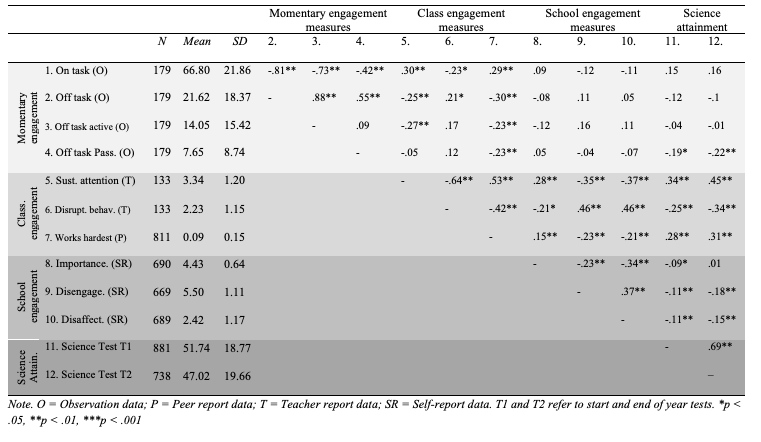
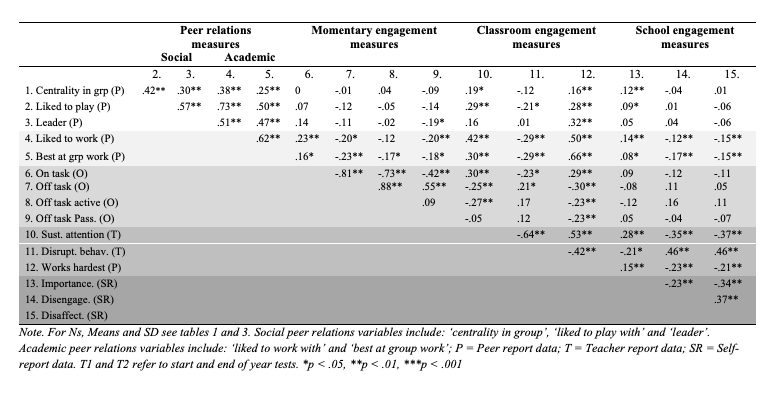
Table 2
Correlations among peer relations (social and academic), momentary engagement, classroom engagement and school engagement measures
Analyses first focused on the associations between the different engagement measures that represent different levels of granularity (momentary, classroom and school engagement) collected from different perspectives (observation, teacher report, peer report and self-report) and in relation to science attainment at the start and end of the year (see Table 1).
The measures of ‘momentary engagement’ and ‘classroom engagement’ were moderately correlated. Teacher reported ‘sustained attention’ correlated positively with the percent of ‘on-task’ observations and negatively with the percent of ‘off-task’ and ‘off-task-active’ (but not ‘passive’) observations. While we should be cautious about comparing correlations with different sample sizes, the same trend was found for peer reports of ‘who works the hardest’ with the addition of a negative correlation with ‘off-task passive’ – suggesting that pupils might be more aware than the teacher of which children are ‘passively off-task’. Nevertheless, there is a high overlap between teacher report and peer reports of ‘classroom engagement’. Similarly momentary measures of engagement correlate well.
Measures of observed ‘momentary engagement’ were not associated with self-report measures of school (dis)engagement. However, teacher and peer reported ‘classroom engagement’ measures showed moderate associations with self-reports of school (dis)engagement.
With the exception of a weak negative association for ‘off-task passive’, momentary engagement measures were not associated with ‘science attainment’ measures collected at the start and the end of the year. However, teacher and peer reported classroom engagement measures, and measures of school (dis)engagement were weakly related to ‘science attainment’ measures.
Correlations of ‘academic peer relations’ variables as expressed in the classroom and more socially focused peer relations variables (see Table 2) were highly interconnected. In relation to momentary, classroom and school engagement variables, academic peer relations variables, but not social peer relations variables, were significantly correlated with observed ‘classroom engagement’ variables. Academic peer relations variables were more strongly associated with ‘classroom engagement’ variables than socially focused peer relations variables. Academic peer relations variables also showed weak associations with ‘school engagement’ measures.
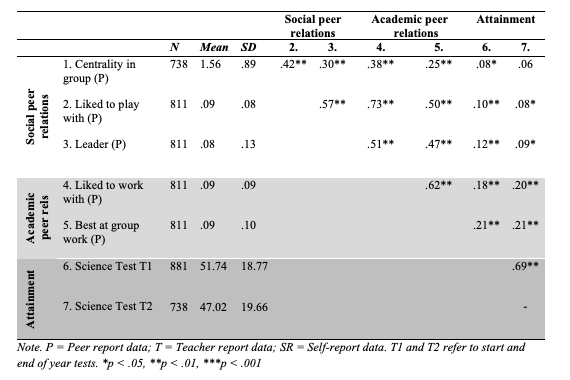
Table 3
Means, standard deviations, and correlations among peer relations and science assessments at the start and end of the year.
Social peer relations measures were not associated with ‘momentary engagement’, except in terms of ‘off-task-passive’ being less associated with ‘leadership’. ‘Liking to play with’ was moderately associated with ‘classroom engagement’ measures and ‘network centrality’ was weakly associated with ‘sustained attention’, ‘works hardest’ and ‘school importance’.
While all peer relations measures were associated with ‘attainment’ at the start of the year (see Table 3) and, with the exception of centrality, at the end of the year, academic in-class peer relations measures were more strongly correlated than social peer relations measures.
Table 4
Results of regressions predicting observed momentary on- and off-task behaviour
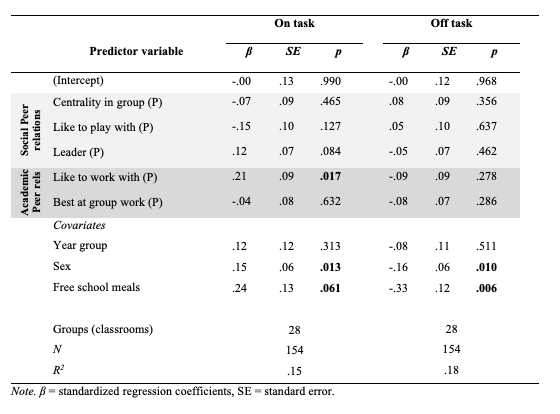
On the basis of the correlations, a number of multiple regressions were undertaken to examine how the academic in-class and social peer relations measures worked together to predict the range of engagement and attainment measures used in this study. Models involved corrections for the nested structure of pupils within classrooms along with covariates of school year group, sex of pupil and the percentage of the school roll that received free school meals2 . Results of analyses are reported in Tables 4–6.
The models presented in Table 4 indicate that the peer relations measure of being ‘liked as someone to work with’ was a significant predictor of observed pupil ‘on-task’ behaviour. None of the other peer relations measures were significant predictors. Further, none of the peer relations measures were predictive of the momentary measure of observed pupil ‘off-task’ behaviour (‘off-task-active’ and ‘off-task-passive’ categories combined).
Analyses of classroom engagement measures as rated by the teacher (‘sustained attention’ and ‘disruption’) and by peers (‘works hardest’) indicated that being ‘liked as someone to work with’ significantly predicted teacher ratings of ‘sustained attention’ and peer ratings of ‘works hardest’. It also negatively predicted teacher ratings of ‘disruption’ (see Table 5). Being regarded by peers as the ‘best at group-work’ was negatively predictive of teacher ratings of ‘classroom disruption’. Peer ratings of ‘leadership’ were positively predictive of teacher ratings of ‘classroom disruption’.
The model predicting the peer assessment of ‘who works the hardest in class’ found that peer ratings of being ‘best at group-work’ and being ‘liked to work with’ were positive predictors. Surprisingly and in contrast to other engagement measures, peer nominations of ‘being liked as someone to play with’ was also a positive predictor of peer nominations of ‘who works the hardest in class’. It is important to note that these moderate positive effect sizes may, in part, be due to shared method variance since these measures came from the peer nomination questionnaire.
Analyses relative to the pupil self-report school (dis)-engagement measures (see Table 6) show small R2 values, suggesting that the peer relations measures explained relatively little of the variation in scores. However, peer report of ‘liked to work with’ was positively and negatively related to the three school engagement measures and in expected directions. Being the ‘best at group-work’ negatively predicted pupil self-reported ‘disengagement’. Surprisingly, peer report of ‘liking to play with’ and ‘leadership’ were positive predictors of pupil self-reported ‘disengagement’, suggesting that young people who were high in social ‘acceptance’ or ‘leaders’ in informal peer settings were more likely to report ‘disengagement’, though not disaffection.
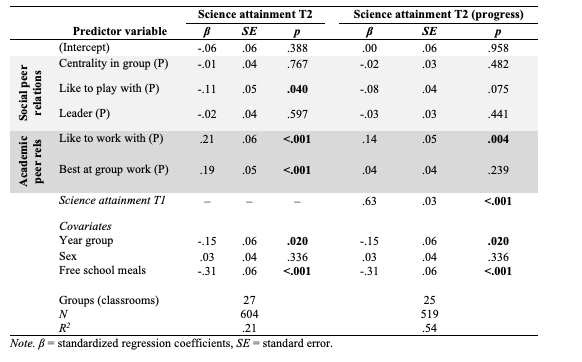
In relation to science attainment, two multiple regressions were undertaken (see Table 7). The first examined the peer relations variables relative to attainment at the end of the year and the second did the same but took account of science attainment at the start of the year to provide an analysis of progress.
Being identified by peers as someone ‘liked to work with’ in the classroom positively predicted both individual pupil attainment and progress, and being socially liked as a playmate negatively predicted attainment and approached significance relative to progress. This is consistent with the earlier reported pattern in the regression examining predictors of ‘school disengagement’. Being reported by peers as higher in ‘best at group-work’ in the classroom was a significant predictor of pupil attainment at Time 2 but was not predictive of pupil’s achievement progress over the year.
Table 5
Results of regressions predicting classroom engagement measures
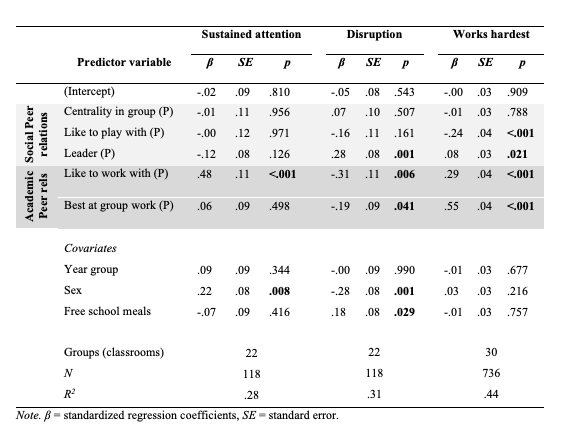
Table 6
Results of regressions predicting student reported school engagement
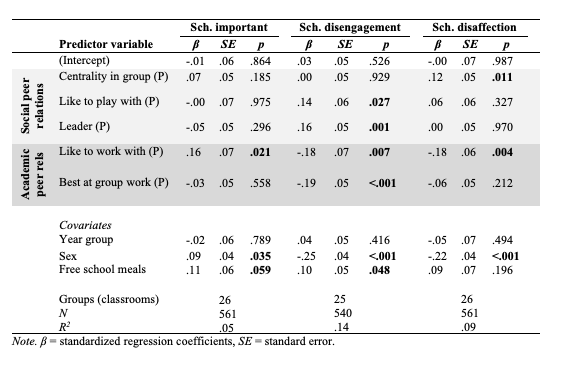
Table 7
Results of regressions predicting student attainment and progress
 4.
4.
This study sought to examine the connections between different measures of peer relations (both academic and social peer relations measures), and different measures of engagement as well as attainment and progress in science over the course of a year in school. The research findings provide new insights into the overlaps between the different measures of engagement from different respondents and between the different levels of engagement within the school ecosystem. Results also indicate that academic and socially focused peer relationships connect with (dis)engagement processes as well as science attainment and progress in different ways.
The study was unique in that it involved the collection of multiple measures of engagement at different levels of granularity (momentary, classroom and school levels of engagement) and from different respondent perspectives (self-report, peer report, teacher report and researcher observation data). This provides a multi-faceted perspective of engagement at the different levels. Few studies that focus on engagement examine it across multiple respondents or levels within the school system. Other studies often use self or teacher report measures and resultant findings may be overly inflated by shared method variance (Brannick et al., 2010). The multiple perspectives provided data on elements which respondents are uniquely placed to comment on (e.g., self-report data related to affective (internal) aspects of school engagement).
Data were robust in that they were collected from a large sample of children in schools, involved the use of an established systematic in-situ observation system to collect data on children working in authentic classroom contexts and with sensitivity to the nature of engagement within different pedagogic and activity settings (Blatchford et al., 2006; Golley et al., 2010). The study also utilised conventional peer and teacher report methods (Ladd, 2005), self-report questionnaire data and attainment and progress data in science (Baines et al., 2007).
A first key finding was that the measures of engagement at different levels were varied in their associations. Momentary engagement and classroom engagement measures were moderately correlated. As these measures came from different respondents, this highlights meaningful consistency across these different perspectives and levels of granularity/ temporal frames of reference. As the specific measures at momentary and classroom engagement levels connect with a behavioural engagement construct, overlap might be expected more than between other types of engagement, such as cognitive or affective engagement. Nevertheless, the moderate level of overlap between researcher perspective (momentary engagement) and that of the teacher and peers (classroom engagement measures) emphasises a level of concordance in these perspectives and credibility for the different temporal frames.
Conversely, measures of momentary engagement did not correlate with any of the self-report school engagement variables. This is surprising but may reflect either the different temporal frames of reference (momentary vs school engagement) or the distinctive nature of these engagement measures. Momentary engagement measures relate to behavioural-cognitive aspects of engagement in the classroom, while the school engagement variables reflect internal states of affect/attitudes towards school generally.
The finding that classroom engagement measures correlated with the school engagement variables, as well as the momentary measures, however, complicates the picture, though importantly suggests overlaps between these temporal frames of reference and suggests that these constructs are all connected. In particular teacher reported disruptive behaviour and the self-reported school engagement variables of disengagement and disaffection were moderately associated. Again, this might be to a degree about thematic overlaps in that it is not unusual for children who are disengaged or disaffected with school to be more distracted or disruptive in class.
Classroom engagement variables also correlated well with science attainment measures at the start and the end of the year, indicating that teacher judgements and peer judgements are broadly in agreement and are associated with science attainment. This suggests that children have a good understanding of which pupils work the hardest in class. These findings are similar to other studies demonstrating associations between engagement and attainment outcomes (Finn & Zimmer, 2012; Gettinger & Walter, 2012; Wang & Fredricks, 2014). School engagement measures were only weakly associated with science attainment, and momentary engagement measures, with the exception of off-task passive, did not correlate at all with science attainment. This may reflect the very general nature of the school engagement measures and very specific nature of the momentary engagement data. It is likely that had momentary measures of engagement been collected in greater number over time and within the specific context of science lessons, rather than during lessons generally, then associations between momentary engagement and attainment/progress might have been more evident.
Our findings highlight the value in collecting data on engagement from different participant perspectives and also the utility and overlap between momentary engagement and other more general measures of engagement in schools (Symonds et al., 2024). A focus on momentary engagement is of value in enabling studies to develop micro level explanations about mechanisms in the classroom and how these connect with or influence more enduring features of classroom and school engagement. It allows the modelling of dynamic momentary aspects relative to more invariant elements of classroom experience (such as teacher-pupil relationships which fluctuate over a larger timescale) to provide a comprehensive understanding of classroom processes and effects over time.
Peer relations variables were highly correlated, as might be expected when comparing variables derived from the same research tool. A key finding was that academic peer relations variables were more strongly related to and better predictors of momentary, classroom and school engagement measures and science attainment measures than were the socially based peer relations variables. This suggests that children who are preferred as work partners or seen as better at group-work are more likely to be engaged momentarily with schoolwork and more broadly with learning in their classrooms, have positive attitudes towards school and are less likely to be disaffected or disengaged from school. These children also achieve at higher levels and make more progress in science assessments than children who were less accepted as work mates.
Previous research has tended to only examine associations between general measures of peer acceptance/rejection and classroom engagement and achievement in school (Ryan & Shin, 2018) and has not differentiated between academically focused and more socially focused peer relations variables. Findings highlight the value in considering peer relations variables in specific behavioural settings in school and that peer liking in one setting might have different implications for engagement and attainment outcomes than peer liking in a different sub-setting of school. It has been difficult to understand the mechanisms that may explain such connections but previous work has suggested that generally accepted children are likely to feel a greater sense of school belonging and are thus more likely to become engaged or that children tend to like peers who are model school citizens (Ryan & Shin, 2018). These are explanations that likely play a role, but our research suggests that those who are preferred as work partners or seen as the best at group-work, may be more proactive and effective in collaborative learning settings, possibly through prosocial interaction in the classroom such as helping and social support (Ryan et al., 2019) and are thus more likely to be engaged at momentary, classroom and school levels.
More socially focused measures of ‘liking to play with’, ‘being a leader’ or ‘being centrally involved in playground groups’ did not predict the engagement measures when the academic peer relations measures were included in the analyses. The social peer relations variables, however, were positive predictors of class disruption, school disengagement and disaffection. Social peer liking also negatively predicted science attainment and progress over the year. Given previous research on this topic (Ryan & Shin, 2018), these findings were surprising especially as these children are in the primary school phase. This suggests that social success/leadership may be more associated with disruption, disengagement, and disaffection. These findings are consistent with studies that examine perceived popularity relative to disengagement (Cillessen & van den Berg, 2012) as well as studies that suggest that as socially accepted children move towards the transition into secondary school, they show increased dissatisfaction and disaffection with school and become less motivated to learn and attend school (Galton et al., 2003). However, studies also show that children who are more accepted by peers are less likely to show declines in engagement during this period (De Laet et al., 2015). By contrast, a longitudinal study of early teens, a few years on in age compared to the pupils involved in the current study, found that likeability and popularity in the peer group were related to lower levels of behavioural engagement over time (Engels et al., 2016). Our research suggests that these incongruent trends might be to do with the settings in which children are accepted with an increasing separation between social success in the peer group and engagement in class and school as children move toward early adolescence. For some children and young people at this age, being disruptive in class and cynical about school might serve to raise their social profile with peers through a sense of excitement associated with the disruption they cause. Alternatively, it may be that these children choose to focus on developing social relationships without investing in school academics. These suggestions require further research attention.
As with any study, there are limitations to the research. A more focused design involving observations just in science lessons would have enabled a clearer comparison with science attainment data. A further limitation relates to the different sample sizes of data collected and this would have been overcome by a full study without the need for sub-samples. Nevertheless, observation data are time consuming to collect and a trade-off was necessary in this research.
It is useful to reflect on the notion that engagement can exist at different levels and/or temporal frames. This idea needs further conceptual and empirical scrutiny. While differentiation between engagement based on narrow and broad temporal periods makes sense, as does a hierarchy of types of engagement (Skinner et al., 2008), we question how far they reflect a reality rather than a logic. We also wonder how important considerations of the curriculum area, the pedagogic activity setting (e.g., whole-class teaching, groupwork, homework etc.) as well as conceptual and methodological issues. A conceptual framework that starts with momentary engagement experiences within settings and builds up to connect with more general perspectives on school engagement would seem fruitful for future research. Peer relations may connect with engagement in different ways and at different points in class, for example during collaborative learning peer liking might be more meaningful than during independent work. On the other hand, disruption and its promotive effect on popularity might be more expressed during whole-class teaching where there is an audience. These speculative points require further investigation.
This research has identified important overlaps and distinctions between different types of engagement. It also highlights the important and varied ways in which peer relationships may have different implications for different aspects of behaviour and interaction in school depending on whether children are liked by peers in relation to academic work or are liked more in relation to social activities in school. This serves to highlight the complex connections between the academic and social sides of school life.
Altermatt, E. R. (2012). Children’s achievement-related discourse
with peers: Uncovering the processes of peer influence. In A. M.
Ryan & G. W. Ladd (Eds.), Peer relationships and
adjustment at school (pp. 109–132). IAP Information Age
Publishing.
Anderson, L. W., & Scott, C. C. (1978). The relationship among
teaching methods, student characteristics, and student involvement
in learning. Journal of Teacher Education, 29(3),
52–57.
https://doi.org/10.1177/002248717802900323
Baines, E., & Blatchford, P. (2009). Sex differences in the
structure and stability of children’s playground social networks
and their overlap with friendship relations. British Journal
of Developmental Psychology, 27 (3), 743–760.
https://doi.org/10.1348/026151008X371114
Baines, E. & Blatchford, P. (2011). Children's games and
playground activities in school and their role in development. In
A. D. Pellegrini (Ed.), The Oxford Handbook of the
Development of Play (pp. 260-283). New York: Oxford
University Press.
https://doi.org/10.1093/oxfordhb/9780195393002.013.0020
Baines, E., & Blatchford, P. (2023). The decline in breaktimes
and lunchtimes in primary and secondary schools in England:
Results from three national surveys spanning 25 years.
British Educational Research Journal, 49 (5), 925–946 .
https://doi.org/10.1002/berj.3874
Baines, E., Blatchford, P., & Chowne, A. (2007). Improving the
effectiveness of collaborative group work in primary schools:
Effects on science attainment. British Educational Research
Journal, 33(5), 663–680.
https://doi.org/10.1080/01411920701582231
Baines, E., & MacIntyre, H. (2022). Children’s social
experiences with peers and friends during primary school
mealtimes. Educational Review, 74 (2), 165–187.
https://doi.org/10.1080/00131911.2019.1680534
Barker, R. G., & Gump, P. V. (1964). Big school, small school:
High school size and student behavior.
Barton, K. (2017). MuMIn: Multi-model Inference. R package Version
1.40. 0.
http://CRAN.R-project.org/package=MuMIn
Bates, D., Mächler, M., Bolker, B., Walker, S., Christensen, R.
H., Singmann, H., & Dai, B. (2014). Lme4: Linear mixed-effects
models using Eigen and S4. R package version 1.1–7. 2014.
Retrieved from
http://CRAN.R-project.org/package=lme4
Blatchford, P. (2003). The class size debate: Is small better?
McGraw-Hill Education (UK).
Blatchford, P., & Baines, E. (2010). Peer relations in school.
In K. Littleton, C. Wood & J. Kleine-Staarman (Eds)
International Handbook of Psychology in Education (pp227-276).
Bingley, UK:Emerald .
Blatchford, P., Baines, E., & Pellegrini, A. (2003). The
social context of school playground games: Sex and ethnic
differences, and changes over time after entry to junior school.
British Journal of Developmental Psychology, 21 (4),
481–505.
https://doi.org/10.1348/026151003322535183
Blatchford, P., Baines, E., Rubie-Davies, C., Bassett, P., &
Chowne, A. (2006). The effect of a new approach to group work on
pupil-pupil and teacher-pupil interactions. Journal of
Educational Psychology, 98(4), 750.
https://psycnet.apa.org/doi/10.1037/0022-0663.98.4.750
Blatchford, P., Pellegrini, A. D., & Baines, E. (2015). The
child at school: Interactions with peers and teachers. Routledge.
Brannick, M. T., Chan, D., Conway, J. M., Lance, C. E., &
Spector, P. E. (2010). What is method variance and how can we cope
with it? A panel discussion. Organizational Research Methods,
13(3), 407–420.
https://doi.org/10.1177/1094428109360993
Buhs, E. S., & Ladd, G. W. (2001). Peer rejection as
antecedent of young children’s school adjustment: An examination
of mediating processes. Developmental Psychology, 37(4),
550.
https://doi.org/10.1037/0012-1649.37.4.550
Cairns, R. B., & Cairns, B. D. (1994). Lifelines and risks:
Pathways of youth in our time. Cambridge University.
Cairns, R., Xie, H., & Leung, M. (1998). The popularity of
friendship and the neglect of social networks: Toward a new
balance. New Directions for Child and Adolescent
Development, 1998 (81), 25–53.
https://doi.org/10.1002/cd.23219988104
Christenson, S., Reschly, A. L., & Wylie, C. (2012). Handbook
of research on student engagement (Vol. 840). Springer.
Cillessen, A. H., & van den Berg, Y. H. (2012). Popularity and
school adjustment. In G. W. Ladd & A. M. Ryan (Eds.),
Peer relationships and adjustment at school (pp.
135–164). Information Age Publishing.
De Laet, S., Colpin, H., Vervoort, E., Doumen, S., Van Leeuwen,
K., Goossens, L., & Verschueren, K. (2015). Developmental
trajectories of children’s behavioral engagement in late
elementary school: Both teachers and peers matter. Developmental
Psychology, 51(9), 1292.
https://psycnet.apa.org/doi/10.1037/a0039478
Doyle, W. (2013). Ecological approaches to classroom management.
In Evertson, C. M., & Weinstein, C. S. (Eds.). Handbook
of classroom management: Research, practice, and contemporary
issues . (pp. 107-136). Routledge.
Engels, M. C., Colpin, H., Van Leeuwen, K., Bijttebier, P., Van
Den Noortgate, W., Claes, S., Goossens, L., & Verschueren, K.
(2016). Behavioral engagement, peer status, and teacher–student
relationships in adolescence: A longitudinal study on reciprocal
influences. Journal of Youth and Adolescence, 45 (6),
1192–1207.
https://doi.org/10.1007/s10964-016-0414-5
Finn, J. D., Pannozzo, G. M., & Voelkl, K. E. (1995).
Disruptive and inattentive-withdrawn behavior and achievement
among fourth graders. The Elementary School Journal, 95
(5), 421–434.
https://doi.org/10.1086/461853
Finn, J. D., & Zimmer, K. S. (2012). Student engagement: What
is it? Why does it matter? In Amy L. Reschly, L Christenson
Sandra, & C. Wylie (Eds), Handbook of research on student
engagement (pp. 97–131). Springer.
https://doi.org/10.1007/978-1-4614-2018-7_5
Fredricks, J. A. (2011). Engagement in school and out-of-school
contexts: A multidimensional view of engagement. Theory into
Practice, 50(4), 327–335.
https://doi.org/10.1080/00405841.2011.607401
Fredricks, J. A., Blumenfeld, P. C., & Paris, A. H. (2004).
School engagement: Potential of the concept, state of the
evidence. Review of Educational Research, 74 (1),
59–109.
https://doi.org/10.3102/00346543074001059
Fredricks, J. A., Filsecker, M., & Lawson, M. A. (2016).
Student engagement, context, and adjustment: Addressing
definitional, measurement, and methodological issues. Learning
and Instruction, 43, 1–4.
https://doi.org/10.1016/j.learninstruc.2016.02.002
Fredricks, J. A., Parr, A. K., Amemiya, J. L., Wang, M.-T., &
Brauer, S. (2019). What matters for urban adolescents’ engagement
and disengagement in school: A mixed-methods study. Journal
of Adolescent Research, 34 (5), 491–527.
https://doi.org/10.1177/0743558419830638
Furrer, C. J., Skinner, E. A., & Pitzer, J. R. (2014). The
influence of teacher and peer relationships on students’ classroom
engagement and everyday motivational resilience. Teachers
College Record, 116(13), 101–123.
https://doi.org/10.1177/016146811411601319
Galton, M., Gray, J., & Rudduck, J. (2003). Transfer and
transitions in the middle years of schooling (7-14): Continuities
and discontinuities in learning Department for Education and
Skills, Research Report RR443. Nottingham: DfES Publications..
Galton, M., Hargreaves, L., Comber, C., & Wall, D. with Pell,
A. (1999). Inside the primary classroom: 20 years on. Routledge.
https://doi.org/10.4324/9780203161272
Galton, M., Steward, S., Hargreaves, L., Page, C., & Pell, A.
(2009). Motivating your secondary class. Sage.
Gettinger, M., & Walter, M. J. (2012). Classroom strategies to
enhance academic engaged time. In Handbook of research on student
engagement (pp. 653–673). Springer.
https://doi.org/10.1007/978-1-4614-2018-7_31
Gifford-Smith, M. E., & Brownell, C. A. (2003). Childhood peer
relationships: Social acceptance, friendships, and peer networks.
Journal of School Psychology, 41 (4), 235–284.
https://doi.org/10.1016/S0022-4405(03)00048-7
Golding, K. (2021). A study investigating the prevalence, practice
and perspectives of the use of internal exclusion in mainstream
secondary schools. Doctoral dissertation, UCL (University College
London).
Golley, R., Baines, E., Bassett, P., Wood, L., Pearce, J., &
Nelson, M. (2010). School lunch and learning behaviour in primary
schools: An intervention study. European Journal of Clinical
Nutrition, 64(11), 1280–1288.
https://doi.org/10.1038/ejcn.2010.150
Guthrie, J. T., Wigfield, A., & You, W. (2012). Instructional
contexts for engagement and achievement in reading. In Amy L.
Reschly, L Christenson Sandra, & C. Wylie (Eds),
Handbook of research on student engagement (pp. 601–634).
Springer.
https://doi.org/10.1007/978-1-4614-2018-7_29
Heft, H. (2018). Places: Widening the scope of an ecological
approach to perception–action with an emphasis on child
development. Ecological Psychology, 30 (1), 99–123.
https://doi.org/10.1080/10407413.2018.1410045
Janosz, M. (2012). Part IV commentary: Outcomes of engagement and
engagement as an outcome: Some consensus, divergences, and
unanswered questions. In Handbook of research on student
engagement (pp. 695–703). Springer.
https://doi.org/10.1007/978-1-4614-2018-7_33
Kindermann, T. A. (2007). Effects of naturally existing peer
groups on changes in academic engagement in a cohort of sixth
graders. Child Development, 78 (4), 1186–1203.
https://doi.org/10.1111/j.1467-8624.2007.01060.x
Kindermann, T. A., & Gest, S. D. (2018). The peer group:
Linking conceptualizations, theories, and methods. In W. M.
Bukowski, B. Laursen, & K. H. Rubin (Eds.), Handbook of
peer interactions, relationships, and groups (2nd ed.,
pp. 84–105). Guilford
Kindermann, T. A., & Skinner, E. A. (2012). Will the real peer
group please stand up? A" tensegrity" approach to examining the
synergistic influences of peer groups and friendship networks on
academic development. In A. Ryan & G. Ladd (Eds), Peer
Relations and Adjustment at School. Information Age
Publishing: Charlotte, NC.
Kline, P. (1999). The handbook of psychological testing, (2nd
Edition) London: Routledge
https://doi.org/10.4324/9781315812274
Knifsend, C. A., Espinoza, G., & Juvonen, J. (2022). The role
of peer relationships on academic and extracurricular engagement
in school. In A.L.Reschly & Christenson (Eds.) Handbook
of Research on Student Engagement, (2nd Edition)
Switzerland: Springer.
https://doi.org/10.1007/978-3-031-07853-8_21
Kutnick, P., & Blatchford, P., with Baines, E., & Tolmie,
A. (2013). Effective group work in primary school classrooms: the
SPRinG approach. London: Springer.
https://doi.org/10.1007/978-94-007-6991-5
Kuznetsova, A., Brockhoff, P. B., & Christensen, R. H. (2017).
LmerTest package: Tests in linear mixed effects models.
Journal of Statistical Software, 82 (1–26).
https://doi.org/10.18637/jss.v082.i13
Ladd, G. W. (2005). Children’s peer relations and social
competence: A century of progress. Yale University Press.
Ladd, G. W., Herald‐Brown, S. L., & Reiser, M. (2008). Does
chronic classroom peer rejection predict the development of
children’s classroom participation during the grade school years?
Child Development, 79 (4), 1001–1015.
https://doi.org/10.1111/j.1467-8624.2008.01172.x
Ladd, G. W., Kochenderfer-Ladd, B., Visconti, K. G., &
Ettekal, I. (2012). Classroom peer relations and children’s social
and scholastic development: Risk factors and resources. In A. Ryan
& G. Ladd (Eds), Peer Relations and Adjustment at School.
Information Age Publishing: Charlotte, NC.
Ladd, G. W., & Profilet, S. M. (1996). The Child Behavior
Scale: A teacher-report measure of young children’s aggressive,
withdrawn, and prosocial behaviors. Developmental Psychology,
32(6), 1008.
https://doi.org/10.1037/0012-1649.32.6.1008
Lubbers, M. J., Van Der Werf, M. P., Snijders, T. A., Creemers, B.
P., & Kuyper, H. (2006). The impact of peer relations on
academic progress in junior high. Journal of School
Psychology, 44(6), 491–512.
https://doi.org/10.1016/j.jsp.2006.07.005
Martins, J., Cunha, J., Lopes, S., Moreira, T., & Rosário, P.
(2022). School engagement in elementary school: A systematic
review of 35 years of research. Educational Psychology
Review, 34(2), 793–849.
https://doi.org/10.1007/s10648-021-09642-5
Nuthall, G. (2007). The hidden lives of learners. NZCER Press
Pianta, R. C., Hamre, B. K., & Allen, J. P. (2012).
Teacher-student relationships and engagement: Conceptualizing,
measuring, and improving the capacity of classroom interactions.
In In Amy L. Reschly, L Christenson Sandra, & C. Wylie (Eds),
Handbook of research on student engagement (pp.
365–386). Springer.
https://doi.org/10.1007/978-1-4614-2018-7_17
Pinto, C., Baines, E., & Bakopoulou, I. (2019). The peer
relations of pupils with special educational needs in mainstream
primary schools: The importance of meaningful contact and
interaction with peers. British Journal of Educational
Psychology, 89 (4), 818–837.
https://doi.org/10.1111/bjep.12262
Reschly, A. L., & Christenson, S. L. (2012). Jingle, jangle,
and conceptual haziness: Evolution and future directions of the
engagement construct. In In Amy L. Reschly, L Christenson Sandra,
& C. Wylie (Eds), Handbook of Research on Student
Engagement (pp. 3–19). Springer.
https://doi.org/10.1007/978-1-4614-2018-7_1
Reschly, A. L., & Christenson, S. L. (2022). Jingle, jangle
revisted: History and further evolution of the student engagement
construct. In A.L.Reschly & Christenson (Eds.) Handbook
of Research on Student Engagement , (2nd Edition)
Switzerland: Springer.
https://doi.org/10.1007/978-3-031-07853-8_1
Resnick, M. D., Bearman, P. S., Blum, R. W., Bauman, K. E.,
Harris, K. M., Jones, J., Tabor, J., Beuhring, T., Sieving, R. E.,
& Shew, M. (1997). Protecting adolescents from harm: Findings
from the National Longitudinal Study on Adolescent Health. Jama,
278(10), 823–832.
https://doi.org/10.1001/jama.1997.03550100049038
Rogers, L. (2015). Disengagement from Education. London: Trentham
Books
Ryan, A. M., North, E. A., & Ferguson, S. (2019). Peers and
engagement. In Jennifer A. Fredricks, Amy L. Reschly, & Sandra
L. Christenson (Eds), Handbook of Student Engagement
Interventions (pp. 73–85). Elsevier.
https://doi.org/10.1016/B978-0-12-813413-9.00006-1
Ryan, A. M., & Shin, H. (2018). Peers, academics, and
teachers. In W. B. Bukowski, B. Laursen, & K. H. Rubin (Eds),
Handbook of Peer Interactions, Relationships and Groups
(pp. 637–646). New York: Guilford Press.
Sinatra, G. M., Heddy, B. C., & Lombardi, D. (2015). The
challenges of defining and measuring student engagement in
science. Educational Psychologist, 50 (1), 1–13.
https://doi.org/10.1080/00461520.2014.1002924
Skinner, E., Furrer, C., Marchand, G., & Kindermann, T.
(2008). Engagement and disaffection in the classroom: Part of a
larger motivational dynamic? Journal of Educational
Psychology, 100(4), 765.
https://psycnet.apa.org/doi/10.1037/a0012840
Skinner, E. A., Kindermann, T. A., & Furrer, C. J. (2009). A
motivational perspective on engagement and disaffection:
Conceptualization and assessment of children’s behavioral and
emotional participation in academic activities in the classroom.
Educational and Psychological Measurement, 69 (3),
493–525.
https://doi.org/10.1177/0013164408323233
Skinner, E. A., & Pitzer, J. R. (2012). Developmental dynamics
of student engagement, coping, and everyday resilience. In Amy L.
Reschly, L Christenson Sandra, & C. Wylie (Eds),
Handbook of research on student engagement (pp. 21–44).
Springer.
https://doi.org/10.1007/978-1-4614-2018-7_2
Skinner, E. A., & Raine, K.E. (2022). Unlocking the positive
synergy between engagement and motivation. In A.L.Reschly &
Christenson (Eds.) Handbook of Research on Student
Engagement, (2nd Edition) Switzerland: Springer.
https://doi.org/10.1007/978-3-031-07853-8_2
Symonds, J. E., Kaplan, A., Upadyaya, K., Salmela Aro, K.,
Torsney, B. M., Skinner, E., & Eccles, J. S. (2024). Momentary
student engagement as a dynamic developmental system.
Journal of Theoretical and Philosophical Psychology .
Advance online publication.
https://doi.org/10.1037/teo0000288
Symonds, J. E., Schreiber, J. B., & Torsney, B. M. (2021).
Silver linings and storm clouds: Divergent profiles of student
momentary engagement emerge in response to the same task.
Journal of Educational Psychology, 113 (6), 1192.
https://psycnet.apa.org/doi/10.1037/edu0000605
Wang, & Fredricks, J. A. (2014). The reciprocal links between
school engagement, youth problem behaviors, and school dropout
during adolescence. Child Development, 85(2), 722–737.
https://doi.org/10.1111/cdev.12138
Wang, M.-T., & Hofkens, T. L. (2020). Beyond classroom
academics: A school-wide and multi-contextual perspective on
student engagement in school. Adolescent Research Review, 5,
419–433.
https://doi.org/10.1007/s40894-019-00115-z
Wang, M.-T., & Holcombe, R. (2010). Adolescents’ perceptions
of school environment, engagement, and academic achievement in
middle school. American Educational Research Journal, 47
(3), 633–662.
https://doi.org/10.3102/0002831209361209
Wang, Z., Bergin, C., & Bergin, D. A. (2014). Measuring
engagement in fourth to twelfth grade classrooms: The Classroom
Engagement Inventory. School Psychology Quarterly, 29(4),
517.
https://psycnet.apa.org/doi/10.1037/spq0000050
Wentzel, K. R., & Caldwell, K. (1997). Friendships, peer
acceptance, and group membership: Relations to academic
achievement in middle school. Child Development, 68(6),
1198–1209.
https://doi.org/10.2307/1132301
Wentzel, K. R., Donlan, A., & Morrison, D. (2012). Peer
relationships and social motivational processes. In A. M. Ryan
& G. W. Ladd (Eds.), Peer Relationships and Adjustment at
School (pp. 79–105). Information Age Publishing: Charlotte,
NC.
Wentzel, K. R., Jablansky, S., & Scalise, N. R. (2018). Do
friendships afford academic benefits? A meta-analytic study.
Educational Psychology Review, 30 , 1241-1267.
https://doi.org/10.1007/s10648-018- 9447-5
Zajac, R. J., & Hartup, W. W. (1997). Friends as coworkers:
Research review and classroom implications. The Elementary
School Journal, 98 (1), 3–13.
https://doi.org/10.1086/461881