
Frontline Learning Research: Vol. 13 No. 2 (2025)
67 - 101
Special Issue: Perspectives on Momentary Engagement and
Learning Situated in Classroom Contexts
ISSN 2295-3159
1Swarthmore College, USA
2University of Klagenfurt, Austria
3Technical University of Munich, Germany
4llinois State University, USA
5Facultad de Educación, Pontificia Universidad Católica
de Chile
Article received 27 September 2023 / Article revised 18 October 2024 / Accepted 24 October 2024/ Available online 14 March 2025
Collaborative problem solving (CPS) has been shown to both engage and benefit students’ learning of mathematics. However, there is evidence that group work is not always easy to facilitate, in part because educators lack details about learners’ engagement during group work: the processes of problem solving involved, and how these are engaged. In this exploratory study, we focused on these processes in the moments of related math activity, or math moments, engaged by two groups of interested, urban, middle-school aged students during four sessions of work in the Virtual Math Teams (VMT) environment. We examined three phases of their problem solving: Exploring, Constructing, and Checking. In addition, to further describe the students’ cognitive and behavioral engagement, we considered both the process of students' use of executive functions (EF), during problem solving, termed executive functions in practice (EFP), as well as the stage of CPS (Participation, Cooperation, and Collaboration), during phases of problem solving. We learned that the relation between each phase of problem solving, categories of EFP, and stages of CPS vary; for example, the problem-solving phase of Exploring was found to have a more positive effect on EFP and CPS than either Constructing or Checking. Implications for educational practice, and next steps for related research are described.
Keywords: momentary engagement, problem solving, executive functions, collaborative problem solving
Studies have shown that, compared to individual activity, students’ collaboration during mathematical problem-solving increases their opportunities for engagement (e.g., Webb et al., 2019) and can support students to develop their identities as learners of mathematics (e.g., Featherstone et al., 2011). However, following a review of 66 qualitative and quantitative studies, van Leeuwen and Janssen (2019) concluded that teachers’ abilities to adjust the assistance they offer their students during collaborative activities vary, and their effectiveness, in turn, significantly impacts whether student learning occurs. To understand how collaborative problem solving (CPS) might be optimized in classroom instruction, detail is needed about students’ engagement in phases of problem solving during moments when they are working with mathematics.
Momentary engagement refers to individuals’ activity, or participation, during a brief period of time, and has primarily been discussed as situation-specific (Nolen et al., 2015; Symonds et al., 2021). Dietrich et al. (2022) pointed to the importance of further examining such experiences to consider complex change. Investigation of momentary engagement in group-based contexts, in particular, could extend understanding of the role of group work in supporting students’ attention to tasks (e.g., Hmelo-Silver et al. 2018; Pollastri, et al., 2013), enhancing reasoning (e.g., Barron, 2003), and promoting the development of a collective working memory that may increase their capacity for problem solving (Kirschner et al., 2018; van den Bossche, et al. 2011; Zambrano et al., 2019).
In this article, we report on findings from an exploratory study of two groups of urban middle school students’ work with online collaborative problem solving in the Virtual Math Teams (VMT, https://vmt.mathematicalthinking.org/) environment (Stahl, 2013). These data are publicly available and de-identified. The two groups each worked with the same four sessions of open-ended dynamic geometry problems, and their sustained engagement across the sessions indicated that all participants had a developed interest in the problem solving they were doing (Renninger et al., manuscript in preparation; Renninger & Hidi, 2016). To study cognitive and behavioral engagement during phases of the students' problem solving (Exploring, Constructing, and Checking), we investigated the students’ use of core categories of executive functions (EF; Working Memory, Cognitive Flexibility, Inhibitory Control) which we describe as executive functions in practice (EFP), their cognitive engagement, as well as their behavioral engagement in each stage of CPS (Participation, Cooperation, Collaboration).
Studies of engagement in academic tasks have primarily focused on three types of engagement: cognitive, behavioral, and affective (e.g., Skinner & Pitzer, 2012; see Fredricks et al., 2004; Fredricks & McColskey, 2012 for reviews). Research has shown that these types of engagement co-occur and are malleable. As Pohl (2020) explained, students who are completing math tasks benefit from being cognitively engaged as this positions them to recall math concepts and to use these in planning strategies, work on solving the problem, monitor their progress, and evaluate their correctness. Moreover, research has shown that when students are sufficiently behaviorally engaged to complete tasks and participate in their mathematics class, their cognitive engagement is effectively supported (Dong, et al., 2020), and they are able to maintain engagement (Cook, et. al., 2020). Within-person fluctuations in engagement levels have also been observed, leading a number of researchers to call for more situated and moment-specific analyses (e.g., Dietrich et al., 2022; Nolen, 2020; Rogat et al., 2022; Salmela-Aro et al., 2021; Symonds et al., 2019, 2021). Given these findings, the study of momentary engagement in the context of collaborative activity in mathematics may be particularly important. 1.1.1 Mathematical sense-making and practices
Mathematical sense-making is central to the process of problem solving in mathematics, as it describes individuals' developing understanding and flexible use of mathematical concepts (e.g., Harel & Sowder, 2005; Schoenfeld, 1992/2016). The development of mathematical sense-making is a cognitive process that requires students to work with new information and make connections to what they already know (e.g., Kasmer & Kim, 2011; Rau & Matthews, 2017); it also is a skill that is developed and enhanced through collaboration in specific contexts, such as problem solving (Bonotto, 2005; Gerson 2008; Kelton et al., 2018; Stahl, 2013).
Problem solving has been variously described as a set of steps, or phases, that begins with understanding the problem and progresses through a sequence that includes making a plan, carrying it out, and checking (Polya, 1945; Schoenfeld, 1992/2016). Stahl (2013) clarified that the process is not so linear when individuals are working collaboratively with open-ended, inquiry problems that allow exploration. In the collaborative context, the process involves discovery which includes explorative dragging (exploring), experimental construction (constructing), and determination of dependencies (checking)—phases of problem solving that have been shown to benefit conceptual understanding.
Boaler and Selling (2017), for example, reported that students in mathematics classrooms that have explicitly prioritized the exploration of strategies as a component of problem solving have a deeper understanding of mathematics content, as well as more positive feelings about mathematics, than students in classrooms that do not encourage exploration. Studies also have provided evidence that checking work following problem solving is associated with higher levels of student performance and conceptual understanding (e.g., Eshuis et al., 2019; Kuhn et al., 2020; Zhang et al. 2021).
1.1.2 How mathematics practices are engaged, EFP and CPS
Study of students’ use of cognitive and behavioral engagement with phases of problem solving has the potential to provide detail about how students engage in collaborative mathematics activities. Research has addressed the outcomes of EFs, as individual categories of behavior, and as a composite description of engagement (e.g., Mann et al., 2017; Younger et al., 2023) and CPS (e.g., Andrews-Todd & Forsyth, 2020) individually. To the best of our knowledge, however, no one has either investigated the use of executive functions (EFs) and/or stages of CPS during students’ behavioral engagement in phases of problem solving.
In the present study, we use EFP to describe the process of students’ use of EFs in naturally occurring settings such as collaborative group work. Whereas EFs are usually studied in controlled settings with standardized tasks (Bailey et al., 2018, Chan et al., 2008; McCoy, 2019), in our investigation we are focused on the process of students’ cognitive and behavioral engagement with problem solving; therefore, we review EFs as they are activated and practiced in an ecologically valid context.
In general, three core EFs are used to describe individuals’ cognitive engagement with tasks: working memory, cognitive flexibility, and inhibitory control (Diamond, 2013). Working memory refers to the ability to recall and manipulate relevant information to work with tasks (Bailey et al., 2018; Diamond, 2013; Radvansky & Copeland, 2006). Cognitive flexibility describes the ability to adjust one’s behavior or thoughts to changed circumstances such as unexpected failure, or opportunity (Diamond, 2013; Jacques & Zelazo, 2001). Inhibitory control pertains to the ability to resist the impulse to respond to a situational demand and to instead engage in a more appropriate but subdominant response (Letang et al., 2021; Veraska et al., 2020).
Studies of EFs have shown that they are critical for both achievement and learning (Caviola et al., 2020; Jose et al., 2020; Long et al., 2011; Mann et al., 2017; Skaguerlund et al., 2019). In mathematics, research has pointed to positive associations between math achievement and core EFs (e.g., Brookman-Byrne et al., 2018; Clark et al., 2010; Swanson & Beebe-Frankenberger, 2004; see also Cragg & Gilmore, 2014 for a review of the literature on EF and mathematics). Specifically, in solving a mathematical problem, working memory allows students to recall and apply previously learned knowledge (Karpike, 2012; Peng et al., 2016); cognitive flexibility allows students to sort through different solutions and choose the most efficient strategy (Huizinga et al., 2014; Yeniad, et al., 2013); and inhibitory control allows students to focus their attention on the task and ignore distractions (Bishara & Kaplan, 2022; Ponitz et al., 2009).
Different EFs also may be uniquely utilized in one or another part of problem solving. For example, Viterbori et al. (2017) found that when students are working on multi-step problems, working memory significantly predicted problem solving accuracy, presumably because it allowed students to make use of correct mathematical information. Viterbori et al. also reported that students may need to call upon cognitive flexibility to shift between multiple representations of a problem. In other work, Lee et al. (2009) suggested that inhibitory control may be particularly necessary for students’ understanding when a problem includes irrelevant information that needs to be ignored.
By contrast, collaborative problem solving (CPS) describes stages in the process of two or more individuals working together to achieve a shared goal: participation, cooperation, and collaboration. Drawing upon the A3C framework, referring to attendance, coordination, cooperation, and collaboration (Jeong et al., 2017) and self-regulated learning theory (Hadwin et al., 2011), we describe CPS stages as reflecting the extent to which students’ behavioral engagement is influenced by other students in their group. Participation refers to individual behaviors in which a student may act according to their own goals and methods, but their goals and methods are dependent on and shaped by other people; Cooperation refers to group behaviors in which a common goal is explicitly established, but the methods to achieve it are not joint; Collaboration refers to group behaviors in which goals and methods are shared and jointly enacted
Peer-to-peer interactions during group problem solving provide a basis for knowledge construction that results in shared group cognition that is not present when an individual works alone (Stahl, 2013; van den Bossche, 2011; Zambrano, et al., 2019). Students’ behavioral engagement when working with a group has been shown to differ from individual problem solving. For example, Sun et al. (2022) found that fifth grade students’ behavioral engagement was highest during collaborative work and lowest during independent work associated with direct instruction. Furthermore, outcomes of group problem solving often differ from individual problem solving as shown by Mohammadhasani and Asadi’s (2020) study of students' completion of mathematics problems in online collaborative groups. They reported that those who completed the problems collaboratively experienced greater learning gains than those who worked on them individually. These findings are consistent with other studies demonstrating that students working in groups on academic tasks outperform those working individually on the same tasks (e.g., Eshuis et al., 2019; Sankaranarayanan et al., 2021).
In this study, we explored the process of two groups’ momentary engagement during four sessions of online collaborative problem solving in the VMT environment. Our goal was to detail the process of the students’ problem solving during group work, considering variations in cognitive and behavioral engagement among students who were interested and on task. We selected the groups for study based on the following criteria as assessed in a prior study (Renninger et al., manuscript in preparation): high levels of interest in mathematics (all participants in each group studied, remained on task throughout each of the problem-solving sessions; Renninger & Hidi, 2016), similar number of math moments (see section 2.3.1), but differences in their demonstrated levels of collaboration (for the methodological determination, see 2.3.4). Specifically, Group 1 was less collaborative than Group 2. Although there were different numbers of students in the two groups selected for analysis, data from prior study suggested that differences in the number of participants in student groups did not influence the observable dynamics of groups.
Study of two groups that had high levels of interest allowed study of high levels of cognitive and behavioral engagement during group work; study of groups that had approximately the same number of moments of math-related activity, or math moments ensured that the structure of the sessions were similar for both groups. These two criteria allowed us to focus on potential differences between the groups related to the quality of the students’ collaboration. We expected that these data could provide a preliminary mapping of the engagement of students in this age groups’ online collaborative problem solving and could help to address what teachers need to know to effectively support their students to work collaboratively.
Many studies of engagement measure two time points, usually before and after task completion; however, as Siegler (1998) pointed out, study of any type of change ideally assesses and measures change while it is occurring. Given findings such as Symonds et al.’s (2021) indicating that momentary engagement varies within individuals, methods of measurement should ideally assess student engagement across the entire process of problem solving, and, in the group context, should account for co-negotiated engagement processes (Rogat et al., 2022). Here, the chat and replayer functions of VMT provided us with moment-to-moment records of the students’ cognitive and behavioral engagement. We focused on three features: (a) the phases of problem solving engaged – Exploring, Constructing, and Checking; (b) the students’ use of core EFP – Working Memory, Cognitive Flexibility, and Inhibitory Control during phases of problem solving providing information about cognitive engagement; and (c) each stage of CPS – Participation, Cooperation, Collaboration– during phases of problem solving, which provided information about their behavioral engagement.
Two research questions were addressed:
RQ 1: What is the relative proportion of each phase of problem solving overall, and is the distribution of phases similar by session? Do these proportions vary for two groups with different levels of collaboration?
RQ 2: How do groups engage with different phases of problem solving? Are there differences in the cognitive and behavioral engagement of two groups with different levels of collaboration? Specifically, what is the relation between each phase of problem solving and the EFP and CPS of each group? Is there change across sessions? 2.
Participants were two groups of middle school students from the same urban school who were enrolled in an after-school program. Group 1 had three members and Group 2 had four members; their participation in the group was anonymous and their data were de-identified.
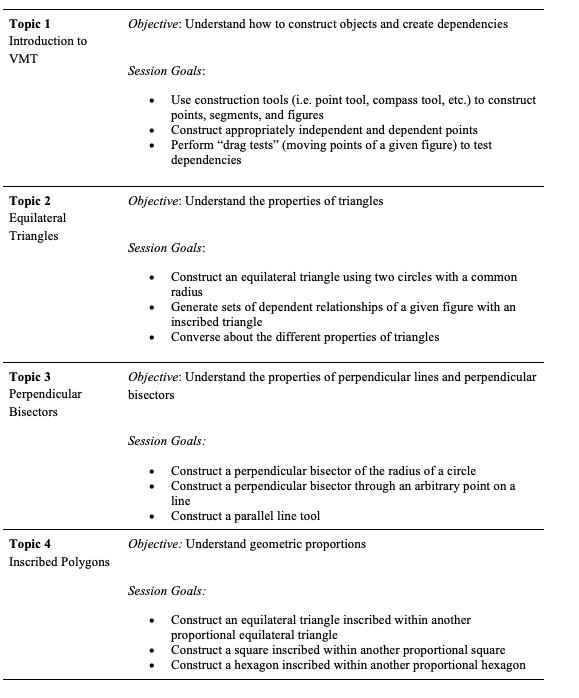
The VMT environment is an online, multi-user version of GeoGebra that includes a shared workspace and a chat tool to the side of the screen (see Figure 1). Each group of students worked in a separate VMT room. Group members communicated with each other through the chat, which allowed them to type and submit messages that were displayed to all of them. Only one student was able to interact with the shared space at a time, and did so by clicking on a “take control” button. While one student was "in control" others made suggestions through the chat. The same groups of students worked together on each of the four sessions of geometry topics (see Table 1). The first three sessions each lasted for an hour. During the fourth session, the students worked for more than two hours, mid-way through the session, they took a break. The problems on which the students worked and the instructions were the same for each group in each session, and prompted student use of the chat to discuss their work.
The problems for each of the sessions were rich, open-ended geometry problems that were specifically designed to scaffold support for developing skills in “collaborative and mathematical discourse, exploring dependencies, geometric construction, analytic explanation and domain content” (p. 163, Stahl, 2013). Problem content for each session was distinct and was anchored in the preliminary standards for high-school geometry described in the Common Core State Standards Initiative (2011). Thus, the students were asked to engage in working with alternate representations and dependencies, including congruence, symmetry, and rigid transformations. Problems for each session were sequenced to support the students’ developing levels of skill for understanding and working with proof, consistent with the van Hiele levels for geometric reasoning (see deVilliers, 2003, as cited in Stahl, 2013). Problems first focused the students on noticing and wondering (Ray-Riek, 2013), and followed this with encouragement to describe what they were doing and their justification for this in their chat-based explanations of their work.
2.4.1 Math moments
Math moments refer to chunks of related and sequential mathematics activity during open-ended problem solving. In the present study, identifying the moments when students were working with mathematics (as opposed to socializing or asking procedural questions) during each session of problem solving provided the context for studying the student groups’ cognitive and behavioral engagement during phases of problem solving. As such, math moments were not identified based on screen or tab in this VMT context. Rather, the group members set the direction of the math moments that they engaged, and we aggregated these based on the group members’ steps in their discovery process as they worked on the open-ended problem solving of each session. Thus, while the sessions of problem solving were comparable to each other in the opportunities they afforded, individual math moments might not be due to their having different foci, lengths, etc. For this reason, we aggregated these data for analyses at the session level.
Math moments were consensually identified by two researchers for each group (Hill, 2012; see Tables 2 and 3 for a description of the content and duration of the math moments engaged by each group’ across sessions). Most of the moments for each session for each group were math moments. While it was expected that the groups would vary in their work with each of the problems, the math moments identified for each included similar content (e.g., constructing an equilateral triangle, or discussing the meaning of constrained points), and/or often reflected the prompts that the problem provided. The consensual reliability check was employed to ensure that a consistent set of considerations informed the identification of math moments for each group, and between groups (e.g., the decision that multiple attempts at the same construction were described as multiple moments).
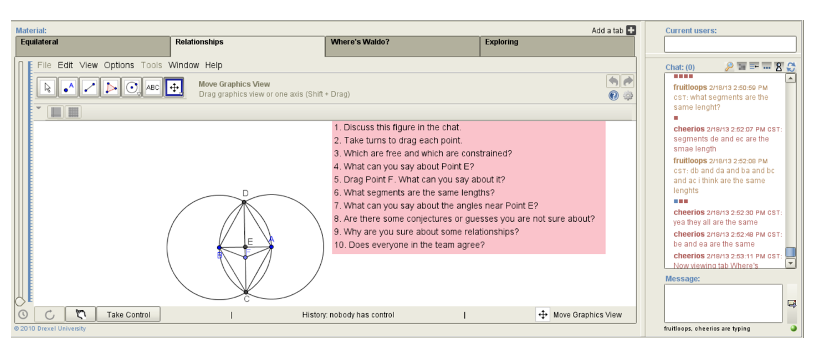
Figure 1. screenshot of VMT Activity.
Note. The screenshot is of Topic 2, Equilateral
Triangles.
Table 1
Session Topic Descriptions
2.4.2 Phases of problem solving
As described in Table 4, three phases of problem solving may characterize math moments: Exploring, Constructing, or Checking (e.g., Polya, 1945; Salminen-Saari et al., 2021; Schoenfeld, 1992/2016; Stahl, 2013). Although more formal conceptualizations of problem solving may point to these phases occurring sequentially, as Stahl (2013) noted, groups working with problems in VMT sessions may engage in these phases in any order. For example, a group may enter the Constructing phase and begin to construct figures before the group has had a chance to explore the problem, or the group may skip the Checking phase entirely after they have completed their constructions. Two researchers coded the phases of problem solving associated with each math moment, following which an independent researcher coded 20% of the data drawn at random and conducted a reliability check; reliability was substantial, k= .67 (Landis & Koch, 1977).
2.4.3 EFP
Group members' EFP were coded at the individual student level for each math moment. All students were coded for categories of behaviors associated with Inhibitory Control, Working Memory, and Cognitive Flexibility (see Table 5). As shown in Table 5, the coding rubric for assessing each EFP was derived from the existing literature on the relevant EF and consisted of multiple items. By definition, the coding of EFP involved (a) reviewing the students’ process during problem solving, (b) required identifying the opportunities to use EFP created by the group and afforded by the activity's design, and was followed by (c) consideration of to what extent individuals took advantage of opportunities.
Coding of EFP was undertaken in three steps. First, two researchers reviewed each group’s work using the replayer focusing on the identified math moments for the groups. Second, the researchers had an initial meeting to discuss and agree on opportunities that were identified for group participation (e.g., to code Working Memory, the researchers needed to agree about whether there is information that the students need to recall to complete a task). We only scored items describing behaviors for which students had opportunities to engage in. When students did not have an opportunity to use EFP, we coded this as nonapplicable.
Third, the researchers conducted an independent assessment of each student’s EFP during math moments using the questions described in Table 5. For each question, students were scored on a four-point scale consisting of the values 1 (fully exhibited described behaviors), 0.5 (had some but not all behaviors), -0.5 (had minimal number of associated behaviors), and -1 (did not exhibit the behaviors). Scores ranged from -1 to 1, with a 1 indicating that the student took full advantage of the opportunities afforded in that moment to exhibit a given EF, and a -1 indicating that a participant took no advantage of those opportunities. As described above, an exception was made for instances in which no opportunity was present (n/a). This affected Cognitive Flexibility scores the most, possibly because it is a higher order EF (Diamond & Ling, 2016) more than other EFP, leading to fewer moments in which Cognitive Flexibility was coded.
Finally, an average score for each type of EFP (Working Memory, Cognitive Flexibility, and Inhibitory Control) was calculated for each individual and for the group. The average EFP score was an aggregate of Working Memory, Cognitive Flexibility, and Inhibitory Control average scores for the individual and the group. Amount of each type of EFP was calculated for each student. To confirm reliability, two raters independently rated students’ use of EFP. All coding was established through discussion; scores were reviewed and revised following Hill (2012) until 100% agreement was achieved.
Table 2
Group 1’s Math Moment Content and Duration, Sessions 1-4
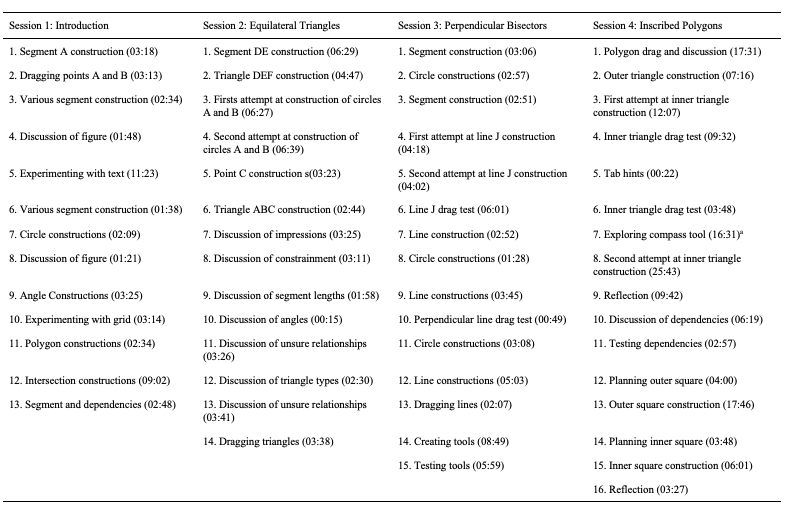
Note. Duration is reported in minutes and seconds based on time stamp. a Students took a break and then resumed work.
Table 3
Group 2’s Math Moment Content and Duration, Sessions 1-4
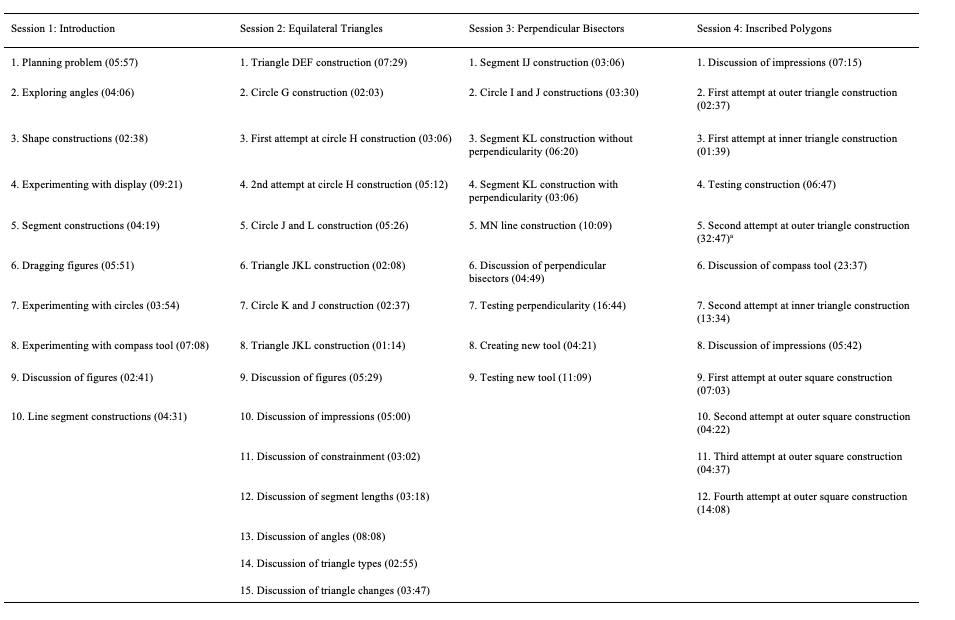
Note. Duration is reported in minutes and seconds based on time stamp.
a Students took a break and then resumed work
Table 4
Phases of Mathematical Problem Solving During Math Moments, Definitions and Examples
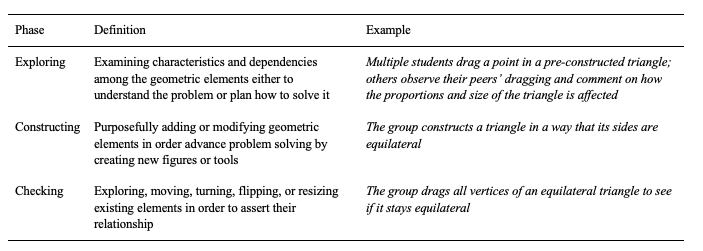
Note. Math moments may also include hybrids of the different phases of problem solving or discussion.
2.4.4 CPS
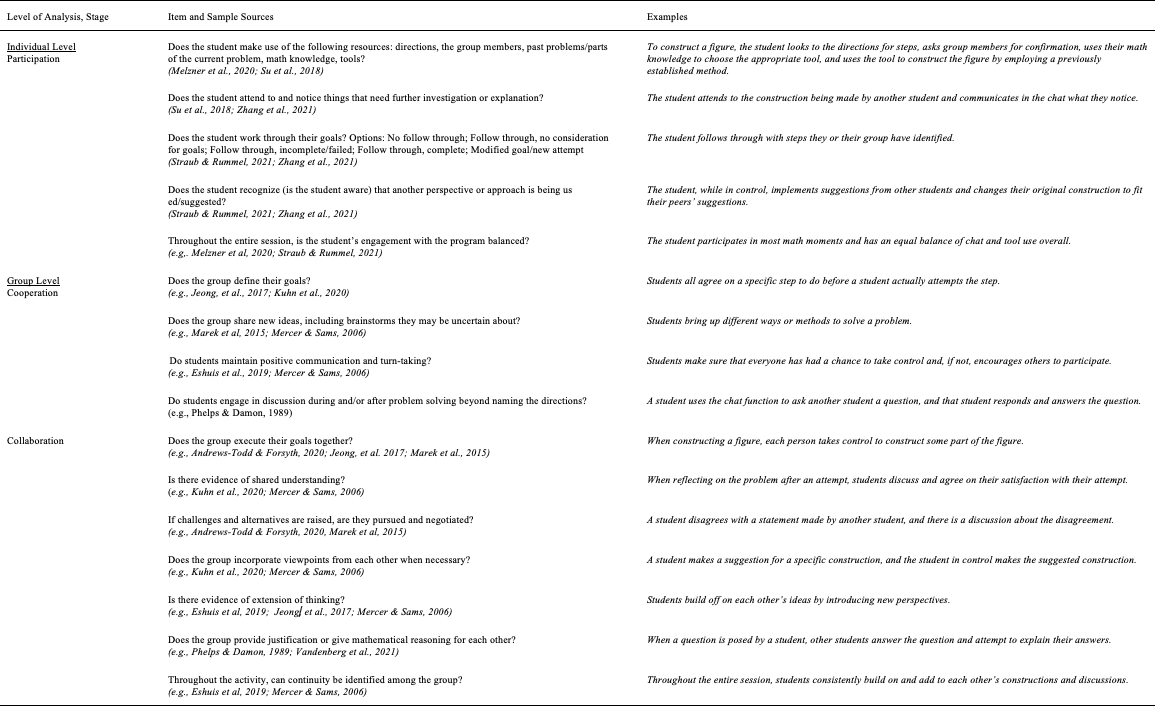
Group members’ CPS was coded using a three-step process that paralleled that described for coding and scoring EFP. CPS was coded at the individual level for behaviors associated with participation, and at the group level for behaviors associated with cooperation and collaboration (see Table 6). Although the groups were drawn for analysis based on differences in levels of collaboration, here we studied each stage of each group’s CPS to understand their collaboration during phases of problem solving, and in relation to EFP during phases of problem solving. As depicted in Table 6, the coding rubric for each stage of CPS was derived from the existing literature and included multiple items. Reliability of all coding was established through discussion; scores were reviewed and revised following Hill (2012) until 100% agreement was achieved.
Table 5
Rubric for Scoring Categories of Core Executive Functions in Practice (EFP)
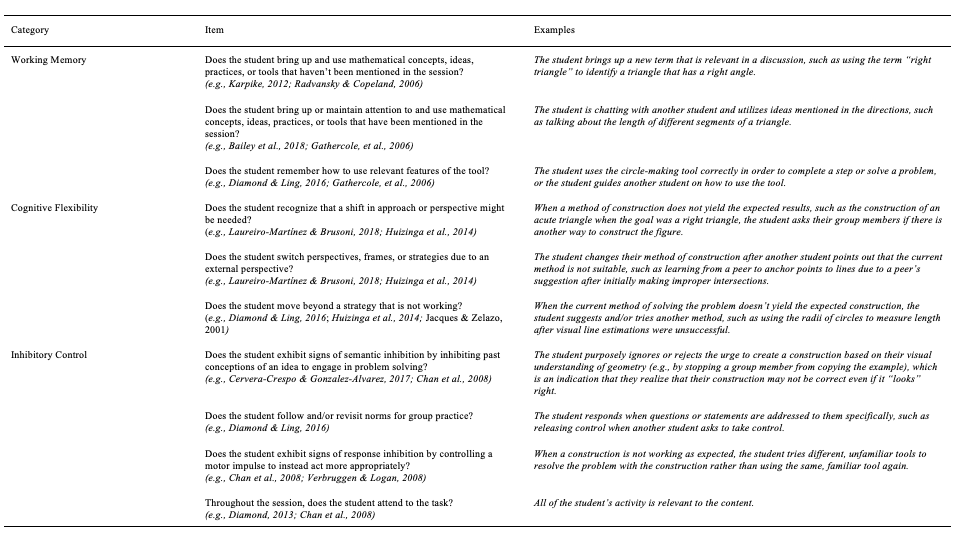
Table 6
Rubric for Scoring Stages of Collaborative Problem Solving (CPS)
Data analyzed for each group’s cognitive and behavioral engagement with each session of problem solving includes information about the students' activity in the shared workspace, as well as their written contributions in the chat. Observed information about student participation is reported first, followed by a description of analyses of the problem solving of each group. To answer RQ1, we first used Wald Z tests to compare the proportion of phases in each group’s total number of math moments. We used Wald Z to directly compare each proportion as some moments were coded in more than one phase. To consider the distribution of phases between sessions, bar graphs were developed to show patterns in the data.
In RQ2, we explored how each group engaged during math moments; we studied both their cognitive (EFP) and behavioral (CPS) engagement. We divided our analyses into three parts. The first set of analyses focused on the scores for aggregated sessions to observe general behavior. To understand the importance of each phase of problem solving on participants' engagement, we used bar graphs to compare EFP and CPS scores in each of the three phases.
For the second and third parts, we ran multivariable regression analyses. Each analysis had a particular EF (Average EFP, Working Memory, Inhibitory Control, or Cognitive Flexibility) or CPS (Participation, Cooperation, or Collaboration) indicator score, averaged across students in a group for each moment, as the outcome variable. In analyzing phases, comparison always assessed one phase against the other two phases. The initial model (Model 1) included the phase and the group as binary predictors, whereas Model 2 (when appropriate) also included a phase-group interaction term. We looked for statistically significant coefficients for the phase predictor, the group predictor, and the phase-group interaction predictor. A significant phase coefficient suggested that the outcome differed between moments in that phase compared to moments not in that phase. A significant group coefficient indicated that the two groups differed on that outcome on average. A significant phase-group interaction suggested that the effect of phase on that outcome differed between the two groups. Because the within-group correlations of observations may result in downwardly biased standard errors in an ordinary linear regression (Moulton, 1986), we employed sandwich estimators for the standard errors to correct for this possibility. We conducted one follow-up analysis on the effect of phase on Collaboration using just the Group 1 data, given that Group 2 was selected because they evidenced more collaborative behaviors than Group 1, to determine whether any particular phase had a more significant effect on this outcome. Finally, for the fourth part, we used line graphs to further consider change across sessions for each group’s EFP and CPS scores during each phase of problem solving. We looked for patterns of increase and/or decrease in each outcome across sessions. 3.
A total of 8-16 math moments were identified in each session of problem solving (see Tables 2 and 3; see Table 4 for an explanation and illustration of each phase of problem solving). Moments in which students were disengaged or were not actively working on problem solving (e.g., learning to use one of the VMT tools) were not analyzed. Although both groups worked for the same amount of time on each session, the number of math moments within problem solving sessions varied by group and by session, but not to a statistically significant degree.
We report and discuss results by research question.
We begin addressing RQ1 by overviewing findings from analyses of aggregated data from all four sessions and both groups. We examined the relative proportion of the three phases of problem solving, as well as the between-group differences in these proportions.
3.1.1 Overall findings
As shown in Figure 2, both groups spent most of their time constructing. Although we identified very few moments that included more than one phase of problem solving, these moments were counted in the analyses of all relevant phases.
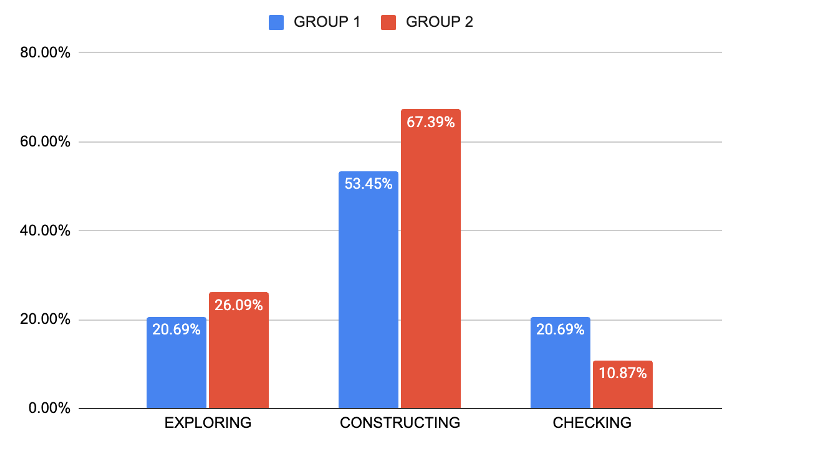
Figure 2. Relative Proportions of Phases of Problem
Solving
3.1.2 Between-group comparisons
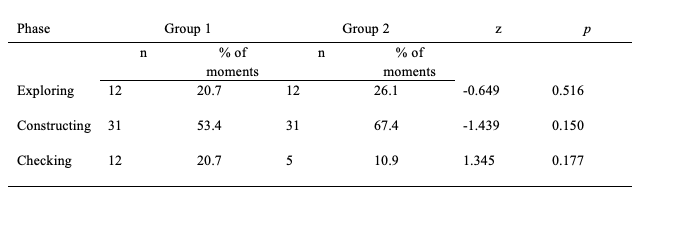
For both groups, we identified similar numbers of math moments corresponding to each phase of problem solving (see Table 7). As such, it appeared that across the two groups, the frequency of engagement in each phase of problem solving was approximately the same. In other words, phase and group were not interacting. We suggest, however, this does not necessarily mean that the two groups were engaged in problem solving in the same way. They could potentially vary in how they engaged and the strategies they employed, given that the groups were purposefully selected for study based on differences in their collaboration. We addressed this question in RQ2, by analyzing students’ EFP and CPS.
Table 7
Groups’ Math Moments by Phase
3.1.3 Analyses by session
Overall, for both groups, the relative proportions of all phases of problem solving fluctuated considerably (Figure 3). We included the data from the first session in our analyses as it was the students’ orientation to engaging with the VMT. Similar to Symonds et al.’s (2021) results, this meant that students' engagement in different sessions varied. We conjectured that this might also indicate that the phases engaged were influenced by the context (the topic, the prompts of the activity; opportunities created during the groups' engagement). Indeed, collaborative contexts have been found to offer learners support for engagement that enables the development of cognitive, as well as social skills (Romero-López et al., 2020; Sun et al., 2022).
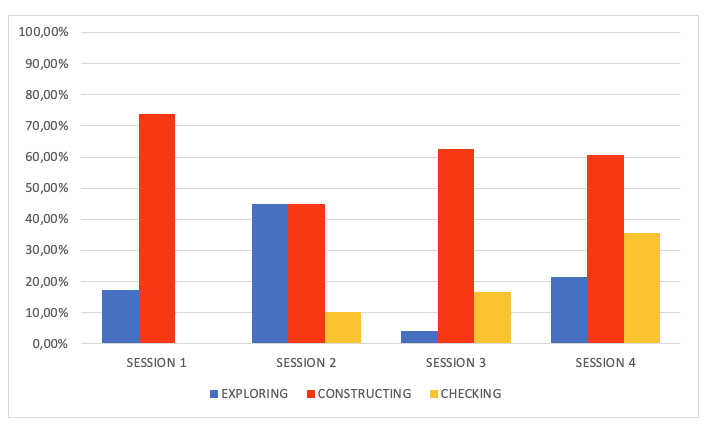
Figure 3.
Proportion of Phases in Each Session.
Having examined the frequencies of each group’s engagement in different phases of problem solving in RQ1, we then turned to considering how each of these phases related to students' cognitive and behavioral engagement both as individuals and as a group. RQ2 examined how Exploring, Constructing, and Checking were associated with participants' EFP and CPS scores. We began this investigation with analyses that used aggregated data from all sessions and both groups. An Average EFP score, representing the mean of the three EFP, was calculated. Then, both overall and across sessions, we addressed how each group engaged EFP and CPS during each phase of problem solving.
3.2.1 Phases
As shown in Figure 4, different patterns were identified in students’ EFP scores during each of the three phases of problem solving. We found that Average EFP, which combined the three categories of EFP, was highest during Exploring (0.85). The same pattern was true with each of the core EFP (Working Memory, Cognitive Flexibility, Inhibitory Control): scores were higher in moments of Exploring. Scores were similar during Constructing and Checking, but on average, as indicated by Average EFP, Constructing was associated with slightly higher average EFP than Checking, and specifically with higher Working Memory and Inhibitory Control than Checking. Nevertheless, Cognitive Flexibility was higher during Checking than during Constructing. We also observed that, across all phases, Working Memory was always the highest-scoring EFP. Inhibitory Control was the second highest overall, and Cognitive Flexibility was the lowest.
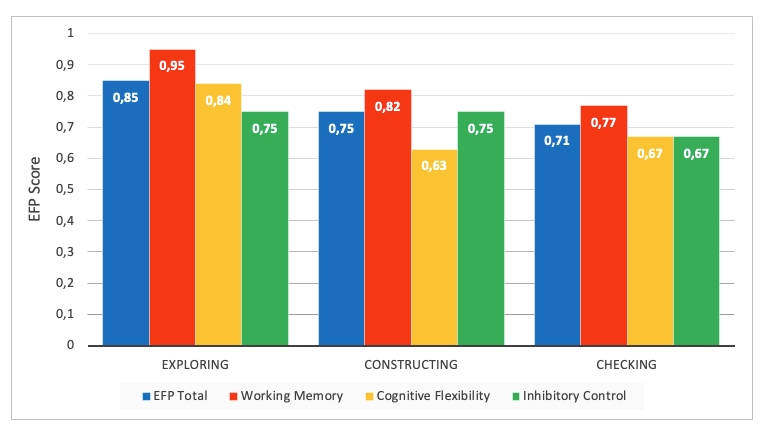
Figure 4.
EFP Scores by Phase of Problem Solving.
CPS scores also varied by phase, as shown in Figure 5. Overall, we observed that the three CPS scores were high and did not differ substantially during moments of Exploring; Collaboration – the most developed stage of CPS – was especially high in this phase. Math moments that included Exploring had the highest CPS scores; Exploring also was the phase in which the three stages of CPS were more balanced.
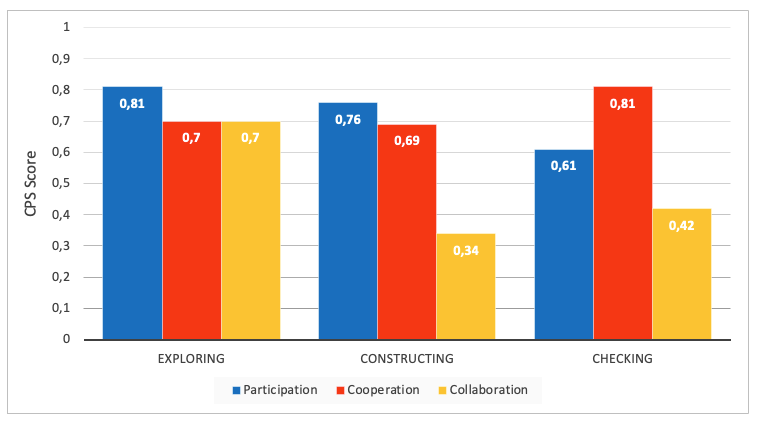
Figure 5.
CPS Scores by Phase of Problem Solving.
Analyses of each individual stage of CPS revealed additional patterns. Participation and Cooperation scores were relatively similar for each of the three phases of problem solving, whereas Collaboration was higher during Exploring and much lower during Construction and Checking. These results appeared to indicate that the phase of students’ Exploring afforded more opportunities for full behavioral engagement in CPS practices than either of the two other phases of problem solving.
3.2.2 Effect of phases
In the next analyses, we examined whether the differences observed were significant. We assessed the effect of phases on EFP and CPS using regression (Table 8). As shown in Table 8, moments of Exploring had significantly higher EFP and CPS than non-Exploring moments, specifically for the indicators of Average EFP, Working Memory, Participation, and Collaboration. These findings complemented the observations of the previous section, suggesting that EFP and CPS scores were highest in moments of Exploring.
Table 8
Regressions, Between Group Analyses, EFP and CPS
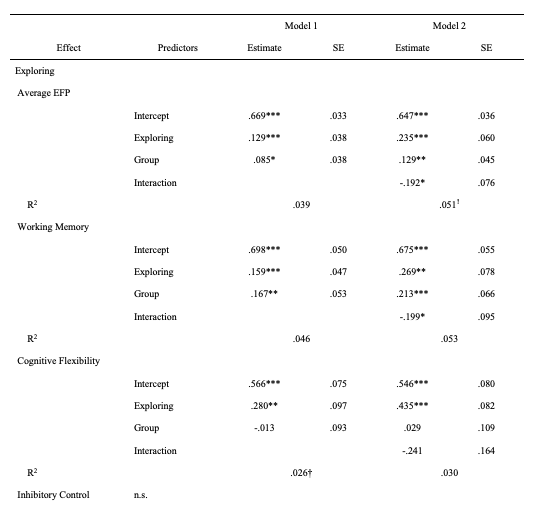
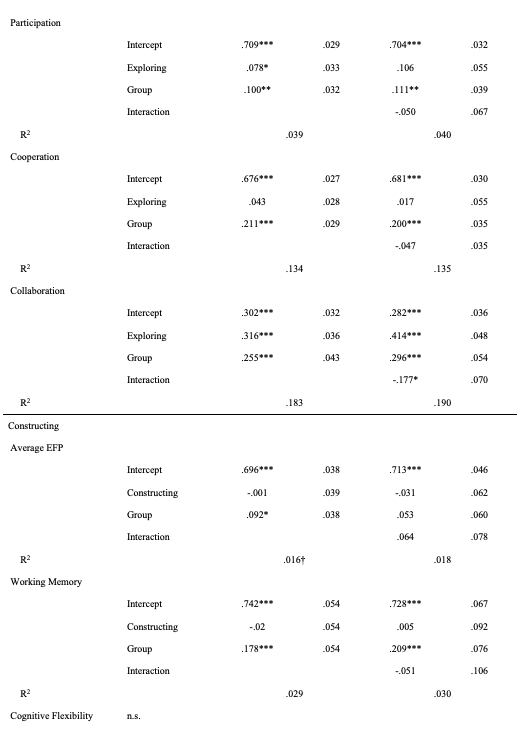
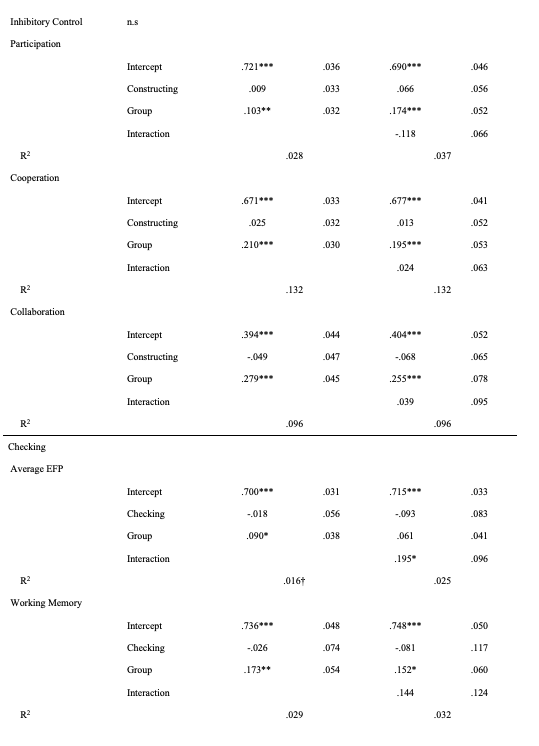
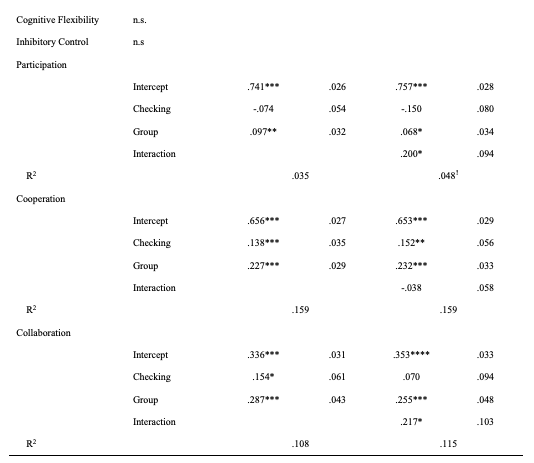
Note. We considered Model 2 only when the change in R2
was significant, denoted by ꜝ. SE = standard error. *** p <
.001; ** p < .01; * p < .05. All estimated coefficients are
unstandardized. In cases where Model 1 is not a significant
improvement over the null model (denoted by † in R2), but a
predictor significantly differs from 0, we include the model in
the table. n.s. indicates a model that does not significantly
differ from the null model and has no statistically significant
predictors.
We also found a group-phase interaction for the effect of Exploring on Average EFP. It appeared that because the Group-Exploring coefficient in Model 2 was negative, Exploring had less of an effect on Average EFP for Group 2 than Group 1. In fact, despite the positive Group coefficient in Model 2, Group 1 had higher Average EFP in moments of Exploring than Group 2. One possible explanation for this finding was that Group 2 just had consistently higher Average EFP, and we were seeing a ceiling effect. Regardless, the model results suggested that Exploring could have a strong and positive effect on Average EFP.
In contrast, we found that moments of Checking evidenced significantly higher CPS than non-Checking moments, specifically for Cooperation and Collaboration in Model 1. Interestingly, in Model 1 for Participation, Checking was not a significant predictor, although Group was. However, Model 2, which included the interaction term, was a significant improvement over Model 1; in that model, the Checking coefficient was significant and negative, whereas the Group-Checking interaction coefficient was significant and positive, and the Group coefficient was not significant. Model 2 suggests that both groups experienced similar levels of Participation in moments other than Checking, but Group 1 experienced less participation in Checking moments than Group 2. One possible explanation for this finding is that Group 2, which was selected for study because they evidenced stronger collaboration than Group 1, may have had broader Participation in moments of Checking, whereas Group 1 may have had uneven Participation in moments of Checking.
In summary, the presence of Exploring appears to strengthen students’ EFP and CPS scores, particularly Collaboration, more than other phases. This finding points to the possible benefit of the development of Collaborative skills and of having time and opportunities to explore. Another potential takeaway is related to the finding that Checking was an important predictor of CPS stages, but not EFP scores. This finding could suggest that moments of Checking bring students together to work either in parallel or in coordination. However, the Group-Checking interaction for Participation and the significant Group coefficients for Cooperation and Collaboration suggest that groups also may operate differently in moments of Checking.
3.2.3 Comparing groups' EFP and CPS across phases
For Average EFP, Working Memory, Participation, Cooperation, and Collaboration, we observed significant and positive Group coefficients across multiple phase models, suggesting that Group 2 scored consistently higher overall on these indicators than Group 1. In general, we did not observe significant phase-group interactions in the models, suggesting that both groups were affected equally by each phase. However, for two models, Average EFP in Exploring and Participation in Checking, we observed phase-group interactions, as discussed in the previous section. For these two indicators, we did not observe the same patterns or phase effects for both groups. Specifically, Exploring had a substantially larger effect on Average EFP for Group 1 compared to Group 2, whereas Checking had a negative effect on Participation for Group 1 and a small positive effect on Participation for Group 2.
3.2.4 Relative collaboration between phases
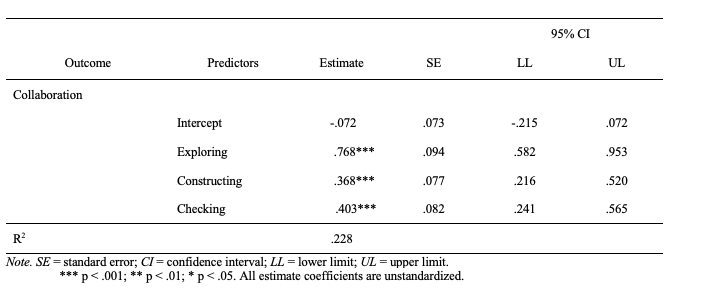
Recall that the key distinction between the two groups in our study was that Group 2 evidenced substantially higher collaboration than Group 1 overall. As stated above, both Exploring and Checking had significant effects on Collaboration scores. However, we were curious about the relative importance of phase on Collaboration, and, based on inspection of the data, we were concerned that a ceiling effect on Group 2’s Collaboration scores could obfuscate relationships by limiting the potential variance. Therefore, we conducted a regression analysis for Collaboration with just the Group 1 data and all three phases as predictors. In this model (Table 9), all three phases had statistically significant and positive coefficients. However, the 95% confidence interval for the Exploring coefficient did not overlap with the 95% confidence interval for the Constructing or Checking coefficient. We concluded that the Exploring phase was associated with significantly higher levels of Collaboration than either the Constructing or Checking phases for Group 1. Additionally, the R2 value for this model was .288, indicating that phases explained 28.8% of the variance in Group 1’s Collaboration scores.
Table 9
Regression, Group 1 Collaboration by Phase
3.2.5 Across sessions comparison
To further explore patterns of change, line graphs were employed to compare both groups' EFP and CPS scores over time (see Figures 6 and 7). Given the small number of sessions, we have limited ability to make conclusive statements explaining patterns. However, we could make a few observations based on the figures and our analysis of these data.
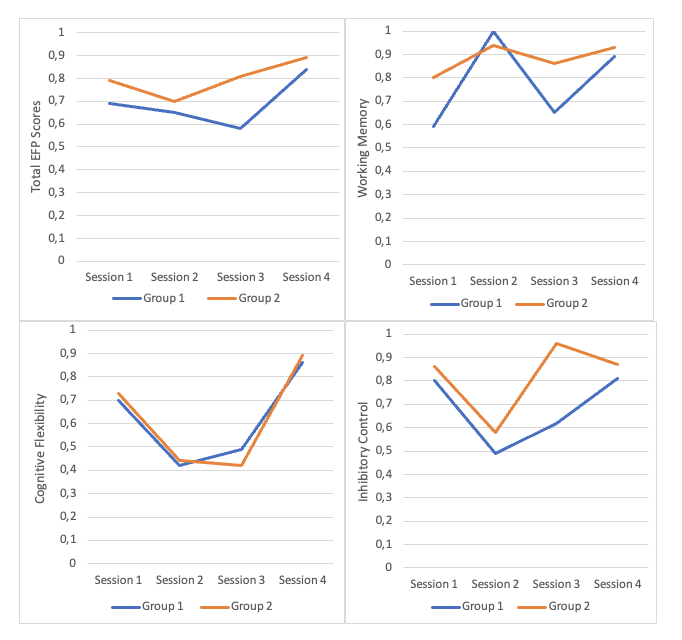
Figure 6.
Average EFP Scores Across Sessions for Group 1 and Group 2.
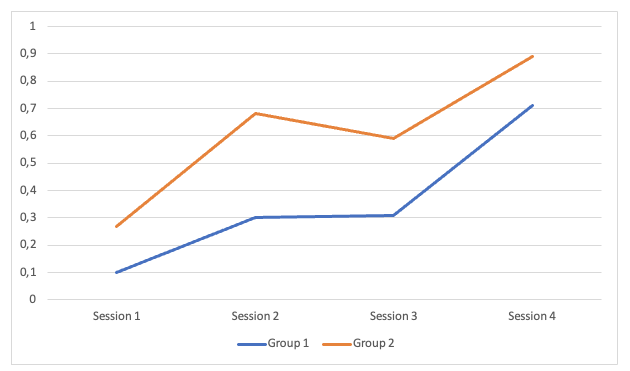
Figure 7.
Average Collaboration Scores of Group 1 and Group 2 During
Constructing Moments for Four VMT Sessions.
We first note that the two groups differed in Exploring and Checking by session. Group 1 had no moments of Exploring in sessions 3 and 4, while Group 2 engaged in this phase in all sessions. No group engaged in Checking in session 1, and Group 1 engaged in Checking in session 2, but not Group 2, and both groups engaged in similar amounts of Checking in sessions 3 and 4. In what follows, we focus on Constructing, as it was not only the most common phase but also the only phase in which both groups were involved across all four sessions.
As shown in Figure 6, during Constructing moments, the EFP scores of both groups followed similar patterns of change across sessions, although the scores of Group 2 in each session were generally higher than those of Group 1. We also note that the two groups generally followed similar patterns of change in their EFP and that none of the observed patterns are linear, nor do they show a clear increase or decrease over time; both groups' EFP fluctuated from session to session.
Review of the line graphs for each of the stages of CPS during Constructing moments showed similar patterns of change; Figure 7 provides an example for Collaboration. As expected, Collaboration scores were consistently higher for Group 2 than for Group 1. We call attention to the similarity of the groups' patterns of engagement and increases in their Collaboration scores over time. These results suggest that, with time, the groups were becoming more collaborative.
This analysis does not differentiate between the effect of time and the effect of mathematical topic. Each group engaged in the problem solving sessions in the same order, so time and topic were confounded. Therefore, it was not possible to determine whether the findings were a function of change over time or characteristics specific to each session. While spending time working together may progressively increase students’ EFP and CPS, the groups may also be influenced by the opportunities provided by the design of each activity. The fact that we saw similar patterns of variation may suggest that there was some shared feature or structure of the activity that was guiding the students’ behavior. 4.
We undertook this study to consider the process of middle school students’ momentary engagement during phases of collaborative mathematical problem solving. Although students have been repeatedly found to enjoy and benefit from opportunities to work together on problem solving (e.g., Featherstone et al., 2011; Webb et al., 2019), van Leeuwen and Janssen’s (2019) review of collaborative activity and learning showed that collaboration does not always result in learning and can be difficult to facilitate. In our study design, we sought insight that could inform teachers about the cognitive and behavioral engagement of students’ online collaborative mathematics activity, and purposefully examined moments during which the students were engaged in mathematics. We selected for study two groups of students who in prior study had been identified as having high levels of interest in working collaboratively online with mathematics problems—students in both groups were continuously engaged in working with their peers on math across the four sessions of problem solving. Studying interested youth enabled us to explore the potential for middle-schoolers’ productive engagement during the math moments of their work together. Furthermore, because we studied students’ online collaboration in the VMT environment, we were able to examine their moment-to-moment work in the workspace, as well as their interactions in the chat, which allowed study of fluctuations that differs from those possible had our analyses focused on the outcomes of cognitive or behavioral engagement, face-to-face, or even using video footage.
From RQ1, we learned that Constructing was the most frequently engaged phase of problem solving compared to the other phases of problem solving. However, RQ 2 showed that Exploring was associated with higher EFP and CPS scores, providing corroboration for Boaler and Selling’s (2017) results and suggesting that students who were encouraged to explore use of strategies in their work with mathematics developed deeper understanding, as well as positive feelings, compared to students who did not receive the same support. We also noted that scores for Collaboration in particular were higher when the math moments involved Exploring.
While findings from RQ 1 suggested that the frequency of the cognitive and behavioral engagement for each group in each phase of problem solving was approximately the same, we learned from RQ 2 that how the groups engaged the phases varied. Given that we selected these two groups for study because the students had been identified as interested in the collaborative math sessions, it is not surprising that our results indicated that in all phases of problem solving, across all sessions, students in both groups maintained high and continuous levels of Participation (Renninger & Hidi, 2016). That the two groups also differed in their level of Collaboration was expected because they were selected for study based on this information. However, Group 2 also consistently scored higher than Group 1 in Cooperation in all phases of problem solving.
Although prior study has shown that collaboration develops through working with others on problem solving (Bonotto 2005; Gerson, 2008; Kelton et al., 2018; Stahl, 2013), and its importance for the development of EF has been noted (Pollastri et al., 2013), we did not know how the processes associated with EFP might unfold. Our results showed that this effect most likely originates from higher EFP engagement during Exploring. Moreover, our findings related to the stage of Collaboration are particularly interesting. In each phase of problem solving, both groups of students had similar patterns of increase in their Collaboration scores across the problem solving sessions. Thus, although Group 2 was more collaborative in general, and we do not know how details of each task affected collaboration behaviors per se, we also saw that both groups became more collaborative the more they worked together. These results are consistent with literature showing how groups become better at collaborating over time as they start to share mental models that make them more efficient and effective even when problems demand higher mental power (van den Bossche, et al., 2011; Zambrano, et al., 2019).
We also observed that despite differences in the EFP and CPS scores of the two groups, their scores fluctuated in similar ways across sessions during moments of Constructing. This finding leads us to wonder if there is some shared feature or structure of the problems (e.g., prompts for discussion, mathematics topic) that was guiding the groups’ behaviors (see Lieber & Graulich, 2020), as both groups of students received the same instructions and tasks in each problem-solving session.
Our findings contribute to discussions of momentary engagement as both situation specific (e.g. Nolen et al., 2015; Symonds et al., 2021) and complex (Dietrich, et al., 2022); they also provide an extension of the existing literature. Focused study of the process of two groups of interested middle school students’ engagement during the math moments of their phases of their problem solving reveals relatively similar fluctuations and also highlights differences in how they are engaging. Study of the students’ use of EFP and stages of CPS, moreover, provides insight into what might be expected of students at this age as they engage in group work that involves open-ended problem solving. These results confirm that the collaborative context of group work promotes attention to the task (e.g., Hmelo-Silver et al., 2018; Pohl, 2020), enhances reasoning (e.g., Barron, 2003), and promotes use of working memory (e.g., Kirschner et al., 2018); they also underscore the importance of considering how students are engaging in this context. In addition, our findings suggest the potentially essential contribution of task features such as prompts to discuss math in mediating student cognitive and behavioral engagement.
These data show that students vary in their cognitive and behavioral engagement in different phases of problem solving. They further point to the benefit of student group engagement in the phase of Exploring, in particular, as Exploring was associated with increased use of Working Memory and Collaboration. Our results also suggest that students may need support to collaborate during moments that include Constructing and Checking. As such, it may be critical to support teachers to attend to what a group is doing moment to moment, and specifically to variations in students’ behavior during different phases of problem solving.
Future study with additional student groups, who vary in their level of interest in mathematics, as well as by age, and for whom demographic information is available is clearly warranted. Moreover, while for present purposes we aggregated study of moments of collaboration, a more qualitative exploration would provide a rich description of the context from which collaboration emerges. In addition to systematically examining the role of task features as determinants of fluctuations in momentary engagement during collaborative problem solving, we also suggest the utility for practitioners of additional analyses of the components of each EFP as well as those of each stage of CPS (represented by the questions used for assessment in our coding scheme rubric). Analyses such as these would provide additional detail and insight about which behaviors account for and are contributing to how student groups are engaging in problem solving.
The authors gratefully acknowledge Jane Huynh’s editorial assistance in preparing this manuscript for publication. We also are most appreciative of support for our collaboration from an EARLI (European Association of Research on Learning and Instruction) Emerging Field Group Grant and the Jacobs Foundation, awarded to Jennifer Symonds and Ricardo Böheim, as well funding for project research from the EF+Math Program of the Advanced Education Research and Development Fund (AERDF) to K. Ann Renninger. Opinions expressed in this article are those of the authors and do not necessarily represent views of the EF+Math Program or AERDF.
Andrews-Todd, J., & Forsyth, C. M. (2020). Exploring social
and cognitive dimensions of collaborative problem solving in an
open online simulation-based task. Computers in Human
Behavior, 104, 105759.
https://doi.org/10.1016/j.chb.2018.10.025
Bailey, B. A., Andrzejewski, S. K., Greif, S. M., Svingos, A. M.,
& Heaton, S. C. (2018). The role of executive functioning and
academic achievement in the academic self-concept of children and
adolescents referred for neuropsychological assessment. Children,
5(7), 83. https://doi.org/10.3390/children5070083
Barron, B. (2003). When smart groups fail. The Journal of
the Learning Sciences, 12 (3), 307–359.
https://doi.org/10.1207/S15327809JLS1203_1
Bishara, S., & Kaplan, S. (2022). Inhibitory control,
self-efficacy, and mathematics achievements in students with
learning disabilities. International Journal of Disability,
Development, and Education, 69 (3), 868–887.
https://doi.org/10.1080/1034912X.2021.1925878
Boaler, J., & Selling, S. K. (2017). Psychological
imprisonment or intellectual freedom? A longitudinal study of
contrasting school mathematics approaches and their impact on
adults' lives. Journal for Research in Mathematics
Education, 48 (1), 78–105.
https://doi.org/10.5951/jresematheduc.48.1.0078
Bonotto, C. (2005). How informal out-of-school mathematics can
help students make sense of formal in-school mathematics: The case
of multiplying by decimal numbers. Mathematical Thinking and
Learning, 7 (4), 313–344.
https://doi.org/10.1207/s15327833mtl0704_3
Brookman-Byrne, A., Mareschal, D., Tolmie, A. K., &
Dumontheil, I. (2018). Inhibitory control and counterintuitive
science and maths reasoning in adolescence. PLoS One, 13(6),
e0198973-e0198973. https://doi.org/10.1371/journal.pone.0198973
Caviola, S., Colling, L. J., Mammarella, I. C., & Szűcs, D.
(2020). Predictors of mathematics in primary school: Magnitude
comparison, verbal and spatial working memory measures. Developmental
Science, 23(6), e12957. https://doi.org/10.1111/desc.12957
Cervera-Crespo, T., & González-Alvarez, J. (2017). Age and
semantic inhibition measured by the Hayling Task: A meta-analysis.
Archives of Clinical Neuropsychology, 32 (2), 198–214.
https://doi.org/10.1093/arclin/acw088
Chan, R. C., Shum, D., Toulopoulou, T., & Chen, E. Y. (2008).
Assessment of executive functions: Review of instruments and
identification of critical issues. Archives of Clinical
Neuropsychology, 23(2), 201–216.
https://doi.org/10.1016/j.acn.2007.08.010
Clark, C. A., Pritchard, V. E., & Woodward, L. J. (2010).
Preschool executive functioning abilities predict early
mathematics achievement. Developmental Psychology, 46(5),
1176–1191. https://doi.org/10.1037/a0019672
Common Core State Standards Initiative (CCSSI) (2011). High
school-- geometry. Common core state standards for mathematics,
https://www.thecorestandards.org/Math/Content/HSG/
Cook, C. R., Thayer, A. J., Fiat, A., & Sullivan, M. (2020).
Interventions to enhance affective engagement. In A. L. Reschly,
A. J. Pohl, & S. L. Christenson (Eds.), Student
engagement: Effective academic, behavioral, cognitive, and
affective interventions at school (pp. 203–237). Springer
Cham. https://doi.org/10.1007/978-3-030-37285-9_12
Cragg, L., & Gilmore, C. (2014). Skills underlying
mathematics: The role of executive function in the development of
mathematics proficiency. Trends in Neuroscience and
Education, 3(2), 63–68.
https://doi.org/10.1016/j.tine.2013.12.00
deVilliers, M. (2003). Rethinking proof with the Geometer’s
Sketchpad . Emeryville, CA: Key Curriculum Press.
Diamond, A. (2013). Executive functions. Annual Review of
Psychology, 64 , 135–168.
https://doi.org/10.1146/annurev-psych-113011-143750
Diamond, A., & Ling, D. S. (2016). Conclusions about
interventions, programs, and approaches for improving executive
functions that appear justified and those that, despite much hype,
do not. Developmental Cognitive Neuroscience, 18,
34–48. https://doi.org/10.1016/j.dcn.2015.11.005
Dietrich, J., Schmiedek, F., & Moeller, J. (2022). Academic
motivation and emotions are experienced in learning situations, so
let’s study them. Introduction to the special issue. Learning
and Instruction, 81, 101623.
https://doi.org/10.1016/j.learninstruc.2022.101623
Dong, A., Jong, M. S. Y., & King, R. B. (2020). How does prior
knowledge influence learning engagement? The mediating roles of
cognitive load and help-seeking. Frontiers in Psychology, 11,
591203-591203. https://doi.org/10.3389/fpsyg.2020.591203
Eshuis, E. H., ter Vrugte, J., Anjewierden, A., Bollen, L.,
Sikken, J., & de Jong, T. (2019). Improving the quality of
vocational students’ collaboration and knowledge acquisition
through instruction and joint reflection. International
Journal of Computer-Supported Collaborative Learning, 14
, 53–76. https://doi.org/10.1007/s11412-019-09296-0
Featherstone, H., Crespo, S., Jilk, L. M., Oslund, J. A., Parks,
A. N., & Wood, M. B. (2011). Smarter together!
Collaboration and equity in the elementary math classroom.
National Council of Teachers of Mathematics.
Fredricks, J. A., & McColskey, W. (2012). The measurement of
student engagement: A comparative analysis of various methods and
student self-report instruments. In S. L. Christenson, A. L.
Reschly, & C. Wylie (Eds.), Handbook of research on
student engagement (pp. 763–782). Springer.
https://doi.org/10.1007/978-1-4614-2018-7_37
Fredricks, J. A., Blumenfeld, P. C., & Paris, A. H. (2004).
School engagement: Potential of the concept, state of the
evidence. Review of Educational Research, 74 (1),
59–109. https://doi.org/10.3102/00346543074001059
Gathercole, S. E., Lamont, E., & Alloway, T. P. (2006).
Working memory in the classroom. In S.J. Pickering (Ed.),
Working memory and education (pp. 219–240). Academic
Press. https://doi.org/10.1016/B978-012554465-8/50010-7
Gerson, H. (2008). David's understanding of functions and
periodicity. School Science and Mathematics, 108(1),
28–8. https://doi.org/10.1111/j.1949-8594.2008.tb17937.x
Hadwin, A. F., Järvelä, S., & Miller, M. (2011).
Self-regulated, co-regulated, and socially shared regulation of
learning. In B. J. Zimmerman, & D. H. Schunk (Eds.),
Handbook of self-regulation of learning and performance
(pp. 65-84). Routledge.
Harel, G., & Sowder, L. (2005). Advanced mathematical thinking
at any age: Its nature and development. Mathematical
Thinking and Learning, 7 (1), 27–50.
https://doi.org/10.1207/s15327833mtl0701_3
Hill, C. E. (Ed.) (2012). Consensual qualitative research: A
practical resource for investigating social science phenomena
. American Psychological Association.
Hmelo-Silver, C. E., Kapur, M., & Hamstra, M. (2018). Learning
through problem solving. In F. Fischer, C. E. Hmelo-Silver, S. R.
Goldman, & P. Reimann (Eds.), International handbook of
the learning sciences (pp. 210–220). Routledge.
Huizinga, M., Smidts, D. P., & Ridderinkhof, K. R. (2014).
Change of mind: Cognitive flexibility in the classroom.
Perspectives on Language and Literacy, 40 (2), 31–35.
Jacques, S., & Zelazo, P. (2001). The Flexible Item Selection
Task (FIST): A measure of executive function in preschoolers.
Developmental Neuropsychology, 20 (3), 573–591.
https://doi.org/10.1207/875656401753549807
Jeong, H., Cress, U., Moskaliuk, J., & Kimmerle, J. (2017).
Joint interactions in large online knowledge communities: The A3C
framework. International Journal of Computer-Supported
Collaborative Learning, 12 , 133–151.
https://doi.org/10.1007/s11412-017-9256-8
Jose, R. G., Samuel, A. S., & Isabel, M. M. (2020).
Neuropsychology of executive functions in patients with focal
lesion in the prefrontal cortex: A systematic review. Brain
and Cognition, 146, 105633.
https://doi.org/10.1016/j.bandc.2020.105633
Karpicke, J. D. (2012). Retrieval-based learning: Active retrieval
promotes meaningful learning. Current Directions in
Psychological Science, 21 (3), 157–163.
https://doi.org/10.1007/s10648-012-9202-2
Kasmer, L., & Kim, O. K. (2011). Using prediction to promote
mathematical understanding and reasoning. School Science and
Mathematics, 111 (1), 20–33.
https://doi.org/10.1111/j.1949-8594.2010.00056.x
Kelton, M. L., Ma, J. Y., Rawlings, C., Rhodehamel, B., Saraniero,
P., & Nemirovsky, R. (2018). Family meshworks: Children’s
geographies and collective ambulatory sense-making in an immersive
mathematics exhibition. Children's Geographies, 16(5),
543–557. https://doi.org/10.1080/14733285.2018.1495314
Kirschner, P. A., Sweller, J., Kirschner, F., & Zambrano, J.
R. (2018). From Cognitive Load Theory to Collaborative Cognitive
Load Theory. International Journal of Computer-Supported
Collaborative Learning, 13 (2), 213–233.
https://doi.org/10.1007/s11412-018-9277-y
Kuhn, D., Capon, N., & Lai, H. (2020). Talking about group
(but not individual) process aids group performance.
International Journal of Computer-Supported Collaborative
Learning, 15 (2), 179–192.
https://doi.org/10.1007/s11412-020-09321-7
Landis, J. R., & Koch, G. G. (1977) The measurement of
observer agreement for categorical data. Biometrics, 33(1),
159–174. https://doi.org/10.2307/2529310
Laureiro‐Martínez, D., & Brusoni, S. (2018). Cognitive
flexibility and adaptive decision‐making: Evidence from a
laboratory study of expert decision makers. Strategic
Management Journal, 39(4), 1031–1058.
https://doi.org/10.1002/smj.2774
Lee, K., Ng, E. L., & Ng, S. F. (2009). The contributions of
working memory and executive functioning to problem representation
and solution generation in algebraic word problems. Journal
of Educational Psychology, 101 (2), 373–387.
https://doi.org/10.1037/a0013843
Letang, M., Citron, P., Garbarg‐Chenon, J., Houdé, O., &
Borst, G. (2021). Bridging the gap between the lab and the
classroom: An online citizen scientific research project with
teachers aiming at improving inhibitory control of school‐age
children. Mind, Brain and Education, 15 (1), 122–128.
https://doi.org/10.1111/mbe.12272
Lieber, L., & Graulich, N. (2020). Thinking in alternatives–A
task design for challenging students’ problem-solving approaches
in organic chemistry. Journal of Chemical Education, 97(10),
3731–3738. https://doi.org/10.1021/acs.jchemed.0c00248
Long, B., Spencer-Smith, M. M., Jacobs, R., Mackay, M., Leventer,
R., Barnes, C., & Anderson, V. (2011). Executive function
following child stroke: The impact of lesion location.
Journal of Child Neurology, 26 (3), 279-287.
https://doi.org/10.1177/0883073810380049
Mann, T. D., Hund, A. M., Hesson‐McInnis, M. S., & Roman, Z.
J. (2017). Pathways to school readiness: Executive functioning
predicts academic and social–emotional aspects of school
readiness. Mind, Brain, and Education, 11 (1), 21–31.
https://doi.org/10.1111/mbe.12134
Marek, L. I., Brock, D.-J. P., & Savla, J. (2015). Evaluating
collaboration for effectiveness: Conceptualization and
measurement. The American Journal of Evaluation, 36
(1), 67–85. https://doi.org/10.1177/1098214014531068
McCoy, D. C. (2019). Measuring young children’s executive function
and self-regulation in classrooms and other real-world settings.
Clinical Child and Family Psychology Review, 22 (1),
63–74. https://doi.org/10.1007/s10567-019-00285-1
Melzner, N., Greisel, M., Dresel, M., & Kollar, I. (2020).
Regulating self-organized collaborative learning: The importance
of homogeneous problem perception, immediacy and intensity of
strategy use. International Journal of Computer-Supported
Collaborative Learning, 15 (2), 149–177.
https://doi.org/10.1007/s11412-020-09323-5
Mercer, N., & Sams, C. (2006). Teaching children how to use
language to solve maths problems. Language and Education, 20(6),
507–528. https://doi.org/10.2167/le678.0
Mohammadhasani, N., & Asadi, S. (2020). The investigation of
the effect of computer supported collaborative learning (CSCL)
environment and dynamic mathematics software on trigonometric
problem solving skill. Technology of Education Journal, 14
(4), 867–875. https://doi.org/10.22061/tej.2020.5964.2312
Moulton, B. R. (1986). Random group effects and the precision of
regression estimates. Journal of Econometrics, 32(3),
385–397. https://doi.org/10.1016/0304-4076(86)90021-7
Nolen, S. B. (2020). A situative turn in the conversation on
motivation theories. Contemporary Educational Psychology, 61,
101866. https://doi.org/10.1016/j.cedpsych.2020.101866
Nolen, S. B., Horn, I. S., & Ward, C. J. (2015). Situating
motivation. Educational Psychologist, 50(3), 234–247.
https://doi.org/10.1080/00461520.2015.1075399
Peng, P., Namkung, J., Barnes, M., & Sun, C. (2016). A
meta-analysis of mathematics and working memory: Moderating
effects of working memory domain, type of mathematics skill, and
sample characteristics. Journal of Educational Psychology,
108 (4), 455–473. https://doi.org/10.1037/edu0000079
Phelps, E., & Damon, W. (1989). Problem solving with equals:
Peer collaboration as a context for learning mathematics and
spatial concepts. Journal of Educational Psychology, 81(4),
639–646. https://doi.org/10.1037/0022-0663.81.4.639
Pohl, A. J. (2020). Strategies and interventions for promoting
cognitive engagement. In A. L. Reschly, A. J. Pohl, & S. L.
Christenson (Eds.), Student engagement: Effective academic,
behavioral, cognitive, and affective interventions at school
(pp. 253-280). Springer Cham.
https://doi.org/10.1007/978-3-030-37285-9_14
Pollastri, A. R., Epstein, L. D., Heath, G. H., & Ablon, J. S.
(2013). The collaborative problem solving approach: Outcomes
across settings. Harvard Review of Psychiatry, 21
(4), 188–199. https://pubmed.ncbi.nlm.nih.gov/24651507/
Polya, G. (1945). How to solve it. Princeton University
Press.
Ponitz, C. C., McClelland, M. M., Matthews, J. S., & Morrison,
F. J. (2009). A structured observation of behavioral
self-regulation and its contribution to kindergarten outcomes.
Developmental Psychology, 45(3), 605–619.
https://doi.org/10.1037/a0015365
Radvansky, G. A., & Copeland, D. E. (2006). Memory retrieval
and interference: Working memory issues. Journal of Memory
and Language, 55 (1), 33–46.
https://doi.org/10.1016/j.jml.2006.02.001
Rau, M. A., & Matthews, P. G. (2017). How to make ‘more’
better? Principles for effective use of multiple representations
to enhance students’ learning about fractions. ZDM
Mathematics Education, 49, 531–544.
https://doi.org/10.1007/s11858-017-0846-8
Ray-Riek, M. (2013). Powerful problem solving: Activities
for sense-making with the mathematical practices .
Portsmouth, NH: Heineman.
Renningr, K. A., Corven, J., De Dios, M.C., Hogan, M. R., Kyaw,
M.H.,Michels, A.G., Nakayama, M., Werneck, H., & Yared, F.
(manuscript in preparation). Collaborative problem solving
and executive functions in middle-schoolers’ work in the Virtual
Math Teams environment .
Renninger, K. A., & Hidi, S. E. (2016). The power of
interest for motivation and engagement. Routledge.
Rogat, T., Hmelo-Silver, C., Cheng, B., Traynor, A., Adeoye, T.,
Gomoll, A., & Downing, B. (2022). A multidimensional framework
of collaborative groups’ disciplinary engagement. Frontline
Learning Research, 10(2), 1–21.
https://eric.ed.gov/?id=EJ1369028
Romero-López, M., Pichardo, M. C., Bembibre-Serrano, J., &
García-Berbén, T. (2020). Promoting social competence in preschool
with an executive functions program conducted by teachers.
Sustainability, 12 (11), 4408.
https://doi.org/10.3390/su12114408
Salmela‐Aro, K., Upadyaya, K., Cumsille, P., Lavonen, J., Avalos,
B., & Eccles, J. (2021). Momentary task-values and
expectations predict engagement in science among Finnish and
Chilean secondary school students. International Journal of
Psychology, 56(3), 415–424.
https://doi.org/10.1002/ijop.12719
Salminen-Saari J. F. A., Garcia Moreno-Esteva, E., Haataja, E.,
Toivanen, M., Hannula, M. S., & Laine, A. (2021). Phases of
collaborative mathematical problem solving and joint attention: A
case study utilizing mobile gaze tracking. ZDM Math
Education, 53(4), 771–784.
https://doi.org/10.1007/s11858-021-01280-z).
Sankaranarayanan, R., Kwon, K., & Cho, Y. (2021). Exploring
the differences between individuals and groups during the
problem-solving process: The collective working-memory effect and
the role of collaborative interactions. Journal of
Interactive Learning Research, 32(1), 43–66.
https://psycnet.apa.org/record/2021-80316-002
Schoenfeld, A. H. (1992). On paradigms and methods: What do you do
when the ones you know don't do what you want them to? Issues in
the analysis of data in the form of videotapes. The Journal
of the Learning Sciences, 2 (2), 179-214.
https://doi.org/10.1207/s15327809jls0202_3
Schoenfeld, A. H. (2016). Learning to think mathematically:
Problem solving, metacognition, and sense making in mathematics
(Reprint). Journal of Education, 196 (2), 1–38.
https://doi.org/10.1177/002205741619600202
Siegler, R. S. (1998). Emerging minds. Oxford University
Press.
Skaguerlund, K., Bolt, T., Nomi, J. S., Skagenholt, M., Västfjäll,
D., Träff, U., & Uddin, L. Q. (2019). Disentangling
mathematics from executive functions by investigating unique
functional connectivity patterns predictive of mathematics
ability. Journal of Cognitive Neuroscience, 31 (4),
560–573. https://doi.org/10.1162/jocn_a_01367
Skinner, E. A., & Pitzer, J. R. (2012). Developmental dynamics
of student engagement, coping, and everyday resilience. In S. L.
Christenson, A. L. Reschly, & C. Wylie (Eds.), Handbook
of research on student engagement (pp. 21-44). Springer.
https://doi.org/10.1007/978-1-4614-2018-7_2
Stahl, G. (2013). Translating Euclid: Designing a
human-centered mathematics . Springer Cham.
https://doi.org/10.1007/978-3-031-02200-5
Straub, S., & Rummel, N. (2021). Promoting regulation of equal
participation in online collaboration by combining a group
awareness tool and adaptive prompts. But does it even matter?
International Journal of Computer-Supported Collaborative
Learning, 16 (3), 67–104.
https://doi.org/10.1007/s11412-021-09340-y
Su, Y., Li, Y., Hu, H., & Rosé, C. P. (2018). Exploring
college English language learners’ self and social regulation of
learning during wiki-supported collaborative reading activities.
International Journal of Computer-Supported Collaborative
Learning, 13 (1), 35–60.
https://doi.org/10.1007/s11412-018-9269-y
Sun, J., Anderson, R. C., Lin, T. J., Morris, J. A., Miller, B.
W., Ma, S., Nguyen-Jaheil, K. T., & Scott, T. (2022).
Children’s engagement during collaborative learning and direct
instruction through the lens of participant structure. Contemporary
Educational Psychology, 69, 102061.
https://doi.org/10.1016/j.cedpsych.2022.102061
Swanson, H. L., & Beebe-Frankenberger, M. (2004). The
relationship between working memory and mathematical problem
solving in children at risk and not at risk for serious math
difficulties. Journal of Educational Psychology, 96
(3), 471–491. https://doi.org/10.1037/0022-0663.96.3.471
Symonds, J. E., Kaplan, A., Upadyaya, K., Salmela-Aro, K.,
Torsney, B., Skinner, E. & Eccles, J. S. (2021). Momentary
engagement as a complex dynamic system. PsyArXiv.
https://doi.org/10.31234/osf.io/fuy7p
Symonds, J. E., Schreiber, J. B., & Torsney, B. M. (2019).
Silver linings and storm clouds: Divergent profiles of student
momentary engagement emerge in response to the same task. Journal
of Educational Psychology, 113(6), 1192–1207.
https://doi.org/10.1037/edu0000605
van den Bossche, P., Gijselaers, W., Segers, M., Woltjer, G.,
& Kirschner, P. (2011). Team learning: Building shared mental
models. Instructional Science, 39 (3), 283–301.
https://doi.org/10.1007/s11251-010-9128-3
van Leeuwen, A., & Janssen, J. (2019). A systematic review of
teacher guidance during collaborative learning in primary and
secondary education. Educational Research Review, 27,
71-89. https://doi.org/10.1016/j.edurev.2019.02.001
Vandenberg, J., Zakaria, Z., Tsan, J., Iwanski, A., Lynch, C.,
Boyer, K. E., & Wiebe, E. (2021). Prompting collaborative and
exploratory discourse: An epistemic network analysis study.
International Journal of Computer-Supported Collaborative
Learning, 16 (3), 339–366.
https://doi.org/10.1007/s11412-021-09349-3
Veraksa, A., Bukhalenkova, D., & Almazova, O. (2020).
Executive functions and quality of classroom interactions in
kindergarten among 5-6-year-old children. Frontiers in
Psychology, 11, 603776–603776.
https://doi.org/10.3389/fpsyg.2020.603776
Verbruggen, F., & Logan, G. D. (2008). Automatic and
controlled response inhibition: Associative learning in the
go/no-go and stop-signal paradigms. Journal of Experimental
Psychology, 137(4), 649–672.
https://doi.org/10.1037/a0013170
Viterbori, P., Traverso, L., & Usai, M. C. (2017). The role of
executive function in arithmetic problem-solving processes: A
study of third graders. Journal of Cognition and Development,
18(5), 595–616.
https://doi.org/10.1080/15248372.2017.1392307
Webb, N. M., Franke, M. L., Ing, M., Turrou, A. C., Johnson, N.
C., & Zimmerman, J. (2019). Teacher practices that promote
productive dialogue and learning in mathematics classrooms.
International Journal of Educational Research, 97 ,
176–186. https://doi.org/10.1016/j.ijer.2017.07.009
Yeniad, N., Malda, M., Mesman, J., van IJzendoorn, M. H., &
Pieper, S. (2013). Shifting ability predicts math and reading
performance in children: A meta-analytical study. Learning
and Individual Differences, 23, 1-9.
https://doi.org/10.1016/j.lindif.2012.10.004
Younger, J., O'Laughlin, K., Anguera, J., Bunge, S., Ferrer, E.,
Hoeft, F. Mccandliss, B., Mishra, J., Rosenberg-Lee, M., Gazzaley,
A., & Uncapher, M. (2023). Better together: Novel methods for
measuring and modeling development of executive function diversity
while accounting for unity. Frontiers in Human Neuroscience,
17, https://doi.org/10.3389/fnhum.2023.1195013
Zambrano, J., Kirschner, F., Sweller, J., & Kirschner, P. A.
(2019). Effects of group experience and information distribution
on collaborative learning. Instructional Science, 47(5),
531–550. https://doi.org/10.1007/s11251-019-09495-0
Zhang, S., Chen, J., Wen, Y., Chen, H., Gao, Q., & Wang, Q.
(2021). Capturing regulatory patterns in online collaborative
learning: A network analytic approach. International Journal
of Computer-Supported Collaborative Learning, 16( 1),
37–66. https://doi.org/10.1007/s11412-021-09339-5