
Frontline Learning Research: Vol. 13 No. 2 (2025)
51 -66
Special Issue: Perspectives on Momentary Engagement and
Learning Situated in Classroom Contexts
ISSN 2295-3159
1University College London, IOE, UCL’s Faculty of
Education and Society, United Kingdom
2Technical University of Munich, School of Social
Sciences and Technology, Germany
3Shanghai Jiao Tong University, School of Education,
China
4University of Bern, Institute for Psychology,
Switzerland
5Universität Augsburg, Lehrstuhl für Psychologie,
Germany
6University of Klagenfurt, Institute for Teaching and
School Development, Austria
7University College Dublin, School of Education,
Dublin, Ireland
Article received 29 January 2024 / Article revised 12 October 2024 / Accepted 15 October 2024/ Available online 14 March 2025
This study used systematic observation to test the direct and moderating effects of class size on children’s momentary behavioural engagement in learning. Data were collected with 632 children (50.6% girls) in 121 classrooms in 92 schools recruited into the Children’s School Lives national cohort study of Irish primary schooling. The Observational and Research Classroom Learning Evaluation (ORACLE) systematic observation tool was used to observe individual children’s behaviour at 30-seconds intervals across a five-minute period in ordinary lessons of English, mathematics, science and Irish. Multilevel path models identified that behavioural engagement was higher in smaller classes and behavioural disengagement was higher in larger classes. Class size also moderated the impact of several individual differences and classroom composition factors on momentary behavioural engagement. For example, smaller classrooms protected lower ability children from disengaging whereas higher ability children were more likely to stay engaged in larger classes compared to lower ability children. Implications for research, practice and policy are discussed.
Keywords: Ability; class size; behavioural engagement; observation.
Children’s behavioural engagement in classrooms is a gateway to learning and achievement. More time spent on task allows individual children to acquire knowledge over a longer period, facilitating their academic performance (Bryce et al., 2019). Scoping research on student engagement has identified that most behavioural engagement measurements are student self-reports of how they tend to behave in academic environments. Very few studies have focused on engagement by observing how student behaviour proceeds across seconds and minutes in classroom settings (Salmela-Aro et al., 2021), a phenomena which we refer to as momentary behavioural engagement. Furthermore, studies that have observed momentary behavioural engagement tend to use samples which are fairly small and non-representative, due to the intensive resources required to observe individual children in class. These gaps in the evidence base have facilitated a lack of understanding of what children’s momentary behavioural engagement in classrooms looks like across a population of individuals.
Adding to the lack of information, there are few investigations of children’s engagement in learning in relation to classroom composition factors such as the average socioeconomic status of children in the classroom. This is because collecting data to achieve enough statistical power to test the impact of factors that vary at the classroom level is resource intensive. Even cohort studies that sample at the classroom or school level rarely recruit all children in the class, meaning that classroom composition factors are rarely able to be ascertained. Research that finds that gender, age, and cultural background impact student engagement at the individual level (Archambault et al., 2013; Chiu et al., 2012; Montroy et al., 2016). Therefore, classroom composition factors that could be important for engagement include the proportion of girls versus boys in the class, the average age of children in the classroom, and the proportion of migrant children in the class.
A further important classroom composition factor is class size, which can vary widely within education systems due to differences in local conditions (Hanushek & Woessmann, 2017). In their comprehensive review of class size research, Blatchford and Russell (2020) propose that class size impacts student engagement not directly, but through other aspects of classroom context and process. In their class size and process model, they propose that other classroom composition factors, such as the proportion of children with special educational needs in the classroom and the ability level of pupils in the classroom, shape children’s engagement in learning differentially according to class size. However, without any large-scale study to examine these assumptions, this part of the model has never been tested.
To address the lack of knowledge on children’s momentary behavioural engagement in a population and how it relates to individual and classroom composition factors, the current study collected systematic observation data with a national sample of children in 121 Irish primary classrooms. The novel contributions of the study are the first large-scale systematic observation of children’s behavioural engagement in Irish primary schools, and an empirical test of the moderating impact of classroom and individual factors on the relationship between class size and children’s momentary behavioural engagement.
Behavioural engagement refers to children’s participation, concentration, compliance, persistence, and perseverance in the task at hand (Skinner, 2016). When behavioural engagement is studied at a fine-grained level across seconds to minutes, this is referred to as momentary behavioural engagement (Symonds et al., 2021). Momentary behavioural engagement is conceptualised as part of a broader dynamic system of emotion, motivation, and cognition that converges into a state of dynamic stability when children are focused and engaged with their classwork (Symonds et al., 2021). The psychological processes underpinning behavioural engagement in classrooms include self-regulation of emotions, impulses, and motor skills, enabling children to manage and modulate their behaviour according to situational demands (e.g., Schunk & Zimmerman, 2023). Research shows that behavioural self-regulation skills are critical not only for a successful school transition but also for academic development (see, e.g., Rimm-Kaufman & Wanless, 2012). Positive relations between behavioural regulation have been reported for different academic domains such as literacy and language, mathematics, science, and information and communication technology (Edossa et al., 2018; Gestsdottir et al., 2014). Longitudinal research also suggests that behavioural regulation predicts academic growth in reading (e.g., Newman et al., 1998) and mathematical skills (e.g., Robinson & Mueller, 2014). Furthermore, the value to individual children of being able to regulate their behaviour in classrooms interlinks with the development of effective learning strategies, which in turn can positively influence their educational trajectories in childhood and adolescence (e.g., Matthews et al., 2009).
Multiple factors, such as age, gender, and migrant status and cognitive ability are found to affect children’s behavioural regulation and engagement at school. As children age, they tend to develop better self-regulation skills, for instance, executive functions and metacognitive skills notably develop between the ages of three and eight (Montroy et al., 2016; Roebers, 2017). Moreover, girls are typically more advanced in self-regulation skills than boys (Montroy et al., 2016) and are more engaged in the classroom (Archambault et al., 2013). Regarding migrant status, large-scale assessments in OECD and European countries revealed that student engagement is often higher in immigrants than native students (Chiu et al., 2012). Student engagement is also a predictor for immigrant children’s academic resilience (Martin et al., 2022). Finally, general cognitive abilities, such as effortful control (Yang & Lamb, 2014), and attention (Pagani et al., 2012), but also more specific cognitive abilities, such as vocabulary and number knowledge (Archambault et al., 2013), predict classroom engagement in a broad age range from kindergarten to sixth grade. Taken together, a higher age, being female, higher cognitive abilities, and immigrant status seem to promote behavioural regulation and engagement in classrooms.
Research on class size tends to focus on cognitive skills such as student achievement (Blatchford & Russell, 2020). Although there is intense interest in this topic, a study of 649 elementary school classrooms across the United States found no relationship between class size and academic test scores (Hattie, 2008; Hoxby, 2000), signalling that research might be productively directed elsewhere. Hence, it is important for studies to look beyond student achievement outcomes towards the impact of class size on children’s psychosocial functioning (Blatchford, 2021) such as their emotional and behavioural regulation and engagement. Research on class size finds that smaller classrooms allow teachers to interact more frequently with individual students, share resources more evenly, deploy creative tasks, and more easily manage their classrooms (Blatchford & Russell, 2020). These features of teaching in smaller classes are proposed to facilitate children’s behavioural engagement. However, the benefits of smaller classes do not occur by default. Quality teaching is required to translate the potential advantages of smaller class sizes into enhanced educational experiences for children (Hanushek & Woessmann, 2017). In education systems where class size has sufficient variation for statistical modelling (e.g., 8 to 34 children; Hoxby 2000), it is possible to identify systematic links between class size and outcomes including children’s behavioural engagement. However, any observed links must be understood in the context of related classroom factors which might mediate the impact of class size on behavioural outcomes.
Blatchford and Russell (2020) show that the empirical literature on the effect of class size on student achievement is riddled with inconsistencies. They argue that class size is a contextual variable that is generally mediated by many other factors which can also be contextual. In their model, they group these factors into three main categories (p. 263), namely contexts, classroom processes, and effects on teachers and pupils. Contexts, which includes class size, additionally includes (a) (available) time, (b) types of students, (c) physical characteristics of the environment, (d) curriculum and assessment arrangements, and (e) interactive contexts as designed by the teacher (e.g. individual work). In their monograph, they discuss at length how each factor mediates class size. Their summary model synthesises the factors identified in other research to explain how class size affects children's engagement in learning in one comprehensive framework.
A crucial element of the model is the composition of the pupils in the classroom, which we refer to as 'classroom composition factors'. For this factor, Blatchford and Russell (2020, 229) note: “Unfortunately, there is surprisingly little systematic research available on fundamental aspects of the classroom support in place for pupils with SEND [special educational needs and disabilities].” As we discussed in the introduction, these factors are rarely tested in educational psychology because it is difficult to obtain sufficient variation in classrooms for robust statistical testing.
Accordingly, there are no studies known to the authors which examine whether key classroom composition factors explain the potential connection between class size and children’s momentary behavioural engagement in learning. This leaves a theoretical and empirical gap that the current study seeks to fill. Identification of potential classroom composition factors comes from Blatchford and Russell’s (2020) review, and from research on the impact of children’s individual differences on behavioural engagement (Archambault et al., 2013; Chiu et al., 2012; Montroy et al., 2016). Factors that could interact with class size to impact behavioural engagement include ability (when ability levels become more diverse in larger classrooms), special educational needs (that are more difficult to cater to in larger classrooms with a single classroom teacher), gender (when there are more girls in the class if girls tend to be more engaged), migrant children (when there are more migrant children in classrooms in Ireland where migrant children tend to be more engaged), socioeconomic disadvantage (when lower-income schools face more challenges in promoting children’s engagement in learning) and age (when classrooms are comprised of older children and because of age those children are better behaviourally regulated).
In general, Blatchford and Russell (2020) conclude that the composition of the classroom is of consequence, as different groups of children have disparate needs that require the attention and time of teachers. They observe that, on average, larger classes result in less interaction between each individual student and their teachers, and that teachers experience difficulty in differentiating and providing individual attention in larger classes. This may be compounded in classrooms with wider pupil ability ranges.
While the most widely used approach for studying student engagement has been self-report surveys (Fredricks et al., 2016, Salmela-Aro et al., 2021), observational methods have also been extensively used, particularly when assessing individual behavioural engagement. Although this approach may be resource intensive, observational methods are able to capture engagement across time and settings, offer a large degree of flexibility in terms of which engagement behaviours to target, and provide detailed descriptive information regarding how engagement processes unfold across a wide range of classroom and school contexts. One approach to studying engagement through observational methods is using standardised rating scales of behaviour. The Classroom Assessment Scoring System (CLASS; Hamre & Pianta, 2010) is one such example. CLASS requires observers to assess classroom quality by assigning a rating from 1 to 7 on a range of seven-point dimensions, including student engagement. These ratings are typically based on two 20-minute classroom observations. Other researchers have used more qualitative approaches to observe engagement in the classroom. Rubie-Davies and colleagues (2010) examined motivation and engagement in relation to interactions between pupils and adults in the classroom. This approach captured rich, detailed descriptions of the quality of the classroom talk between adult and pupils and the extent to which these interactions promoted student engagement. Finally, a time-sampling approach has also been applied by student engagement and motivation researchers. This involves assessing whether pre-specified behaviours (e.g., on-task behaviour) occur within set time intervals. Observational data collected using time-sampling can be analysed quantitatively and are thus well suited to studies examining the effects of school and classroom level factors such as class size and school socioeconomic disadvantage.
A widely cited example of this approach is the ORACLE (Observational Research and Classroom Learning Evaluation) observation system (Galton & Hargreaves, 2019). The ORACLE system was originally developed for use in pre-schools in the 1960s and has since been adapted to capture detailed information on children’s behaviours, classroom activities, and teaching, by school transitions researchers working with large scale samples of children in English schools in the 1970s, 1990s, and 2000s (e.g., Galton & Wilcocks, 1983; Hargreaves & Galton, 2002). Torsney and Symonds (2019) used the ORACLE as their measure of momentary behavioural engagement in a small sample of Irish socioeconomically disadvantaged secondary schools, finding that profiles of combined emotional, cognitive, and behavioural engagement were predicted by student gender, Irish White ethnicity, academic self-efficacy, and peer support. Researchers on the Irish longitudinal cohort study of primary schooling, Children’s School Lives, further adapted the ORACLE to measure children’s behavioural engagement across a national sample of primary school classrooms in Ireland, presenting the first opportunity to examine children’s behavioural engagement at a national level and the associated key individual and school level factors that might promote or inhibit momentary behavioural engagement in classrooms.
Given the significant resources required to observe children’s momentary behavioural engagement in classrooms and to test the impact of classroom composition effects on engagement, there are theoretical and empirical gaps in our understanding of the factors that could explain the impact of class size on engagement in learning. Furthermore, although there have been studies of class size and children’s momentary behavioural engagement in the United Kingdom (c.f., Blatchford & Webster, 2017) there has never been an examination of momentary behavioural engagement across Irish schools. To address these knowledge gaps, the current study aims to (i) test the impact of class size on children’s momentary behavioural engagement in learning after accounting for individual and classroom composition differences that may systematically associate with class size, and (ii) examine whether those individual and classroom composition differences impact children’s momentary behavioural engagement as a function of class size.
One hundred primary schools were recruited using proportionate stratified random sampling to ensure national representation. Classroom teachers selected up to six children in each classroom, balanced in gender, teacher-rated ability (low, middle, or high), and ethnic majority versus minority status. The final sample were 632 children (aged 7 – 9-years) in 121 classrooms in 92 schools. The 632 children were 50.6% female, 88.6% born in Ireland, 33.3% low ability, 36.7% middle ability, and 36.7% high ability.
Trained fieldworkers visited each classroom for one day. During the visit, fieldworkers observed an ordinary lesson of English, maths, Irish, or science (random allocation), administered pencil and paper questionnaires with children and collected teacher-on-child questionnaires. Fieldwork spanned March to June 2019. The data collection was approved by the University College Dublin Human Research Ethics Committee. The study was carried out as part of the broader Children’s School Lives study of primary schooling in Ireland.
Momentary behavioural engagement. Each child was observed at 30-second intervals for five minutes, using the Observational and Research Classroom Learning Evaluation (ORACLE) Pupil Record (Galton & Hargreaves, 2019). The observation order was determined by children’s last names (sequential) and gender (alternating). Children’s main behaviour at each interval was coded as one of five forms of engagement: cooperating alone, cooperating with a friend, cooperating with the teacher, cooperating on routine tasks (e.g., sharpening pencils), and waiting for the teacher; or three forms of disengagement: distracted passive, distracted active, horseplay/disruptive. Engagement and disengagement forms were summed to give overarching indicators of on task and off task behaviour.
Class size was reported by school principals prior to fieldwork and was confirmed by fieldworkers during the school visit via a fieldwork record sheet. Class size was used as a continuous variable in the analysis, and as a categorical variable of smaller classes (1) and larger classes (2). The categorical variable was created by splitting the continuous class size variable at its mean of 21.7 children per classroom, so that classrooms of 22 children or above were designated as larger. The mean level split was in line with national Irish class size data, where in 3092 primary schools in Ireland, the average class size in 2024 was 21 children (Department of Education, nd).
Children’s age in years was collected in the child questionnaire.
Children’s gender (girl = 2, boy = 1) was collected in the child questionnaire and in the teacher-on-child questionnaire. The three 7 – 8-year-old children reporting their gender as ‘other’ were coded as missing gender for data protection reasons.
Children’s migrant status (1 = not born in Ireland, 0 = born in Ireland) was collected in the child questionnaire.
Children’s family affluence was collected in the child questionnaire using four items from the Family Affluence Scale (Inchley et al. 2018). Do you have a mobile phone? Does your family own a car? How many computers/laptops does your family own? During the past year, how many times did you travel away on holiday with your family? The items were scored 0 (no/none) to 1 (mobile phone = yes) or 2 (cars, computers, holidays = more than two). The sum of items was used to represent children’s family affluence.
Children’s special educational needs status was collected in the teacher-on-child questionnaire. Teachers were asked if each child in the study was impacted by any of the Irish National Council on Special Educational Needs (SEN) categories of need: physical disability, visual or hearing impairment, speech impairment, autism, general learning disability, general learning disability, specific learning disability, emotional or behavioural problem, limited knowledge of the main language of instruction. Children identified by teachers as having one or more needs were coded as SEN = 1, versus children without identified needs coded as SEN = 0.
Teacher perceptions of child ability (hereafter ‘ability’) were collected by asking teachers to identify whether children lower, average/moderate, or higher in overall academic ability in comparison to other children in the class. Ability was scored as lower (1), moderate (2), and higher (3). It is clear that there is some unknown variability in teachers' estimation of students' abilities. As a caveat, it is likely that primary school teachers teaching language studies, mathematics, science and other topics have prioritised different subjects in their judgements. It is also possible that they are biased towards some student groups, with the latter bringing in some unknown systematic bias.
Classroom composition variables were created by computing the average value within each classroom for each variable of child gender, age, SEN, ability, family affluence, and migrant status.
Data were processed using IBM SPSS Statistics version 29.0.1.0 and Mplus version 8.7. Descriptive statistics were calculated for individual and classroom level variables, and all variables were correlated with each other using Pearson correlations. Next, multilevel models were computed with children clustered in classrooms. Dependent variables were on task and off task behaviour. Individual scores for each child used as predictors at level 1 were child age, gender, SEN, ability, family affluence, and migrant status. Aggregate scores for each classroom used as predictors at level 2 were the same factors as those modelled at level 1. Class size was included as a predictor at level 2 in the first model for each of on task and off task behaviour. Next, multigroup multilevel models were run for smaller and larger classes, using the same predictors except for class size. This method resulted in six multilevel models (1) on task behaviour in the whole sample, (2) on task behaviour in smaller classrooms (3) on task behaviour in larger classrooms, (3) off task behaviour in the whole sample, (4) off task behaviour in smaller classrooms, and (6) off task behaviour in larger classrooms.
Table 1
Study Variables Correlations and Descriptive Statistics
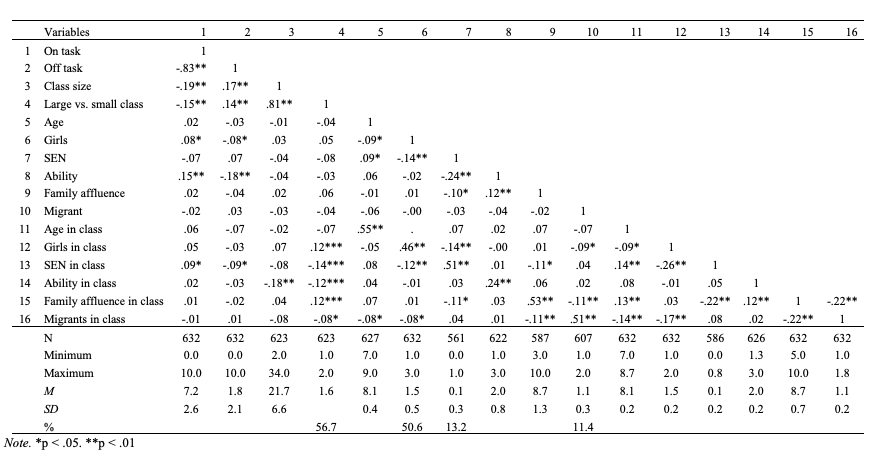
The average class size was 21.7 children (SD = 6.6). There was plenty of variance in the smaller versus larger classes variable, with 270 of the 623 children being in smaller classes (43.3%) and 353 children being in larger classes (56.7%). On average, children were observed as having on task behaviour for approximately 70% of the time during the five minutes they were observed (M = 7.2, SD = 2.6), and as having off task behaviour for approximately 20% of the time (M = 1.8, SD = 2.1). For more descriptive statistics and correlations between variables please see Table 1. The multilevel models fit the data well, with a RMSEA of .02, CFI of .99 and TLI of .93 for both whole sample models, and a RMSEA of .0, and a CFI and TLI of 1 for the multigroup models.
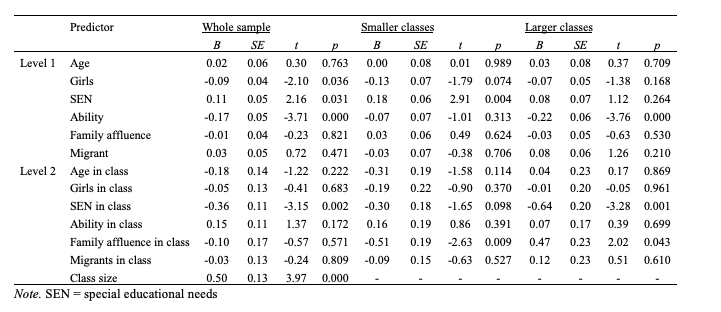
The models (Tables 2 and 3) identified that on task behaviour was lower in larger classes, and that off task behaviour was higher in larger classes. Put simply, more instances of momentary behavioural engagement were observed in smaller classes. Class size had the strongest impact on momentary behavioural engagement compared to all other factors in the models.
The next most important factor was SEN. Individual child SEN predicted less on task behaviour and more off task behaviour across classrooms, suggesting that individual SEN is a risk factor for momentary behavioural engagement. However, classrooms comprising more children with SEN predicted less off task behaviour, when the classrooms were larger.
Ability was also an important factor. Individual child ability predicted more on task behaviour and less off task behaviour across classrooms. However, the multigroup models revealed that this effect was mainly manifest in larger classrooms, where higher ability was a protective factor for momentary behavioural engagement, and lower ability was a risk factor for momentary behavioural disengagement.
The impact of family affluence was only apparent at the classroom level when measured as a classroom composition factor. Here, classrooms with more affluent children predicted less off task behaviour in smaller classrooms, and more off task behaviour in larger classrooms.
Gender had one effect, with girls being more likely to be on task when gender was modelled at the individual level.
Age and migrant status had no impact in any of the models.
Table 2
Multilevel Models for Behavioural Engagement
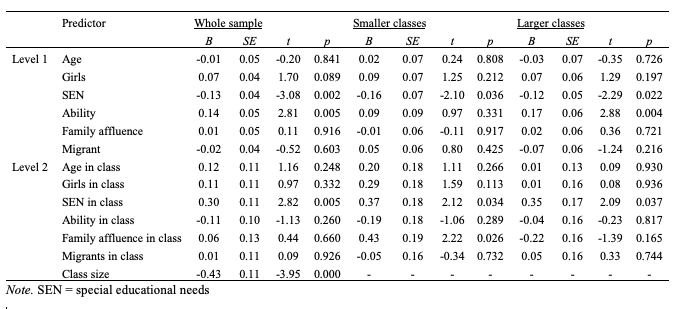
Table 3
Multilevel Models for Behavioural Disengagement
Children’s momentary behavioural engagement in classrooms is rarely studied across representative samples of populations of individuals, because of the significant resources needed to capture observational data on children’s behaviour occurring across seconds to minutes in classrooms. Similarly, the impact of classroom composition factors on children’s momentary behavioural engagement is understudied given the scarcity of studies with more than a handful of classrooms and that recruit children at the classroom level. The current study addressed these empirical gaps, and approached filling a theoretical gap on how classroom composition factors might help explain the impact of class size on children’s engagement, using an Irish national sample of children in primary schools observed every 30-seconds for ten intervals (5-minutes total per child) in lessons of English, Irish, science, and mathematics.
Multilevel models identified that children in smaller classes had higher levels of momentary behavioural engagement and that children in larger classes had higher levels of momentary behavioural disengagement. The models also identified that having SEN was a risk factor for individual children’s momentary behavioural engagement, but that larger classrooms with a greater number of children with SEN were protective for children’s momentary behavioural disengagement. Higher individual ability was a protective factor for children in larger classrooms whereas lower ability was a risk factor for children in larger classrooms. Classrooms with more affluent children promoted behavioural engagement if the class size was smaller but promoted behavioural disengagement if the class size was larger. Finally, girls were more likely to be behaviourally engaged, but there was no impact of the numbers of boys and girls in the classroom on behavioural engagement.
Class size effects on student outcomes are documented internationally (Blatchford & Russell, 2020). Our study of a national Irish sample identified a consistent relationship between larger classes and lower student behavioural engagement in class. Of note, this is the first time that momentary behavioural engagement has been studied large-scale in Ireland and related to class size. Future research might explore this relationship further, by associating class size with student cognitive and emotional engagement. This would allow the Irish context to be compared to other nations, where research from the Trends in International Mathematics and Science Study (TIMSS) has identified that student enjoyment of learning is higher in smaller classes in some countries (Shen et al., 2019).
In this study, children’s behavioural disengagement was lower in larger classes, if those classes had a larger number of children with SEN. In Ireland, even though there are special schools, the state is committed to inclusive education and most children with SEN are educated in mainstream schools alongside their peers without identified SEN. Each school is assessed to identify the level of need across students and is allocated additional resources including special education teachers and special needs assistant teachers who give support where needed (Shevlin & Banks, 2021). Having a larger number of children with SEN in larger classrooms would signal greater need in the school therefore these children may have been receiving support from additional adults in class which may have positively impacted their behavioural engagement. This result may signal the impact of an unmeasured factor, such as additional educational staff supporting children with SEN, teachers better differentiating their work, or more careful management of the speed of learning, in classrooms with the highest levels of need.
However, we also found that having SEN was a risk factor for individual children’s momentary behavioural engagement. This result probably stems from the larger proportion of children with social and emotional behavioural difficulties (SEBD) in the SEN group, as children with SEBD typically have challenges with behavioural regulation (Skalická et al., 2015). These self-regulatory challenges are not characteristic of many other categories of need studied, for example, vision and hearing impairments, and general learning difficulty (e.g., dyslexia). Future research should separate the categories of need into SEN with and without behavioural difficulties for a more fine grained analysis.
A further finding was the association between ability and behavioural (dis)engagement in larger classes. Our teacher rated ability variable was scored 1 (low ability) to 3 (high ability), therefore the finding indicates that students of lower ability had greater behavioural disengagement and less behavioural engagement in larger classes, and vice versa for children of higher ability. This finding aligns with research from Blatchford et al., (2011) where, in a similar sized study of 686 children, the authors found that children with low attainment had lower behavioural engagement in smaller classes, and higher behavioural disengagement in larger classes, and that children with high ability had lower behavioural disengagement in larger classes. Put simply, larger class size is a risk factor for behavioural disengagement for lower ability children, whereas higher ability children appear to be less vulnerable to the negative impact of larger classes. Possibly, teachers were interacting more with higher ability children in larger classes, as these children may have been better able to respond to the teacher’s cues and the teacher had less time to share their attention with the many other children in the room, indicating a selection effect with more students present.
Our result about children’s family affluence was interesting—that classrooms with more affluent children encouraged behavioural disengagement if classes were larger, and discouraged behavioural disengagement if they were smaller. Likewise, classrooms with less affluent children discouraged behavioural disengagement if they were smaller, and encouraged behavioural disengagement if they were larger. In Ireland, schools serving low-income communities are awarded additional resources through the Delivering Equality of Opportunity in Schools (DEIS) programme, which includes reducing class sizes in schools with higher levels of need. The impact of the DEIS programme on children in the current study could explain these effects of classroom composition of family affluence and behavioural disengagement.
Finally, we found that girls had lower levels of behavioural disengagement than boys, but that there were no differences between girls and boys in behavioural engagement. This result may be explained by the qualities of behavioural disengagement as measured in the current study as a combination of actively and passively distracted and horseplay. Post-hoc analysis of the three behavioural disengagement indicators revealed that boys had higher levels of passive distraction (M = 1.18, SD = 1.56) compared to girls (M = .98, SD = 1.40), whereas their levels of active distraction (Boys: M = 0.79, SD = 1.47; Girls: M = 0.63, SD = 1.23) and horseplay were reasonably similar (Boys: M = 0.03, SD = 0.20; Girls: M = 0.02, SD = 0.18). When these three indicators were combined, the analysis detected a larger effect of gender on behavioural disengagement. This result aligns with other research that observes gender differences in children’s ability to self-regulate their behaviour (Montroy et al., 2016).
This study has a number of limitations. First, although smaller classes have been shown to support higher behavioural engagement, this study does not have the data to demonstrate how this translates into student achievement. Further investigation into the impact of class size on momentary student behaviour and its subsequent influence on academic outcomes could provide a more comprehensive understanding. Secondly, the study only considered first-generation migration status as the sole migration variable. While this is a significant factor, it may not fully account for the diverse range of migration-related influences on student behaviour. Future research should incorporate additional variables, such as second-generation migration status or length of time since migration. While the present study did not yield any significant findings on migrant status, a more comprehensive assessment of migration status may potentially yield different results. Thirdly, while the study indicates some significant relationships, for example that children with higher abilities are less affected by larger class sizes, the data do not allow for definitive interpretations. Further research is required to determine the probable causes and mechanisms for the observed relationship. This could include investigating whether students in larger classes are, in fact, less affected or if teachers in these classes tend to allocate more attention to certain groups of students, thereby mitigating the impact of class size on academic performance for these students, but not their peers. 11.
The main findings of our study are that behavioural disengagement is higher in larger classes and lower in smaller classes, and that behavioural engagement is higher in smaller classes and lower in larger classes. These findings are robust after accounting for children’s individual differences and classroom composition factors that could otherwise be responsible for individual variation in children’s behavioural (dis)engagement. A clear message for policy makers is to continue supporting schools through enabling smaller pupil-teacher ratios. By enabling smaller class sizes, policy makers can facilitate less disengagement in classrooms which can promote learning and educational equality.
Archambault, I., Pagani, L. S., & Fitzpatrick, C. (2013).
Transactional associations between classroom engagement and
relations with teachers from first through fourth grade. Learning
and Instruction, 23(1), 1–9.
https://doi.org/10.1016/j.learninstruc.2012.09.003
Blatchford, P. (2021). Rethinking class size. A question and
answer session with Peter Blatchford about a new book and approach
to the class size issue. Education 3-13, 49(4),
387-397.
https://doi.org/10.1080/03004279.2021.1874370
Blatchford, P., & Webster, R. (2017). ORACLE to MAST: 40 years
of observation studies in UK junior school classrooms. In R.
Maclean (Ed.), Life in Schools and Classrooms: Past, Present
and Future (pp. 169-185). Springer Singapore.
https://doi.org/10.1007/978-981-10-3654-5_11
Blatchford, P., & Russell, A. (2020). Rethinking class
size: The complex story of impact on teaching and learning
(p. 328). UCL Press.
Bryce, C. I., Bradley, R. H., Abry, T., Swanson, J., &
Thompson, M. S. (2019). Parents’ and teachers’ academic
influences, behavioral engagement, and first- and fifth-grade
achievement. School Psychology, 34(5), 492-502.
https://doi.org/10.1037/spq0000297
Chiu, M. M., Pong, S. ling, Mori, I., & Chow, B. W. Y. (2012).
Immigrant Students’ Emotional and Cognitive Engagement at School:
A Multilevel Analysis of Students in 41 countries. Journal
of Youth and Adolescence , 41(11), 1409–1425.
https://doi.org/10.1007/S10964-012-9763-X/TABLES/4
Department of Education (2024, 12 October). Class-size
information at individual primary school level.
https://www.gov.ie/en/collection/class-size-information-at-individual-primary-school-level/
Edossa, A. K., Schroeders, U., Weinert, S., & Artelt, C.
(2018). The development of emotional and behavioral
self-regulation and their effects on academic achievement in
childhood. International Journal of Behavioral Development
, 42(2), 192–202.
https://doi.org/10.1177/0165025416687412
Fredricks, J. A., Filsecker, M., & Lawson, M. A. (2016).
Student engagement, context, and adjustment: Addressing
definitional, measurement, and methodological issues. Learning
and instruction, 43, 1-4.
Galton, M., & Wilcocks, J. (Eds.). (1983). Moving from
the primary classroom. Routledge and Kegan Paul.
Galton, M., & Hargreaves, L. (2019). Observational
Research and Classroom Learning Evaluation (ORACLE): The Pupil
Record. University of Cambridge Faculty of Education.
Gestsdottir, S., von Suchodoletz, A., Wanless, S. B., Hubert, B.,
Guimard, P., Birgisdottir, F., et al. (2014). Early behavioral
self-regulation, academic achievement, and gender: Longitudinal
findings from France, Germany, and Iceland. Applied
Developmental Science, 18, 90-109.
https://doi.org/10.1080/10888691.2014.894870
Hamre, B. K., & Pianta, R. C. (2010). Classroom environments
and developmental processes: Conceptualization and measurement. In
Handbook of research on schools, schooling and human
development (pp. 25-41). Routledge.
Hanushek, E. A., & Woessmann, L. (2017). School Resources and
Student Achievement: A Review of Cross-Country Economic Research.
In M. Rosén, K. Y. Hansen, & U. Wolff (Eds.), Cognitive
Abilities and Educational Outcomes . Springer
International Publishing.
Hattie, J. (2008). Visible Learning: A Synthesis of Over 800
Meta-Analyses Relating to Achievement. Routledge.
Hargreaves, L., & Galton, M. (2002). Transfer from the
primary classroom 20 years on . Routledge Falmer.
Hoxby, C. M. (2000). The Effects of Class Size on Student
Achievement: New Evidence from Population Variation. The
Quarterly Journal of Economics ,115(4),
1239-1285.
https://doi.org/10.1162/003355300555060
Inchley, J., Currie, D., Cosma, A. & Samdal, O. (2018). Health
Behaviour in School-Aged Children (HBSC) Study Protocol:
Background, methodology and mandatory items for the 2017/18
survey. St Andrews: CAHRU.
Martin, A. J., Burns, E. C., Collie, R. J., Cutmore, M., MacLeod,
S., & Donlevy, V. (2022). The role of engagement in immigrant
students’ academic resilience. Learning and Instruction,
82, 101650.
https://doi.org/10.1016/J.LEARNINSTRUC.2022.101650
Matthews, J. M., Cameron Ponitz, C., & Morrison, F. J. (2009).
Early gender differences in self regulation and academic
achievement. Journal of Educational Psychology , 101,
689-704. Doi:10.1037/a0014240
Montroy, ,J J, Bowles, R. P., Skibbe, L. E., McClelland, M. M.,
& Morrison, F. J. (2016). The Development of Self-Regulation
Across Early Childhood. Developmental Psychology, 52(11),
1744–1762.
https://doi.org/10.1037/dev0000159.supp
Newman, J., Noel, A., Chen, R., & Matsopoulos, A. S. (1998).
Temperament, selected moderating variables and early reading
achievement. Journal of School Psychology, 36(2),
215–232.
https://doi.org/10.1016/S0022-4405(98)00006-5
Pagani, L. S., Fitzpatrick, C., Parent, S., Pagani, L. S.,
Fitzpatrick, C., & Parent, : S. (2012). Relating Kindergarten
Attention to Subsequent Developmental Pathways of Classroom
Engagement in Elementary School. J Abnorm Child Psychol
, 40, 715–725. https://doi.org/10.1007/s10802-011-9605-4
Rimm-Kaufman, S.E., & Wanless, S. B. (2012). Self-regulation
and academic achievement, In R. Pianta, L. Justice, Barnett, S.,
Sheridan, S.M. (Eds.), The Handbook of Early Education
(pp. 299-323). New York: Guilford Publications.
Robinson, K., & Mueller, A. S. (2014). Behavioral engagement
in learning and math achievement over kindergarten: A contextual
analysis. American Journal of Education, 120, 325-349.
https://doi.org/10.1086/675530
Roebers, C. M. (2017). Executive function and metacognition:
Towards a unifying framework of cognitive self-regulation.
Developmental Review , 45, 31–51.
https://doi.org/10.1016/j.dr.2017.04.001
Rubie-Davies, C. M., Blatchford, P., Webster, R., Koutsoubou, M.,
& Bassett, P. (2010). Enhancing learning? A comparison of
teacher and teaching assistant interactions with pupils.
School Effectiveness and School Improvement , 21(4),
429-449.
https://doi.org/10.1080/09243453.2010.512800
Salmela-Aro, K., Tang, X., Symonds, J., & Upadyaya, K. (2021).
Student engagement in adolescence: A scoping review of
longitudinal studies 2010–2020. Journal of Research on
Adolescence,31(2), 256-272.
https://doi.org/https://doi.org/10.1111/jora.12619
Schunk, D. H., & Zimmerman, B. J. (Eds.). (2023).
Self-regulation of learning and performance: Issues and
educational applications. Taylor & Francis.
Shen, T., & Konstantopoulos, S. (2021). Estimating causal
effects of class size in secondary education: evidence from TIMSS.
Research Papers in Education ,36(5), 507-541.
https://doi.org/10.1080/02671522.2019.1697733
Shevlin, M., & Banks, J. (2021). Inclusion at a Crossroads:
Dismantling Ireland’s System of Special Education. Education
Sciences,11(4), 161.
https://www.mdpi.com/2227-7102/11/4/161
Skalická, V., Stenseng, F., & Wichstrøm, L. (2015). Reciprocal
relations between student–teacher conflict, children’s social
skills and externalizing behavior: A three-wave longitudinal study
from preschool to third grade. International Journal of
Behavioral Development, 39(5), 413-425.
https://doi.org/10.1177/0165025415584187
Skinner, E. (2016). Engagement and disaffection as central to
processes of motivational resilience and development. In K. R.
Wentzel & D. B. Miele (Eds.), Handbook of Motivation at
School(pp. 145-168). Routledge.
Symonds, J. E., Schreiber, J. B., & Torsney, B. M. (2021).
Silver linings and storm clouds: Divergent profiles of student
momentary engagement emerge in response to the same task.
Journal of Educational Psychology ,113(6),
1192-1207.
https://doi.org/10.1037/edu0000605
Torsney, B. M., & Symonds, J. E. (2019). The professional
student program for educational resilience: Enhancing momentary
engagement in classwork. The Journal of Educational Research,
112(6), 676-692.
https://doi.org/10.1080/00220671.2019.1687414
Yang, P. J., & Lamb, M. E. (2014). Factors Influencing
Classroom Behavioral Engagement During the First Year at School.
Applied Developmental Science , 18(4), 189–200.
https://doi.org/10.1080/10888691.2014.924710