
Frontline Learning Research Vol. 14 No. 1 (2026)
110 - 141
ISSN 2295-3159
1Graduate School of Integrated
Sciences & Technology, Shizuoka University
2Department of Psychology, University of Victoria
3Department of Educational Psychology and Leadership
Studies, University of Victoria
Article received 31 July 2025 / revised 27 April 2026 / accepted 12 May 2026 / available online 3 November 2026
Collaborative problem solving requires student groups to not only co-construct their ideas as a group but also regulate several aspects of their teamwork. Although prior research has linked group regulation to the group’s task performance, less is known about the immediate products of regulation. Specifically, limited research has examined the types of regulation that could promote productive knowledge sharing during ongoing collaborative interactions. This study explored how six groups of varying performance levels exercised regulatory actions between moments of productive knowledge sharing (PKS) during online collaboration. We employed a computational technique to analyze the temporal changes in groups’ idea networks to identify episodes where groups’ idea exchanges reached a productive level. Interpretations of students’ regulatory actions as interleaved between PKS episodes were facilitated by Epistemic Network Analysis (ENA). Findings highlight the importance of examining multiple facets of regulatory actions at both the group and individual levels while contextualizing these actions within meaningful knowledge sharing episodes. Socioemotional regulation was notably lacking during pre-task planning in low-performing groups. The lack of shared planning to reaffirm the group’s goal before starting the task appears to relate to groups experiencing behavioural coordination challenges, which likely reduce the chances of achieving PKS. Following instances of PKS, high-performing groups often monitored and evaluated their ideas or cognition, whereas low-performing groups focused on monitoring how the task was being completed. Patterns of individual members’ regulation across the ENA space revealed that members of high-performing groups regulated actively by diversifying their actions. The implications for supporting collaboration are discussed.
Keywords: collaborative problem solving, online collaboration, epistemic network analysis, idea network, socially shared regulation of learning
Collaborative problem-solving requires groups to regulate their tasks and team processes to promote productive knowledge sharing and co-construction (Janssen et al., 2012). The iterative process of regulating collaboration has led researchers to examine its temporality (Nguyen et al., 2021). The temporal features can refer to when an event occurs, the co-occurrence of events, and the sequence of events. All three features may not be examined simultaneously, but each provides insights into groups’ regulatory patterns. Learners’ regulatory patterns in collaboration have often been discussed in association with task performance, such as when high-performing groups engage in more planning and monitoring (Zhang et al., 2021). However, one question remains: What type of regulation promotes productive knowledge sharing and co-construction during learners’ collaborative discussions? Task performance has been used as a distal outcome to examine such questions. Rarely are instances of productive knowledge sharing examined as a proximal product, as an intermediate collaborative knowledge state for assessing group regulation. We attempt to address this gap by examining the types of regulation that precede productive knowledge sharing and those that follow, acknowledging the intertwined processes between knowledge co-construction efforts and regulatory actions during collaborative problem-solving.
From the perspective of collaborative knowledge construction phases (Gunawardena et al., 1997), sharing and comparing information is the first interaction that groups engage in before they can achieve a higher-level co-constructed knowledge. In the knowledge-sharing phase, groups need to construct their problem spaces by bringing their individual understanding of task descriptions as a preparation for co-constructing their group knowledge or solutions (Hadwin, Bakhtiar et al., 2018). A study that followed Gunawardena et al.’s (1997) knowledge construction framework situated in a collaborative analysis type of task, such as used in our study, showed that group conversations were frequently about knowledge and opinion sharing, and to a lesser extent, involving idea negotiation and co-construction (Lehtinen et al., 2023).
Methodologically, studies that examined knowledge construction phases often had to rely on qualitative coding of group discourse, particularly when it involves assessing beyond knowledge sharing to include interactions characterized by dissonance, negotiation, testing tentative construction, and reaching an agreement (e.g., Zabolotna et al., 2023). Several studies, however, attempted to capture the depth of knowledge co-construction by quantitatively examining groups’ use of task concepts, the extent that those concepts are shared, discussed, and connected during closely linked discourse using semantic network analytics (e.g., Oshima et al., 2020; Y. Yang et al., 2024). Following a similar approach, we focused our analysis on instances of knowledge sharing, in which group members shared relevant task concepts and used them in associations during their collaborative interactions. Merely sharing information alone is not indicative of a productive collaborative knowledge co-construction. In a collaborative task with specific task requirements, group members should share and discuss key disciplinary concepts in a sustained conversation to advance their collective ideas for the discussion to be considered productive (Oshima et al., 2020; Scardamalia & Bereiter, 2006). To quantitatively capture this episode using semantic network analytics, we introduce the concept of productive knowledge sharing (PKS). PKS is operationalized as a group’s sustained interactions that involve recurring use of and connecting key ideas or concepts that reflect accurate solutions to the problem-solving task. A network density metric, total of degree-centrality peak, serves as an analytical proxy for concept-dense, task-relevant discourse or extended collaborative idea and knowledge sharing. This proxy is not a direct indicator of productive knowledge co-construction, but rather a quantifiable stand-in that allows us to examine temporal patterns of group idea sharing activities. The fluctuation of groups’ PKS episodes is examined as interleaving between groups’ regulative actions, acknowledging that the knowledge co-construction process and groups’ metacognitive regulatory actions are temporally linked unfolding processes (e.g., Zabolotna et al., 2023).
We view regulation in collaboration as multifaceted (Hadwin, Järvelä, et al., 2018). Specifically, the fundamental regulation processes—planning, monitoring, evaluating, enacting, and adapting—could be aimed at managing cognition, behaviour, and/or affect. That regulation then could take on different modes to influence one’s own (self-regulation), others’ (co-regulation), or the group’s (socially shared regulation) learning. Considering this perspective, we focus on examining the co-occurrence of regulatory events in groups’ collaboration during episodes surrounding their productive knowledge sharing. While PKS is examined as temporally linked to regulatory actions, we also compared groups with differing performance levels to identify patterns of regulatory actions associated with successful and less successful groups. Given that differences between groups can be difficult to draw when comparing their rich regulatory discourse through qualitative coding and content analysis alone, we used epistemic network analysis (ENA) to facilitate data interpretations.
This study’s contribution lies in its attempt to advance the field by applying two types of network analytics to examine the temporal interplay between groups’ regulatory actions and knowledge sharing productivity. Rather than treating regulation and knowledge construction as separate processes, this research foregrounds their intertwined nature. The quantitative approach to identifying moments of productive knowledge sharing in collaborative discourse, interleaved with descriptions of learners’ network of multifaceted orchestration of regulatory actions, is unique to this study. The attempt to examine the rise and fall of groups’ knowledge sharing activities also contribute to the emerging line of research that uses learners’ data to identify signals or events that trigger regulation (see Järvelä & Hadwin, 2024).
Hadwin, Järvelä et al. (2018) described three facets of regulation in collaboration: processes, targets, and modes. Regulatory processes are the basic actions that signify learners’ attempt to take control of their learning by planning, monitoring, evaluating, enacting one or more strategies, or adapting. They reflect the cyclical phases described in models of self-regulated learning (Winne and Hadwin, 1998). Research has shown that in collaboration, groups’ monitoring fluency or aptness in recognizing problems during collaboration is associated with having better social and performance outcomes (Rogat & Adams-Wiggins, 2014; Zhang et al., 2021). Monitoring and evaluating practices drive further regulation, such as revising plans and enacting or adapting strategies.
Regulation targets or focus describe which aspect is being controlled. Learners may control their cognition, behaviour, motivation, and emotions. Su et al. (2018) examined cognitive targets as those that focus on the task, such as regulating task understanding, content, or progress (see also S. Yang et al., 2025). Behavioural targets are sometimes limited to the organizational aspect of collaboration, managing who does what (Zhang et al., 2021). However, they can also include any aspects of externalized behaviours relating to task conduct or manipulation of strategic behaviours. Motivation-focused regulation is activated to influence motivational beliefs and engagement, whereas emotion-focused regulation is directed at managing the feelings surrounding the task and context. In collaboration research, motivation- and emotion-focused regulation are often combined to focus on the socio-emotional dynamics of the group (Bakhtiar et al., 2018; Zabolotna et al., 2025). One issue with research that examines groups’ regulation and collaborative knowledge co-constructions together is the tendency to focus on the cognitive dimension, which involves investigation into how groups manage their knowledge contribution and cognitive understanding of the task requirements and progress (e.g., Gao et al., 2024; Ouyang et al., 2023). Sometimes, the socioemotional target is included by examining interactions that bolster a positive group socioemotional atmosphere (Lehtinen et al., 2023). Nonetheless, we chose to align with the major regulated learning theories by examining regulation as involving multiple targets, including cognitive, behavioural, and socioemotional conditions and situations.
Regulation modes refer to the individual(s) operating the regulation and whether that is intended for managing one’s learning (Self-regulated Learning, SRL), the learning of others (Co-Regulation, CoRL), or the group’s learning together as a group (Socially Shared Regulation, SSRL; Hadwin, Järvelä, et al., 2018). Self-report data indicate that highly self-regulating team members positively contribute to how much co- and shared regulation occurs during collaboration (Ito et al., 2024; Panadero et al., 2015). However, the frequency of those actions does not necessarily influence group performance because it does not reveal how effective the regulation was in addressing the intended target(s). Co-regulation—involving one or more group members or a tool prompting and supporting the regulation of an individual member or the group—plays a crucial role in enhancing group productivity and performance (Lee et al., 2017; Volet et al., 2009). More successful groups exhibited more bidirectional connections between co- and shared regulation (Bakhtiar & Hadwin, 2020; Su et al., 2018). In contrast, less successful groups repeatedly engaged in self-regulation more than the other modes. Co-regulation often functions as the metacognitive hub, directing members’ attention and actions to where the co-regulators see fit.
Piecing all three facets together provides a more detailed description of learners’ regulatory actions during collaboration. Examining regulatory targets captures the context that triggered regulation. The regulatory actions for that context are revealed by examining regulatory processes and modes deployed by the learners. The complex orchestration of these actions requires analysis tools that could capture the co-temporality of regulatory events.
Epistemic Network Analysis (ENA) has been increasingly used in the regulation of learning research to analyze students’ regulation sequence, strategy use, and behaviours (Elmoazen et al., 2022). To examine regulatory actions, we chose ENA over other network or temporal methods because we are primarily interested in unpacking the types of multifaceted regulatory actions that groups enacted (i.e., what regulation process, target, and mode co-occur) surrounding productive moments of knowledge sharing, rather than the sequence of the regulatory actions in groups’ learning activities. One central assumption of ENA is that meaning or ways of knowing emerge through the co-occurrence of epistemic actions (Shaffer, 2006). This assumption aligns well with regulation theory, which views the regulation process, its target or foci, and mode as co-occurring to give meaning to the context and intention of learners’ orchestrated actions when taking control of their situations (Hadwin, Järvelä et al., 2018). ENA can visualize and quantify the structure of the network of associations between these multiple facets of regulation when they co-occur. Additionally, given that our collaborative problem-solving context is not perfectly linear, as groups worked through the problem following question-by-question prompts (like Lehtinen et al., 2023), analysing the fine-grained sequence of regulatory actions is less fitting. Sequential methods would force a linear order from one facet of regulation to another. In contrast, ENA models simultaneous action connections, allowing us to interpret how the multifaceted regulatory actions are woven together and, at the same time, to compare across groups and individuals within groups using the same shared representational space.
ENA draws from qualitative codes assigned to temporally linked phenomena and computes the codes’ co-occurrence within a segment or stanza (Shaffer & Ruis, 2017). In a discourse-based dataset, researchers could interpret the meaning of the discourse by examining code co-occurrence within a stanza or lines of conversation. ENA allows the adoption of a moving stanza method, which models the co-occurrence of codes in multiple overlapping stanzas to emphasize the importance of capturing codes’ proximity within the conversation (Siebert-Evenstone et al., 2017; Zörgö, 2023). In a moving window, each conversation line is connected to every line that precedes it within the window, moving one line at a time from the beginning to the end of the conversation. For example, in a moving stanza window of three, each line within a conversation is related to the two lines preceding it. The relational context is then determined as three lines of data, where codes within the same 3-line stanza are linked in the ENA model and codes within different stanzas are not. Based on a set stanza size, ENA creates an adjacency matrix for each stanza, summarizing co-occurrences between all codes. These matrices are then summed for each unit of analysis (e.g., groups), representing the weighted patterns of co-occurrence among the codes for that unit. To examine differences between units, ENA represents each unit’s summed adjacency matrix as a vector in a high-dimensional space, where each dimension corresponds to the associations between unique pairs of codes. ENA divides each vector by its length to normalize the data, accounting for potential differences in the number of coded lines across units. Once normalized, ENA performs a dimensional reduction so that the network of connections between multiple pairs of codes can be projected on a four-quadrant two-dimensional space.
The positions of network nodes in an ENA space provide information about the thematic association between codes, especially when they co-locate in the same quadrant. For example, in a study that examined learners’ regulation in an online environment, students’ cognitive action of knowledge-building activities was found to be the co-temporal centre of the study’s ENA space, indicating the action’s dominance based on its frequency and connection to the other nodes (Saint et al., 2020). Using similar trace data, Paquette et al. (2021) found a theme in how codes were connected when high- and low-performing students were problem-solving. The co-temporality of their codes indicates that high-performing students showed stronger connections between coherent solution constructions and information-seeking actions than the low-performers. Additionally, the actions of evaluating a solution and reflecting are co-located in the same quadrant of the ENA plot, suggesting their proximity in the data.
Collaboration studies employing ENA to examine learners’ regulatory behaviours have used individual (Melzner et al., 2019), group (Gyasi & Zheng, 2023; Nguyen et al., 2021), or task phase (Kaliisa et al., 2023; Zhang et al., 2021) as their analysis unit. These studies demonstrate the distinct sets of regulatory actions that different categories of individuals or groups adopted when managing their learning. For instance, Melzner et al. (2019) found differences in how students choose to regulate motivation and comprehension problems in collaboration. Additionally, Zhang et al.’s (2021) ENA show that low- and high-performing groups regulating differently at different phases in their online collaboration. High-performing groups engaged in more planning in the initial task phase, and monitoring actions were more strongly connected throughout all phases. In high-performing teams, knowledge or content monitoring was more dominant during the group’s initial-to-middle task phase. In contrast, low-performing groups engaged in less planning in the first phase, and monitoring and regulating (mainly focusing on organizing behaviour) were more strongly connected in the middle-to-end task phase, suggesting a higher need to address planning issues in the latter phase.
Our literature review identifies two limitations in the use of ENA in studies focusing on regulation in collaboration. First, limited studies examined the ENA networks of both groups and their individual members’ regulatory actions. There is a need to unpack regulatory actions at the group and individual levels to understand how individuals’ actions may contribute to the collective performance. Second, limited studies have attempted to divide learning episodes based on instances of productive knowledge sharing or other forms of “meaningfulness” except by using task design or a fixed period to divide the collaboration into phases. We attempt to address these limitations by examining groups’ and their members’ regulation networks in episodes interleaving productive knowledge sharing.
There is an emerging line of research that acknowledges regulatory process and collaborative knowledge co-construction as intertwined and temporally linked (e.g., Zabolotna et al., 2023). Consequently, there is a current methodological shift that attempts to capture the complex interlinked processes using advanced analytics (e.g., Ouyang et al., 2023). The research consensus is that the quality of the interaction between these processes is a key determinant of successful collaboration (Gao et al., 2024). The differences, however, lie in the facets of regulation (cognitive versus socioemotional) or knowledge construction interactions (quality versus content) that researchers choose to foreground, leaving room for much to be explored regarding the nature of interactions between knowledge construction and regulatory actions across different learning contexts.
In terms of collaborative knowledge co-construction, beyond examining cognitive moves or interactional focus (Gunawardena et al., 1997), it is also important to examine learners’ information sharing quality or use of critical ideas and domain-specific concepts during their collaborative interactions (Scardamalia & Bereiter, 2006; Y. Yang et al., 2024). In a productive conversation, learners should be able to leverage group members’ knowledge and expertise and collectively improve their understanding and strategy to solve task problems using key task concepts. The expectation may be that the more individuals share their ideas with the group, the better the knowledge that the group co-constructed. However, this is not necessarily the case, especially when learners are not sharing and discussing the kinds of concepts required by the task or disciplinary pursuits and not engaging in a sustained collective effort to improve their ideas (Scardamalia & Bereiter, 2006). Research indicates that a higher frequency of idea sharing in collaboration does not correspond to collective idea improvement, where ideas generated by individuals are further examined and collectively synthesized (Gyasi & Zheng, 2023). Idea generation and elaborations require activation of regulatory processes such as monitoring and planning, where learners identify gaps in their intermediate state of knowledge and strategize to improve or modify that state with more accurate task concepts and thinking (Damsa et al., 2010; Gyasi & Zheng, 2023; Lee et al., 2017).
A study using a sequential pattern mining suggests the interrelation between groups’ intermediate state of knowledge and regulatory actions (Ouyang et al., 2023). The study’s findings demonstrate that groups showed a high probability of initiating by regulating task understanding as a group and continuing to engage in goal setting and planning through co- and shared regulation. This initial regulation appears foundational to how team members later approach idea sharing and improvement activities. In the same study, the knowledge sharing activity appears to begin with individuals contributing new ideas. This action has a strong direct transition to the peer level, where team members either build consensus on the proposed ideas, ask questions, or provide a perspective that opposes the ideas (see Lee et al., 2017). This intermediate state of knowledge is monitored and evaluated by the group to progress their collective knowledge, where ideas are integrated into a meaningful whole. Overall, the patterns can be summarized as groups beginning the collaboration with group-level planning, followed by knowledge-focused engagement involving perspective sharing at the individual and peer level, then regulatory action of monitoring and reflecting at the individual and peer level, and ending with consolidating group-level knowledge. This finding demonstrates that learners’ regulative action in collaboration is interleaved with their knowledge co-construction engagement, which this study seeks to further examine.
Our unique contribution is, however, in our alignment with the multifaceted aspect of regulation (Hadwin, Järvelä, et al., 2018) and quantitative approach in examining groups’ knowledge sharing process by analyzing their changing knowledge or idea network (i.e., use of key task concepts) during collaborative discourse. We focused on knowledge sharing instances because a quantitative approach could not stipulate other higher-level knowledge construction attempts, such as idea negotiation. However, when a knowledge sharing episode occurs over a longer duration, involves multiple group members, and involves a denser network of key task ideas, we could expect the conversations to be productive, as they are more likely to lead to a deeper knowledge construction phase.
Idea sharing, as a phase in knowledge construction in collaboration, has primarily been examined using qualitative coding of groups’ discourse (e.g., Lehtinen et al., 2023; Zabolotna et al., 2023). A smaller group of researchers is increasingly using computational methods, such as semantic networking tools, to inspect groups’ knowledge sharing activities (Oshima et al., 2020; Zhang & Ouyang, 2023). One tool, called the Knowledge Building Discourse eXplorer (KBDeX) allows researchers to observe the occurrence of groups’ idea use and improvement by visualizing them in the form of an idea network that expands as groups discuss more ideas (Oshima et al., 2012). The tool requires researchers to identify a list of key concepts or nouns pertinent to the task. Then, it searches for these concepts in the conversation and generates the group’s idea network, illustrating the centrality and density of the ideas used in the learners’ discourse. Networks are generated based on the computation of the total of degree-centrality (TDC) value that changes as more key ideas are used. The higher the TDC, the denser the network, meaning learners were using and making connections of the key ideas more in their discussions.
Researchers often focused on the incremental increase in TDC value throughout the learners’ discourse and examined the completeness of groups’ idea network at the end of a learning session (Y. Yang et al., 2024). We propose a different approach by examining the fluctuations of TDC values using a sliding-stanza method (see also Ohsaki & Oshima, 2021). In this approach, the lifetime of the edges in learners’ idea network (i.e., connections between ideas) are limited to several conversation turns, assuming that the ideas are not always used throughout the group’s conversations but may be used at several moments. The peaks in the fluctuation of TDC values are where we assume that idea sharing is at a productive level, involving idea elaborations where several learning concepts are discussed in several turns by group members. In other words, TDC peaks serve as markers or analytical proxy for discourse in which task-relevant concepts are extensively exchanged (i.e., productive idea sharing), although they do not necessarily reflect whether ideas are collaboratively co-constructed or thoroughly discussed among group members. The concept of productive knowledge sharing (PKS) thus refers to concept-dense, task-relevant exchanges within group discourse, without directly measuring the productivity of collaborative knowledge co-construction. However, it is possible that within this concept-dense discussion, ideas are elaborated and co-constructed among team members (e.g., Ohsaki & Oshima, 2021). Examining TDC fluctuations can be used to segment group conversations into smaller, meaningful idea sharing episodes. The idea network generated for each episode can then be examined and assessing the actual conversations on which the network is based may reveal the quality of the group’s idea sharing process. The networking tool’s capability to chunk group conversations into smaller idea sharing episodes was used in this study to contextualize students’ regulative actions. This approach enabled the examination of the types of regulation that precede and follow instances of productive knowledge sharing, thereby providing insights into the intertwined processes and factors that support successful collaboration.
We attempt to address the gap in research examining the intertwined process between productive knowledge sharing (PKS) and regulatory actions in collaboration, using quantitative methods signalling moments of productive knowledge sharing and dips in knowledge construction productivity. Specifically, the study examines (a) the regulatory actions activated by groups and their members as interleaving between instances of PKS during their online collaboration, and (b) whether there are differences between groups with varying task performance levels. The performance level is a grouping variable that serves as a comparison point. We suspect that there are differences in the types of regulatory actions groups (RQ2) and their individual members (RQ3) engage in, which may interact with their knowledge sharing productivity and performance. The research questions are:
RQ1. When does productive knowledge sharing occur during the problem-solving discourse?
RQ2. How do groups’ regulation patterns compare at three phases: pre-task planning, before and after engaging in productive knowledge sharing?
RQ3. Do regulation patterns exhibited by individual members qualitatively differ within their group and between group performance levels?
We conducted a multiple-case study (Yin, 2018) involving six groups and 22 students (Mean age = 18.69, SD = 1.56), who worked on an online collaborative task at a university. We focus our reporting on case comparisons informed by groups’ idea and ENA networks and reified by content analysis of the discourse responsible for the projected networks.
Students’ problem-solving task is situated within an undergraduate Education course, where they collaborated on an online 90-minute case analysis challenge in groups of three to four individuals. Two weeks before group formation, all students completed a quiz with 20 multiple-choice questions. This quiz was meant to test individual understanding of the topics to be covered in the collaborative task and to sort groups relatively equally based on knowledge comprehension. That is, each group should have about equal number of more and less knowledgeable members.
The task required groups to analyze a scenario describing a student working on a major essay, using knowledge about successful strategies and self-regulation processes. The group collaborated on the task using a text-based chat platform and a wiki document in a parallel window to discuss, negotiate, and record answers to analysis questions (Hadwin, Bakhtiar, et al., 2018). The task was a 90-minute collaboration resembling an applied exam. The course instructors graded task products (wiki answers) for accuracy, use of course concepts, and incorporation of concrete examples from the provided scenario to support answers. One week before the task, groups were asked to meet in the chat platform to plan as a group following open-ended prompts. The group planner tool invited groups to think about the task instructions, priorities, and plans to address anticipated challenges.
Groups’ text-based conversations were the primary data. The discourse included conversations during the assigned group planning and the case analysis task. Only the task conversations were used to identify instances of productive knowledge sharing. However, the entire discourse was hand-coded, where we identified the regulation process, target, and mode demonstrated in each conversation turn (Appendix). This coding procedure was informed by Bakhtiar et al. (2018) and Hadwin, Järvelä, et al. (2018). In the iterative process of coding involving two raters, the inter-rater reliability index, Cohen’s Kappa, was computed on 10% of the data for each level of coding. Once a good reliability was achieved, the first author then coded the remaining data. The final reliability indices were within a robust range: .87 for the regulation process, .93 for the regulation target, and .81 for the regulation mode.
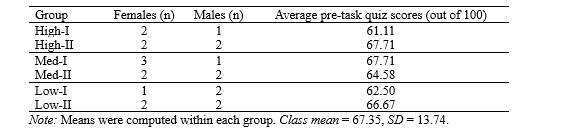
Six groups of different performance levels were randomly selected: two high-performing groups received an A-, two medium-performing groups received a C+, and two low-performing groups received a D for their respective task product (Table 1). The determination of the letter grade followed the university’s grading standards. Pedagogically, studying med-performing groups allows us to identify where groups might need just a bit more support to optimize their performance. Group memberships remained intact. Groups were also relatively equivalent regarding their pre-collaboration knowledge comprehension or quiz scores (last column in Table 1).
Table 1 - Summary of case characteristics
Following our introductions in Sections 1.2 and 1.4 about network analysis tools serving different purposes, this study used two types (a) a semantic or idea network tool to identify instances of productive knowledge sharing, and (b) an epistemic network analysis tool to examine the co-occurrence of regulatory actions. In the first phase, an idea network tool called Knowledge Building Discourse eXplorer ([KBDeX]; Oshima et al., 2012) was used to examine groups’ knowledge sharing activities. The list of keywords or ideas entered in the tool was guided by a detailed marking guide provided by the course instructor. The chosen keywords included course concepts that signify accurate problem-solving. The list included 30 unique concepts. Examples of the keywords include TASC (time, action, standard, and concept as criteria for a study goal) and time management. We then inspected the groups’ idea network to examine each member’s idea contribution. Next, we identified instances where groups’ knowledge sharing activities appear to be productive. Two additional features of the tool were used in this step. First, we applied the stanza-sliding method, setting the analysis unit as a sequence of three inputs within the chat to examine how an input was influenced by its preceding input and subsequently influenced the following input. With the sliding stanza size of three, we moved the window one input at a time to calculate the co-occurrence of words as network edges. Second, we limit the edge lifetime to provide a temporal view of the knowledge sharing activities. Edges were deleted if the same co-occurrences of words did not appear while shifting the stanza window three times. Through this algorithm, we observed how idea sharing activities within students’ discourse unfolded at a finer granularity. Productive points of idea sharing, likely involving idea elaboration and integration, were visualized as peaks in total of degree-centrality values. This approach allowed for group comparisons based on the number and magnitude of peaks. We inferred that these peaks signify that productive knowledge sharing ensued as they demonstrate a high density of keyword use. Groups’ discussions were then divided based on the identified PKS episodes, making the number and timing of the episodes unique to each group.
In the second phase (regulatory action network), qualitatively coded data, which identified the regulation processes, targets, and modes groups enacted during collaboration (see Appendix for coding scheme), were analyzed using the ENA Web Tool. We chose a moving stanza window size of three, given that the smallest group membership was three. The ENA model includes three nested levels: group, followed by episode (relative to PKS), and individual. Networks were visualized using network graphs where nodes correspond to the codes (all regulation codes), and the edges reflect the relative frequency of co-occurrence between any two codes. The result is two coordinated representations for each group: (1) a plotted point, which represents the location of each group’s network in the low-dimensional projected space, and (2) a weighted network graph. The positions of the network graph nodes are fixed, and those positions are determined by an optimization routine that minimizes the difference between the plotted points and their corresponding network centroids. Our model had co-registration correlations (Pearson) between the centroids and the projected points of .97 for the vertical dimension and .96 for the horizontal dimension, indicating a strong goodness of fit between the visualization and the original model.
Group-level regulation within episodes was examined by comparing group centroids (or mean networks) in the resulting ENA plot. At the individual level, we traced each group member’s centroids across episodes to identify (a) the individual’s dominant quadrant or dominant regulative actions in the ENA space and (b) their movements across quadrants.
To examine the above question, we first had to determine whether group members contributed ideas by computing the proportion of shared and unique ideas contributed by each member relative to all ideas present in their group (Table 2). Shared ideas included ideas that were at least discussed by more than one team member, whereas unique ideas are those that were raised by one member only. Group members with relatively high unique ideas were either very knowledgeable about the topic or contributed ideas that were not addressed further by the group (see high- and low-performing groups). Med-performing groups mostly discussed their ideas as a group, as unique ideas were minimal. Across groups, only Iona in the High-II group had < 20% of total contribution to the group network. Examination of the chat transcript and wiki logs indicate that Iona was the group’s sole wiki editor. She provided her ideas directly to the wiki rather than discussing them with the group. Overall, most group members appear to have some level of shared idea contribution, suggesting some attempts to share, elaborate, and/or integrate key ideas during problem-solving.
Table 2 - Proportion of shared and unique idea
contribution by each member in each group
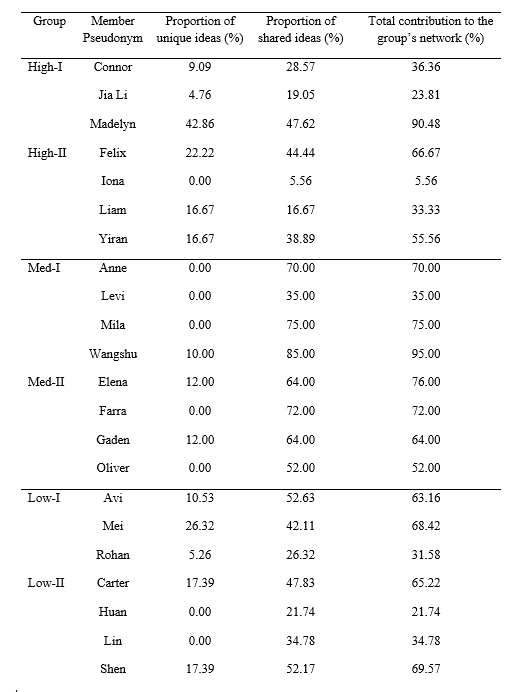
Note. Proportions are calculated out of the total ideas present in each group’s network.
We then examined fluctuations in TDC values across groups’ idea networks to determine when productive knowledge sharing occurs. The TDC fluctuation indicates where key ideas were highly discussed, irrespective of the depth of the conversation. Visual analysis of the magnitude of the TDC peaks across groups indicates that discernible peaks tend to have TDC values of 1.5 (Figure 1). Therefore, we determined that productive knowledge sharing (PKS) is an episode involving TDC peaks reaching a value of 1.5 or higher. While TDC peaks are markers of concept-dense discourse, they are not in and of themselves “PKS episodes” because we did not select PKS episodes based solely on a portion of discourse at the peak or tip of idea sharing productivity. We used TDC peaks to identify the start and the end of a PKS episode. PKS episodes (a) must include exchanges from at least two members, (b) begin at the conversation turn where the TDC begins to rise, and (c) end when the TDC returns to zero. The application of these criteria was assessed by analyzing the content of the actual conversations and was determined to be appropriate (e.g., Barany et al., 2022).
Informed by Järvelä and Hadwin’s (2024) regulation trigger framework, we also infer that the dip in productive knowledge sharing could signal a need to regulate. Unique to this problem-solving context is the need to analyze the same case/problem in a limited time. Therefore, if members are not discussing or responding to the same concepts/ideas, groups may be diverging in focus, fragmenting collaborative effort and hindering task progress.
Figure 1 - The fluctuation of Total of Degree-Centrality (TDC) value of group idea network during problem-solving
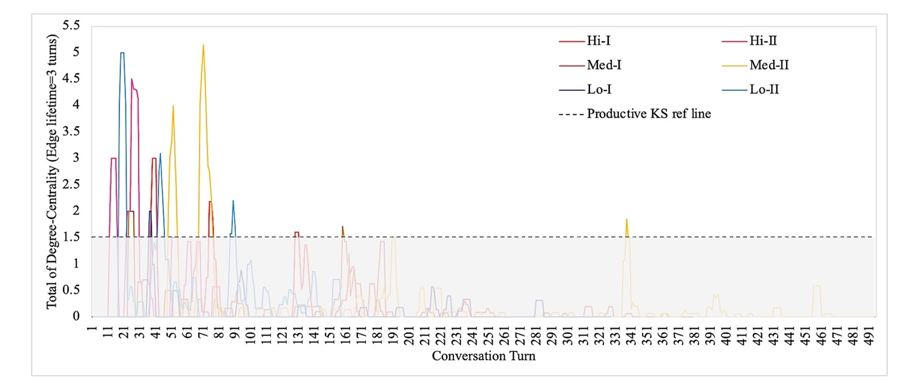
Note. Peaks in TDC were used to determine episodes of productive knowledge sharing.
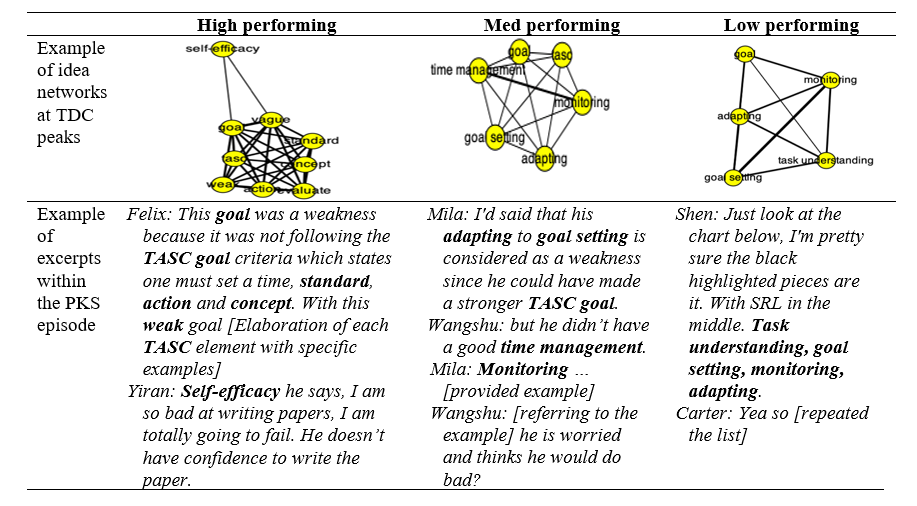
As seen in Figure 1, med-performing groups had lengthier conversation turns. There is no apparent trend for higher TDC values to be associated with specific performance levels. However, content analysis of groups’ idea networks at their productive level indicated that groups’ keyword use is consistent with their task performance (Table 3). Idea networks of the high-performing groups included coherently connected keywords associated with accurate analysis of the problem. The networks of the med-performing groups included some keywords associated with accurate analysis but also included other ideas. Their discourse showed that the groups negotiated competing ideas. In high- and med-performing groups’ TDC peaks, group conversations involve idea sharing, expansion, and negotiation, indicating collaborative knowledge co-construction and problem solving. These are demonstrated in the excerpts provided in the last row of Table 3 for the high- and med-performing groups, in which a group member (Felix in the High-II group and Mila in the Med-I group) presents their ideas, which are later built upon or negotiated by another member. Hence, for these case groups, their PKS episodes reflect productive knowledge co-construction as well.
However, in the low-performing groups, their TDC peaks involved members sharing task information and referencing the studied concepts superficially (last column of Table 3). For instance, Shen and Carter in the Low-II group did not use the concepts in depth to discuss the case problem at hand; their PKS episodes were not indicative of true or productive collaborative knowledge co-construction. Nonetheless, the TDC peaks for low-performing groups revealed the extent of their “productivity” in sharing what they know to solve the case. It is possible that the case analysis answers in the low-performing groups were mostly not collaboratively constructed, as key ideas are shared one-way to the group without back-and-forth exchanges (i.e., not appearing as TDC peaks).
From this analysis phase, we identified that groups with three instances of PKS include High-I, Med-II and Low-II. Groups with two PKS episodes include High-II and Med-I. The group with one PKS episode was the Low-I group. Based on this identification process, we divided the groups’ full discourse into four phases: (a) pre-task planning, (b) before the first PKS episode, (c) at PKS, and (d) after PKS.
Table 3 - Examples of idea networks at productive knowledge sharing episodes by performance level
To examine the regulative actions groups exercised around their productive knowledge sharing, regulation codes were summarized using ENA. Figure 2a provides the resulting ENA model. The centroids refer to the mean networks of all six groups. The dotted lines represent the 95% confidence interval of the corresponding mean. The model explained 45.4% of the variances, 31.9% in the horizontal dimension and 13.5% in the vertical dimension. We selected one group centroid to describe our characterization of the projection space based on the thematic associations between nodes (Figure 2b). Activities in the first quadrant depict learners’ focus on controlling task completion and adaptation. The second quadrant can be defined by the metacognitive monitoring and evaluating process, particularly deployed through co-regulation and closely connected to the regulation of cognition and strategic behaviour. The third quadrant has a self-regulation focus along with the process of constructing and adjusting plans. Socioemotional regulation landed in this third quadrant due to it being frequently about self-regulation of emotions related to frustrations and worries, which were mostly discussed at planning. Finally, the fourth quadrant focused on the enactment of socially shared regulation.
Comparison of the distribution of projected points along the horizontal and vertical dimensions of the ENA space between groups was evaluated using a set of Mann-Whitney U tests. Group differences on both dimensions did not reach statistical significance, indicating that, on average, the types of regulative actions that groups used were similar. Hence, we needed to contextualize groups’ regulatory actions further by examining their regulatory networks at three different phases: (a) pre-task planning, (b) before the first PKS, and (c) after engagement in PKS.
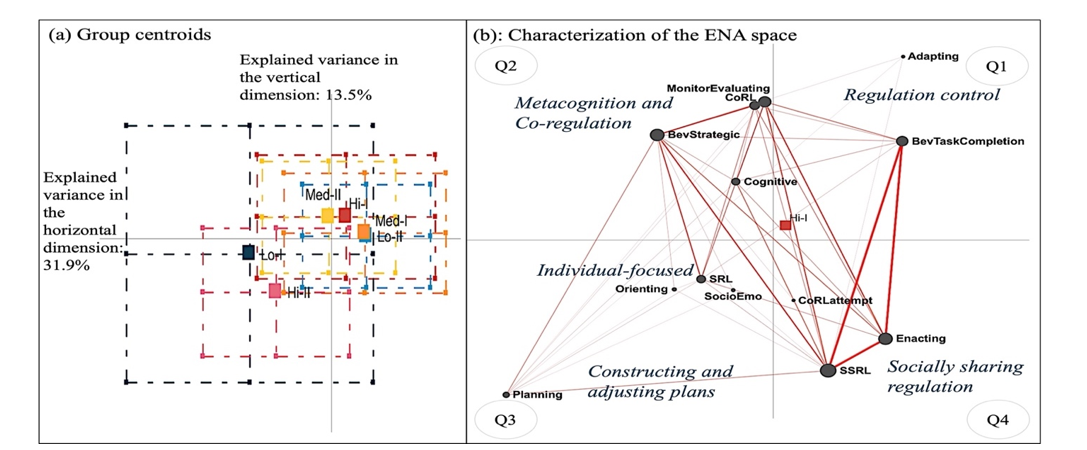
Figure 2 - The ENA model with all group centroids (left) and characterization of the ENA space (right)
3.2.1 Regulation at pre-task planning
All groups’ centroids were found on the third quadrant during pre-task planning (Figure 3). It is not surprising to find groups regulating similarly, where they mostly engaged in shared planning, because this session was scripted. The difference, however, can be seen in how much of the planning node frequently co-occurs with building cognitive understanding, coordinating strategic behaviour, or emotion regulation.
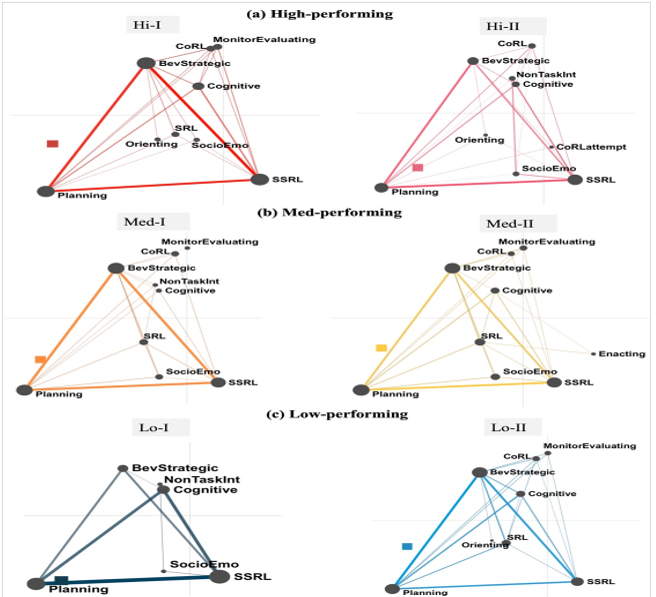
Note.SocioEmo and Planning nodes are not connected in low-performing groups.
Figure 3 - ENA networks of group regulation during pre-task planning
Both med-performing groups are similar (Figure 3b); they were highly engaged in planning activities focusing on the group’s strategic behaviours. Shared planning focusing on building cognitive understanding is evident, but not as dominant (smaller node weight) as strategic behaviour planning. Although less commonly, both groups planned for socioemotional regulation directed to an individual’s or the group’s motivation and emotions. This type of planning is when individuals anticipate experiencing motivation dips or emotionally provoking challenges and situations, and so the group proactively strategized how to manage their team’s affective states or suggest tactics for individual members to use should such situations occur. Given the time-limited nature of the task, some groups noted that this element can influence their affective states, particularly when working with multiple individuals. Med- and high-performing groups also monitored and evaluated their plan for strategic behaviour, but not their plan related to cognitive task understanding; this type of planning was done as a group and sometimes through co-regulatory prompts.
High- and low-performing groups demonstrated some inconsistencies (Figures 3a and 3c), likely influenced by the length of group’s planning conversations. In High-II and Low-I groups, planning for strategic behaviour was brief and consequently, the process of monitoring/evaluating plans did not occur. At least in the High-II group, shared planning was prompted by co-regulation, but not all prompts were acted upon, as indicated by the appearance of the CoRL-attempt node in the same network. The High-II’s chats showed that the attempt was meant to bring the group towards a more shared planning, indicating a proactive effort to minimize planning issues. The other high-performing group (High-I) was seen to monitor and evaluate their plans and had a relatively heavier monitoring node than most groups. Shared planning targeting strategic behaviours and cognition was also relatively more elaborated in High-I.
Both low-performing groups (Figure 3c) did not plan for emotion regulation. In the Low-I group, planning for strategic behaviour was minimal, and planning aimed at cognitive understanding was limited to the planning scripts, which requested groups to discuss the task instructions. For the Low-II group, the edge strength between shared regulation and planning nodes in this group is weaker than the others, indicating a lower co-occurrence.
Overall, the most apparent difference is related to plans for socioemotional regulation, which is lacking in the low-performing groups. Elaboration of plans targeting strategic behaviour and cognition, and the monitoring and evaluating of plans were more salient, at least in one of the high-performing groups. Additionally, one high-performing group showed an early attempt to minimize planning issues.
3.2.2 Before the first productive knowledge sharing
The first progression toward productive knowledge sharing is critical as it sets the stage for how groups would continue to work together. The analysis of group centroids in this session revealed some differences. The high-performing groups spent time constructing plans, individually and as a group, before beginning problem-solving (Figure 4a). The High-II group mostly engaged in orienting the group’s behaviour to the task. In contrast, the High-I group’s plans related to emotion regulation were addressed again before the group commenced work (dotted oval in Figure 4a). This emphasis on socio-emotion was only observed in this high-performing group, when the group emphasized how to manage their stress level going forward by supporting each other so negative emotions would not interfere with their task progress. Through co-regulation, this group also strongly monitored and evaluated their strategic behaviours (strong edge weight between the nodes) during this early phase.
The med-performing groups planned their strategic behaviour as a group before their first PKS. However, compared to the high-performing groups, individual planning (SRL and Planning node connection) was not evident in these groups. Both groups already begin attempting the task as a team, although their knowledge sharing did not reach a productive level as the task completion action is not occurring within PKS peaks. Both groups monitored and evaluated their strategic behaviours through co-regulatory prompts and shared regulation.
Regulation in the low-performing groups in this phase indicated potential coordination issues. Both low-performing groups demonstrated connections between co-regulation and planning (highlighted in Figure 4c), where one or more group members were addressing planning issues related to a group member’s self-processes. In the Low-I group, issues were likely detected by monitoring group members’ strategic behaviours. In the Low-II, the group lacked shared planning. Both low-performing groups had to be co-regulated to complete the task, as shown by the connection between co-regulation and task completion behaviour nodes.
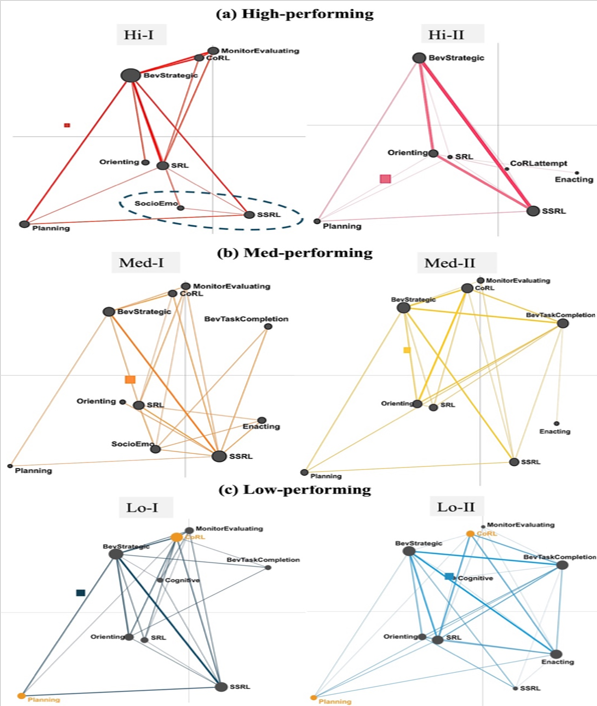
Note. Shared socioemotional regulation occurred in High-I only (dotted oval). Highlighted nodes in low-performing groups indicating member(s)’ prompt to revisit planning.
Figure 4 - ENA networks of group regulation before the first productive knowledge sharing
Overall, socially shared planning aimed at group members’ strategic behaviour is most typical before groups’ first PKS. The lack of shared planning (Low-II) or occurrence of planning and behavioural coordination issues could influence group performance (Low-I; Low-II). Such issues demand some members to activate co-regulatory actions, and the success of that co-regulation could influence how the groups later collaborate. In the absence of such issues, groups swiftly focus on completing the task as a team (Med-I; Med-II) and may reach a productive level of knowledge sharing (High-II). Affirming to regulate socio-emotion early in the collaboration may distinguish high-performing groups from others (High-I).
3.2.3 Regulation after productive knowledge sharing
A detailed analysis of regulative actions during knowledge sharing peaks was not included because they focused on task completion. However, inspections on what groups did after engaging in those instances provide insights on whether productivity in knowledge sharing invited further need for regulation. For high-performing groups, frequently co-occurring nodes were related to monitoring/evaluating in the earlier episodes and to task completion in the latter episodes (thicker edge weights in Figure 5). Monitoring directed at cognition or idea coherence and accuracy was evident in both high-performing groups. This action was observed in the first and second after-PKS episodes in the High-I group and in both after-PKS episodes in the High-II group. The monitoring process in these groups is mostly shared amongst team members and is prompted through co-regulation. Several individuals in the high-performing groups also self-monitored their strategic behaviour and task completion (SRL-MonitorEvaluating-BevStrategic/BevTaskCompletion node connections after PKS1 and PKS2 in High-I and after PKS2 in High-II, Figure 5), indicating that individuals took some personal responsibilities to regulate while working alongside their group. Self-regulation appeared to be supported through co-regulatory prompts, particularly in the High-I group.
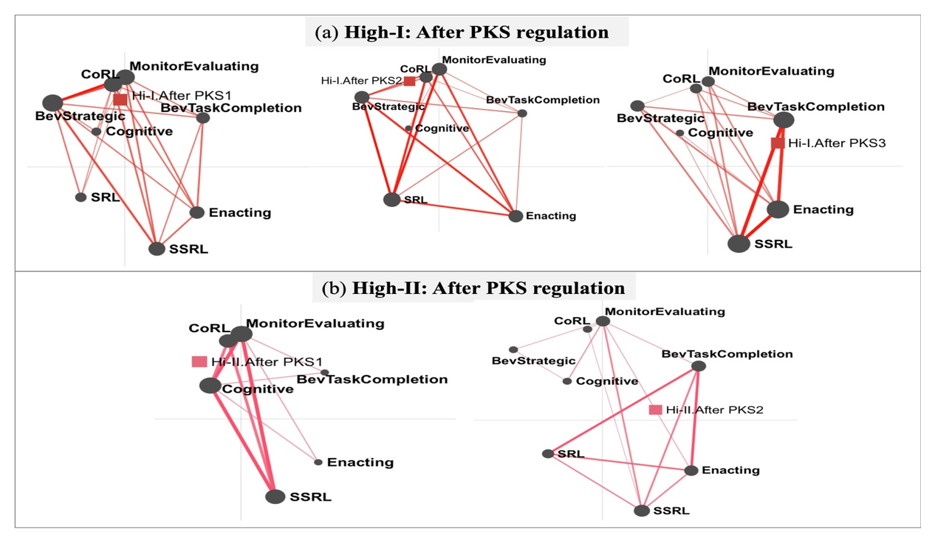
Note. Frequently co-occurring nodes are related to monitoring/evaluating in the earlier episodes and to task completion in the latter episodes.
Figure 5 - Regulation after productive knowledge sharing in high-performing groups
Networks in after-PKS episodes in the med-performing groups (Figure 6) showed that the groups focused on completing the task as a team (thicker edges after both PKS in Med-I and after PKS2 in Med-II). Unlike both high-performing groups, monitoring directed to cognition was not apparent in the Med-I group and was missing in the Med-II group’s middle phase. They monitored and evaluated their strategic behaviour after engaging in PKS, although not highly frequently. In the Med-I group, the first after-PKS episode suggests that planning or coordination issues emerge when an individual creates another plan (SRL-Planning connection). The planning issue appeared to be resolved; the planning node did not re-appear in the latter episodes.
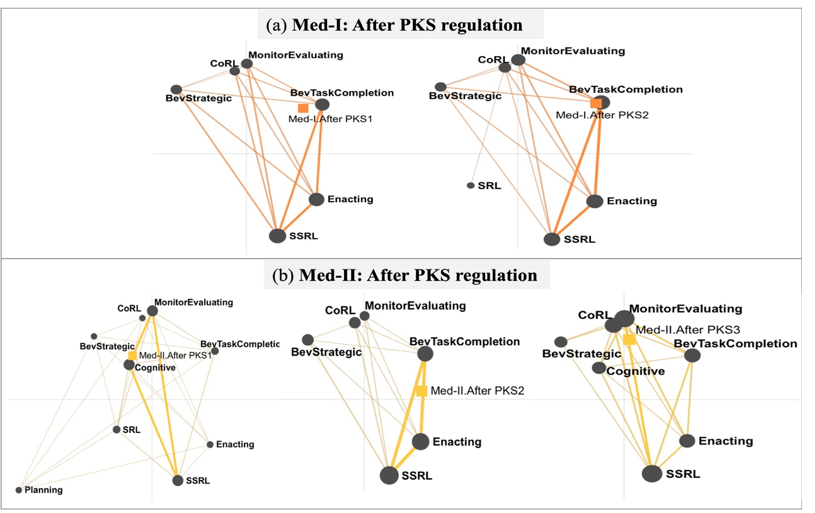
Note. Frequently co-occurring actions are shared enactment of task completion (thicker edges)
Figure 6 - Regulation after productive knowledge sharing in med-performing groups
For the low-performing groups, the networks in the episodes following PKS indicate that both groups revisited planning directed to strategic behaviours, indicating the emergence of behavioural coordination issues (Figure 7). In Low-II, this occurred in the episode after the second PKS. Both groups attempted to adapt their strategic behaviours by planning as a team (adapting node in Figure 7). Both groups monitored/evaluated cognitive understanding rather infrequently and seemed to have a higher emphasis on monitoring task execution or product appearance. For Low-II, although this group initially completed the task as a group, they moved on to highly completing the task alone in the last after-PKS episode. This change is likely due to the group adapting their plan and behaviour to expedite task completion. The Low-I group had the least number of PKS. The occurrence of planning issues and higher emphasis on monitoring members’ behaviour and task execution may have influenced the quality of idea elaboration.
Overall, after engaging in PKS, group members monitoring actions reveal aspects of their learning that could be going well or problematic. Focusing on monitoring cognitive understanding in the early phases of collaboration may benefit group task performance (High-I, High-II). However, when much of the early monitoring was also placed on how the task is being completed by individuals, this could constrain group knowledge sharing progress (Low-I, Low-II). For med-performing groups, the resolution of planning issues allowed the group to focus on task completion (Med-II), but the groups needed to monitor idea accuracy and coherence more frequently to improve task performance (Med-I, Med-II).
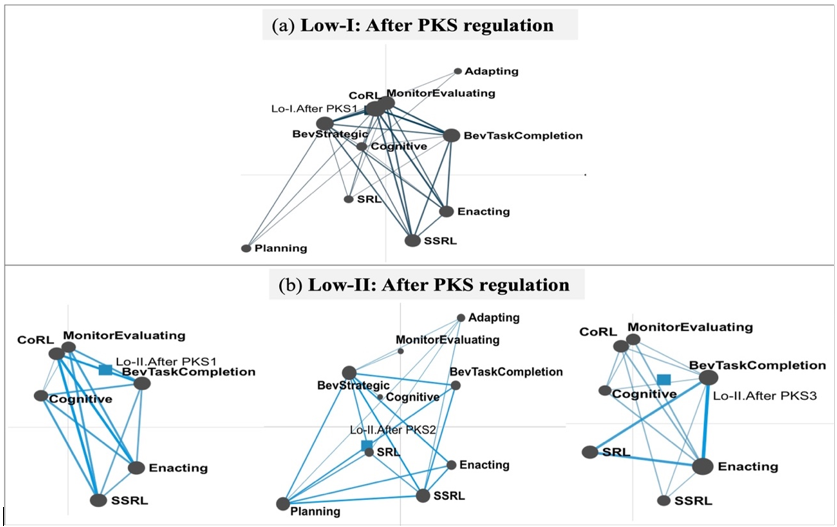
Figure 7 - Regulation after productive knowledge sharing in low-performing groups
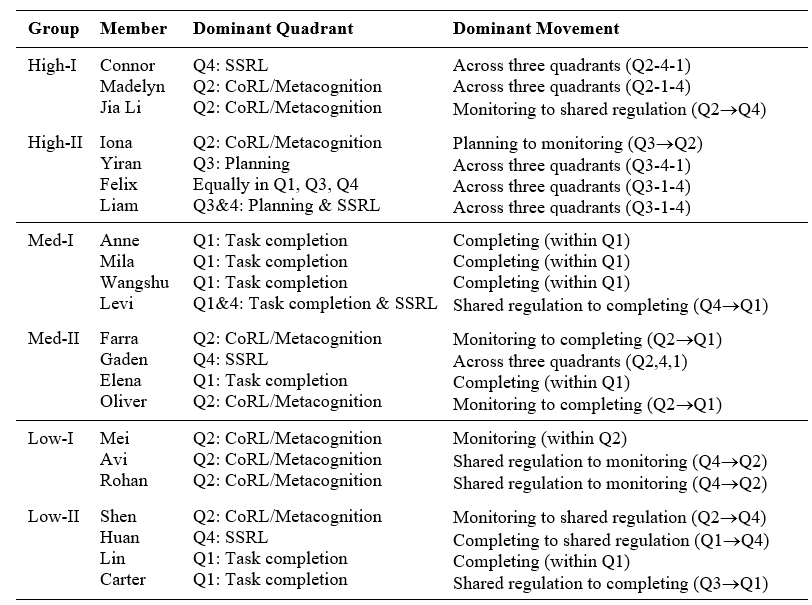
Finally, we examined individuals’ regulation by tracing their centroids on the ENA space (Figure 8) as they proceeded in their learning episodes. Individuals’ dominance and movement in the space are summarized in Table 3. Individuals’ dominant quadrant was judged based on having the highest number of centroids in the quadrant out of the individual’s total centroids. Movement across the ENA space was traced after the prescribed pre-task planning, where individuals’ regulation is not supported externally.
Individuals in the high-performing groups dominantly engaged in either the metacognitive process of co-regulating, monitoring, and evaluating (Q2, High-I) or constructing plans (Q3, High-II). As discussed earlier, high-performing groups’ monitoring process is more focused on cognition and strategic behaviours, and planning was highly dominant early in the groups’ collaboration. The movement of most members in the high-performing groups covered multiple quadrants, suggesting that most members were actively regulating and diversifying regulative actions. In the High-I group, all members’ movements covered the metacognition quadrant, an essential regulative action in an effective group. Meanwhile, in the High-II group, one member strongly performs the metacognitive role, likely allowing others to progress linearly across vast areas in the ENA space.
Individuals in the med-performing groups appeared to dominantly engage in task completion and shared regulation. As in Figure 8b, group members’ centroids in this med-performance level tend to concentrate in the first quadrant, focusing on task completion. Only in the Med-II group were a couple of members co-regulating to monitor and evaluate. For Med-I, there is a lack of dominance in the metacognition quadrant. Movements of individuals in the med-performing groups were either limited to task completion or tread across two quadrants (except for one individual) but, ultimately, settled on task completion.
Members in the low-performing groups dominantly engaged either in co-regulating (Q2, Low-I) or task completion (Q1, Low-II). Recall that the monitoring process in the low-performing groups was mostly related to addressing how the task is being completed. The Low-I group (dark blue centroids, Figure 8c) had no centroids in Quadrant 1 (task completion) and minimal centroids in Quadrant 4 (shared regulation), suggesting that the group experienced issues that stalled task progression as a team. Their movements suggest the group was stuck in monitoring. Although the Low-II group also had one member taking on the metacognitive role, other team members did not move vastly across spaces, often concentrating in Quadrants 1 and 4, where shared regulation and task completion actions occur.
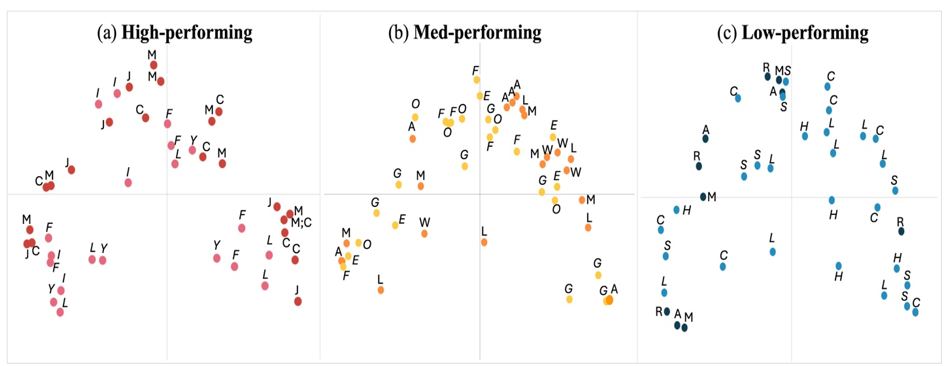
Note. Individuals are identified by their initial. Differences in colour and italicization indicate different group memberships.
Figure 8 - Individual ENA centroids across episodes by group performance levels
Table 4 - Individual members’ dominant quadrant and
movement in the ENA space
This study explored how groups of varying performance levels engaged in knowledge sharing and regulation during an online problem-solving task. The findings contribute to our understanding of productive knowledge sharing (PKS) as a product of and condition for further regulation. Thus far, research in this area demonstrates that collaborative knowledge construction and regulation of learning operate across individual, peer, and group levels, dynamically shifting in response to the group’s needs (Bakhtiar et al., 2018; Gao et al., 2024; Ouyang et al., 2023). Additionally, the dynamic unfolding of knowledge construction both prompts and is prompted by the dynamic unfolding of regulatory actions, and both processes may occur simultaneously within a single conversation (Zabolotna et al., 2023). Group-level shared regulation, in particular, appears to provide a structure for more productive and collaborative knowledge construction (Gao et al., 2024; Ouyang et al., 2023; Zabolotna et al., 2023). Our findings are consistent with these previous findings and extend understanding of how groups regulate their collaboration, particularly around productive knowledge sharing episodes and reveal distinctions in regulatory patterns across performance levels.
Overall, groups did not differ in the types of regulative actions they collectively chose to deploy in the broad sense. This lack of differences at the broad level attests to the need to examine regulation as an unfolding process, investigating further how the regulatory actions were activated in key moments in relation to groups’ knowledge sharing activities. The differences between groups, however, could be observed in their focus on regulating varying aspects at different phases of collaboration and in their members’ regulatory moves. First, beginning to construct knowledge collaboratively appears to require groups to not only plan their behavioural strategies but also consider their shared understanding of the task content and cognitive requirements, as well as the affective concerns of their group members. Effective shared regulation during pre-task planning may better prepare groups to collaborate on the knowledge aspect of the task. Second, findings suggest that groups may not necessarily need a lengthy shared-regulation episode focusing on task completion. However, for groups to move beyond average performance, they also need to frequently monitor and evaluate the coherence and accuracy of their ideas, particularly after group members’ ideas have been pooled and co-constructed. Finally, this study also highlights the importance of examining regulation at the individual and group level and contextualizing the multifaceted nature of regulation at meaningful learning episodes. Our findings showed that more successful groups appear to benefit from having group members who actively co-regulate members’ metacognitive monitoring and evaluation while also showing up as actively contributing members in shared regulation processes in planning, strategic adaptation, and task completion.
In the assigned pre-task planning session, groups behaved similarly by reflecting on the task instructions and developing plans to manage task and group elements. However, groups vary in the elaboration of their plans. High-performing groups emphasized plans targeting cognitive understanding and strategic behaviours, with some attention to socioemotional regulation. As argued in prior studies, the ability to identify broader regulatory targets or anticipated challenges during planning reflects a more metacognitively attuned group of learners (e.g., Zheng et al., 2019). In collaborative research, emotion regulation is understood as reactions to situational affects that occur in the moment, such as when learners control negative feelings arising from their current engagement in the group task (Järvenoja et al., 2019). However, our multilevel coding allows identification of proactive regulation in anticipation of socioemotional challenges as learners discuss concerns about problematic affective situations that may arise during groupwork. Those concerns also reflect experienced affective states, but the regulation that learners put in place targets both current and future situations. Lacking this type of proactive socioemotional regulation may not necessarily put groups at a great risk. However, this proactivity benefits task productivity because the group’s anticipated socioemotions have already been discussed as a team, and they have reached a shared understanding on how to proceed when such challenges occur. Given its potential to promote a more successful collaboration, we have seen researchers prompting group emotion regulation during the planning phase using varied awareness and scripting tools (Järvenoja et al., 2020; Lobczowski et al., 2021; Zheng et al., 2019).
Low-performing groups demonstrated weaker planning connections, particularly around socioemotional aspects, which were entirely absent. This finding suggests that early attention to regulating emotions and team motivation may set high-performing groups apart. In line with previous findings, high-performing groups tend to exhibit shared regulation targeting both the cognition and motivational aspects of their collaboration (Malmberg et al., 2015). In contrast, the low-performing groups focus on the external constraints or behavioural coordination surrounding the environmental aspect of the task. It is common for groups to neglect to regulate their group motivation and emotions before and during collaboration (Järvenoja et al., 2019), despite motivation and emotion challenges being imminent in influencing groups’ knowledge building productivity.
The progression toward productive knowledge sharing highlighted distinctions in how groups addressed planning and coordination issues. High-performing groups refined their plans prior to problem-solving, often addressing socioemotional regulation alongside strategic behaviours. Medium-performing groups engaged in shared planning but lacked the individual planning connections observed in high-performing groups. Retrospective planning that arises from monitoring and evaluating group conditions typical in low-performing groups indicates insufficient planning occurring in the early phase of group collaboration. Low-performing groups experienced coordination issues that required co-regulatory prompts, potentially impeding their ability to engage in productive knowledge construction. These findings underscore the importance of addressing planning issues early to create a foundation for effective knowledge co-construction (e.g., Bakhtiar et al., 2018).
After productive knowledge sharing episodes, high-performing groups maintained a focus on monitoring and evaluating cognitive understanding and idea coherence. These processes were often shared among team members and supported by co-regulation. Content monitoring and evaluation of idea coherence and accuracy are important for groups to optimize their cognitive gains and perform well (see Lee et al., 2017). Medium-performing groups prioritized task completion with frequent back-and-forth idea exchanges but showed less emphasis on monitoring cognition, which may have limited their ability to improve task performance further. Similarly, previous studies have shown that frequent idea sharing with little activation of cognitive monitoring can negatively influence group performance (Gyazi & Zheng, 2023). Low-performing groups revisited planning even after knowledge discussions and focused heavily on monitoring task execution, suggesting unresolved coordination issues. This pattern of low-performing groups being stuck in (re)planning is consistent with previous research (see Bakhtiar et al., 2018; S. Yang et al., 2024). The emphasis on monitoring task completion behaviour in low-performing groups may have constrained their ability to progress collaboratively. Such an outcome may be more likely when the collaborative task is time-limited, where groups have fewer opportunities to bounce back to a productive level.
The importance of co-regulating group members’ content monitoring in supporting a better group outcome is consistent with previous research, such as in Lee et al. (2017) and S. Yang et al. (2024) among others. In S. Yang et al.’s (2024) study, co-regulated content monitoring was found to be critical in facilitating socially shared regulation and task execution, inviting group members to reflect on their cognitive understanding, development of knowledge construction, adapting and activating necessary regulatory strategies and actions. Frequent co-regulation that takes place in a group context with active metacognitive interactions, involving discussion of the required cognitive operations for the collaborative task, is advantages insofar as it can lead to a better learning achievement for the individual group members as well (Haataja et al., 2022).
The analysis of individual regulation patterns revealed further distinctions between performance levels. In line with previous findings (S. Yang et al., 2025), high-performing groups showed diverse regulatory actions, with members actively engaging in metacognitive processes, including co-regulation and monitoring. This diversity reflects a flexible approach to regulation, where individuals adapt their actions based on group needs or task demands. Medium-performing groups, in contrast, were dominated by task completion actions, with limited movement across regulatory processes. Low-performing groups displayed uneven regulatory contributions, with some members focusing on metacognitive processes while others remained narrowly focused on task execution. These patterns suggest that high-performing groups benefit from balanced individual and collective regulation, enabling adaptive collaboration.
This finding aligns with previous research that attempts to unpack the relation between individual group members’ self-regulation in collaborative learning. Quantitative modelling has shown that highly self-regulating team members are likely to engage in co- and shared regulation during collaboration (Ito et al., 2024; Panadero et al., 2015). Although our analysis did not reveal internal self-regulatory actions that occur in the background, such as when an individual detected a problem or inwardly self-regulates their own interests and emotions for the benefit of the group, the effective co-regulation and shared regulation that transpired may have occurred against a backdrop of active self-regulation. The proactive actions shown by some members in the high-performing group in strategically co-regulating or calling attention to detected issues while also showing positive camaraderie by jointly regulating as a team reflect a sophisticated interplay between directing others’ regulation and showing up as a team player during collaboration, such as found in Bakhtiar and Hadwin (2020) and Su et al. (2018). Looking at it from the opposite angle, in line with Lai’s (2021) findings, it is also possible that the more positive social-level regulation seen in high-performing groups may influence individuals to regulate more actively across different team functions.
The time constraints and loosely scripted environment of the collaborative case analysis in this study are important contextual factors. Under time pressure, groups’ regulatory focus may differ from when the collaboration extends multiple learning sessions. The case analysis task itself included specific questions that students needed to address, so the knowledge discussion trajectory is expected to flow from one question to the next. Previous research indicates that the progression of students’ knowledge co-construction phases varies across task designs, with conceptually-driven task demands focusing more on knowledge construction than hands-on tasks (Zabolotna et al., 2025). Using a network density metric as an analytical proxy for concept-dense, task-relevant discourse (productive knowledge sharing) presents limitations for interpreting the quality of groups’ knowledge construction. In this study, productive knowledge sharing was associated with peaks in the groups’ idea networks, in which they repeatedly used and connected task-relevant concepts in their discussions. The time-limited collaborative task required groups to engage in such task-focused discussions. However, even in concept-dense conversations, groups may reference concepts superficially (as seen in the low-performing groups) rather than expand on them to thoroughly problem solve. Despite its limitations, this analytical approach enables a quick scan of groups’ knowledge sharing and idea advancement dynamics as conversations progress, allowing researchers to identify “critical” events or phases that may trigger regulatory actions and decisions.
Although this study utilized a small sample, which makes group differences on the ENA dimensions less likely to be detected, this study is among the few studies to examine both individual and group regulatory networks across learning sessions. The limited number of groups restricts the generalizability of the findings to other contexts or tasks, indicating a need for further investigation. Future research should examine how varying task types or group compositions influence regulation patterns and knowledge sharing and construction activities. ENA has been criticized for providing only averaged networks and lacking temporal information (Elmoazen et al., 2022). Nevertheless, the observation that learners’ networks averaged in different quadrants across learning episodes suggests that learners attempted different sets of regulatory actions at different times. This study also demonstrates how ENA can be efficiently used to draw interpretations from qualitatively coded data by comparing elements in epistemic networks across cases. Considering that our unit of analysis was nested in the ENA model, comparisons between lower-level units proved challenging. Future research should address methodological approaches related to nested-unit analysis in ENA.
This study’s findings point to several areas to consider in supporting collaboration in online and physical classroom contexts. First, it emphasizes the importance of early planning that incorporates socioemotional regulation. Although groups were already asked to engage in a pre-task planning session, groups rarely reflect on the completeness of their plans. It may be worthwhile for classroom teachers to guide reflections on groups’ pre-task planning products by highlighting the different areas they should consider planning for. Future work on computer-supported collaborative learning could include reflection prompts introduced after a group planning session. Groups could be cued to review the goals they set for their collaboration, reflecting on whether their planning has covered all aspects related to knowledge sharing, behavioural strategies, and the group’s socioemotional soundness. The last aspect, particularly, is one support area that needs further development (Järvelä & Rose, 2022). Supporting groups in addressing planning and coordination issues early in the collaboration process may help prevent disruptions in high-quality idea sharing and discussions.
Second, research has shown the positive effects of providing analytics to facilitate groups’ reflective assessment of their collective knowledge and understanding (Y. Yang et al., 2024). However, most tools focus on supporting knowledge or content monitoring after a learning session. The role of content monitoring support during an ongoing task is less explored and often left to the instructor, who occasionally nudges students to check on their work. Considering the successful use of the networking tool in detecting instances of important keyword use, we propose the provision of a keyword or idea meter for groups to track their knowledge use during group learning (Feng et al., 2019). If integrated into ongoing tasks, this technology could significantly enhance learners’ focus on cognitive monitoring, a potential that warrants further exploration. When such technology is unavailable, teachers could intermittently prompt groups to pause and reflect on the list of relevant course concepts they have used and not used so far, encouraging them to assess whether their discussion is deviating from the intended topic or missing essential concepts. This instructional strategy can serve as a temporary scaffold to help students develop the habit of cognitive monitoring at the individual, peer support, and group levels.
Third, the findings indicate the need to support individuals in building internal scripts to enact self-, co-, and shared regulation, allowing them to dynamically and effectively respond to challenges in collaboration (Hadwin, Bakhtiar, et al., 2018). Individuals in the med- and low-performing groups demonstrated limited forms of regulation across the ENA space, likely due to a lack of internal regulation scripts. To facilitate this, we propose developing scaffolds that guide individual students in identifying the types of obstacles they encounter and provide possible scripts for learners to enact self-, co-, or shared regulation appropriate to each obstacle. Highlighting the group’s goals or desirable outcomes within co-regulation scripts could benefit, as demonstrated by one high-performing group’s early attempt to mitigate coordination issues. In a physical classroom approach, teachers could periodically encourage individuals to conduct brief, structured check-ins, prompting learners to name their challenge and select a corresponding regulation strategy from a provided guide (e.g., “I need to voice my confusion and be open in receiving guidance”). This approach builds students’ internalization of regulation scripts by making the often-visible metacognitive regulation tactics a tangible part of classroom discourse.
The theoretical and research implications of this study include reconsiderations of the socially shared regulation function in collaboration. Differences between our med-performing and high-performing groups indicate that groups do not necessarily need a lengthy and frequent shared regulation but benefit from a few high-quality ones that encompass cognitive, behaviour, and socioemotional aspects of their learning. Our study also highlights the need to consider the multifaceted theory of regulation in research implementations, specifically by analyzing the regulation process, target, and mode in concert. In line with theory, we must contextualize regulation action based on who activated it (mode), for what purpose (target), and using what strategic operations (process).
The segmentation of learners’ discourse by identifying productive knowledge-sharing (PKS) peaks challenges the common phase-based segmentation approach. This quantitative, semi-automatic technique offers a way to identify regulation triggers (see Järvelä & Hadwin, 2024) to better contextualize why some regulatory actions are necessary as well as to better support learners when the situation demands. For instance, during a dip in PKS, groups could be signalled to diagnose the issues that are stalling their knowledge construction progress and provided support to (re)strategize so that the group’s knowledge construction and social processes could progress more effectively. The PKS-segmentation approach could still be complemented with phase-based segmentation, such as when we highlight groups’ regulatory actions in the pre-task planning phase, or when research examines the differences between two learning phases (e.g., beginning vs. ending) in terms of their productivity in knowledge-sharing and regulation processes.
Several insights into temporality, the interleaving of knowledge sharing and regulation, and individual-collective dynamics are worth noting. The findings show that regulatory actions function differently depending on their position relative to PKS episodes. For example, the lack of socioemotional regulation during pre-task planning in low-performing groups indicates that the timing of this type of regulatory move matters before substantive knowledge sharing begins. The temporal specificity of certain actions calls for moving beyond examining groups’ frequency and contextually detached sequence of regulatory actions. Instead, it is important to understand the purpose or function of the actions’ timing to support a more productive learning trajectory. The finding that high-performing groups engaged in monitoring and evaluating their ideas or cognition following PKS episodes suggests a sequential pattern in which PKS invites reflective regulatory activity, although enabled through active co-regulation (see also Ouyang et al., 2023). This pattern shows that regulation does not just lay the groundwork for productive taskwork; regulation and PKS mutually enable one another over time (Zabolotna et al., 2023). The interleaving pattern for high-performing groups during problem-solving appears to move from knowledge sharing to idea-focused monitoring and evaluating, then to further knowledge sharing and construction. In contrast, low-performing groups seem to move from surface-level knowledge sharing to procedural monitoring, and to possible breakdown in subsequent knowledge sharing. These patterns suggest that what groups regulate immediately after productive moments shapes whether those moments can propel groups toward deeper collaboration. Regarding individual-collective dynamics, more successful groups achieve a distribution of regulatory labour, with individuals contributing different foci of regulatory actions that collectively address the group’s needs. Rather than pointing to frequent shared regulation as the main contributor to groups’ success, the finding suggests the need to examine more closely individual members’ regulatory flexibility in shifting between regulatory modes and functions as needed, thereby contributing to a dynamic regulatory repertoire for the group.
In summary, this study highlights the importance of (a) proactive regulation, including early planning that involves considerations of the group’s socio-emotion, (b) monitoring and evaluating cognitive understanding or the group’s intermediate state of knowledge, and (c) varied individual-level regulation in achieving productive collaboration. Understanding how regulation unfolds across different knowledge sharing or construction phases of collaboration enables educators and researchers to more effectively support groups in achieving productive learning outcomes. The temporal dynamics identified in this study underscore the importance of studying the interplay between knowledge sharing and regulation, not as separate parallel processes but as deeply intertwined activities that mutually shape one another over time. Productive knowledge sharing is facilitated by thorough regulatory actions early in the collaboration, but such depth in knowledge sharing also creates opportunities for regulation. Fruitful co- and shared regulation following that knowledge sharing activity, in turn, creates conditions for deeper knowledge sharing and construction to emerge.
Table A.1 Coding Scheme Focusing on Three Aspects of Regulatory Actions
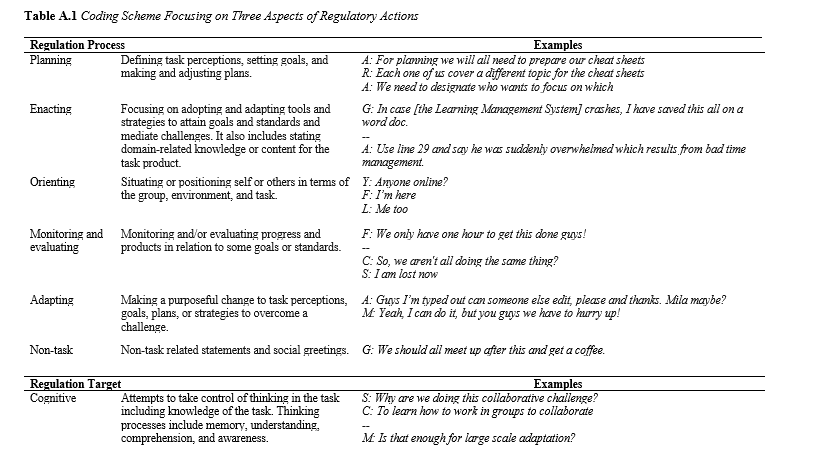
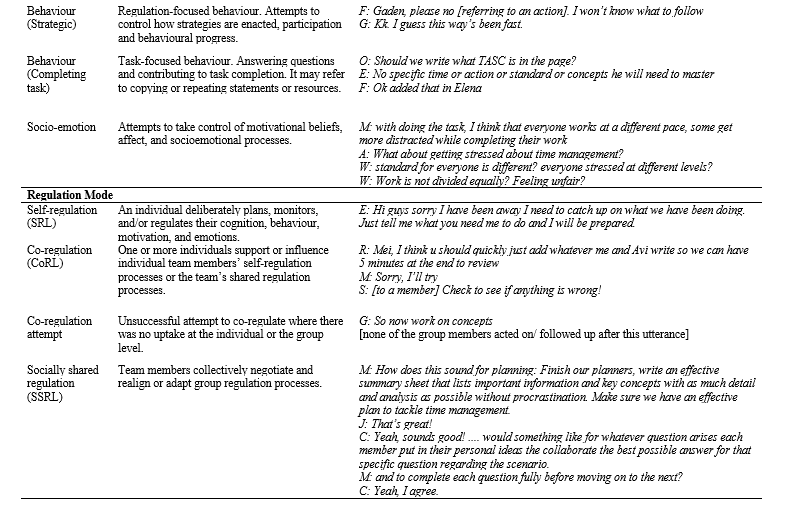
This study was funded by Japan Society for the Promotion of Science Post-doctoral Fellowship awarded to A. Bakhtiar and JSPS KAKENHI (Grant Numbers 21K18502, 21H00902, and 23KF0227) awarded to J. Oshima. Also funded by Social Sciences and Humanities Research Council of Canada Insight Grant awarded to A. F. Hadwin (PAR-21; 435-2012-0529 and PAR-IT: 435-2018-0440).
https://doi.org/10.14786/flr.v8i2.561
Bakhtiar, A., Webster, E. A., & Hadwin, A. F. (2018).
Regulation and socio-emotional interactions in a positive and a
negative group climate. Metacognition and Learning, 13,
57-90.
https://doi.org/10.1007/s11409-017-9178-x
Barany, A., Philips, M., Kawakubo, A. J. T., and Oshima, J.
(2022). Choosing units of analysis in temporal discourse. In B.
Wasson, & S. Zörgő (Eds.,), Advances in quantitative
ethnography (pp. 80-94). Springer.
Bowman, D., Swiecki, Z., Cai, Z., Wang, Y., Eagan, B., Linderoth,
J., & Shaffer, D. W. (2021). The mathematical foundations of
epistemic network analysis. In A. R. Ruis, & S. B. Lee (Eds.),
Advances in quantitative ethnography (pp. 91-105).
Springer.
Damşa, C. I., Kirschner, P. A., Andriessen, J. E. B., Erkens, G.,
& Sins, P. H. M. (2010). Shared epistemic agency: An empirical
study of an emergent construct. Journal of the Learning
Sciences, 19(2), 143-186.
https://doi.org/10.1080/10508401003708381
Elmoazen, R., Saqr, M., Tedre, M., & Hirsto, L. (2022). A
systematic literature review of empirical research on epistemic
network analysis in education. IEEE Access, 10,
17330-17348.
Feng, X., van Aalst, J., Chan, C. K., & Yang, Y. (2019).
Fostering collective knowledge advancement through Idea-Friend
Maps in a large knowledge building community. In A wide
lens: Combining embodied, enactive, extended, and embedded
learning in collaborative settings (pp. 288-295). ISLS.
Gao, Y., Wu, L., Lv, X., Ma, X., & Liu, Q. (2024). A joint
evaluation method of regulated‐learning and cognitive quality in
collaborative knowledge building. Journal of Computer
Assisted Learning, 40 (4), 1806-1822.
https://doi.org/10.1111/jcal.12985
Gunawardena, C. N., Lowe, C. A., & Anderson, T. (1997).
Analysis of a global online debate and the development of an
interaction analysis model for examining social construction of
knowledge in computer conferencing. Journal of Educational
Computing Research, 17(4), 397-431.
https://doi.org/10.2190/7MQV-X9UJ-C7Q3-NRAG
Gyasi, J. F., & Zheng, L. (2023). Idea improvement and
socially shared regulation matter in cross-cultural online
collaborative learning. SAGE Open, 13 (1), 1-17.
https://doi.org/10.1177/21582440221148625
Haataja, E., Dindar, M., Malmberg, J., & Järvelä, S. (2022).
Individuals in a group: Metacognitive and regulatory predictors of
learning achievement in collaborative learning. Learning and
Individual Differences, 96, 102146.
https://doi.org/10.1016/j.lindif.2022.102146.
Hadwin, A. F., Bakhtiar, A., & Miller, M. (2018). Challenges
in online collaboration: Effects of scripting shared task
perceptions. International Journal of Computer-Supported
Collaborative Learning , 13, 301-329.
https://doi.org/10.1007/s11412-018-9279-9
Hadwin, A., Järvelä, S., & Miller, M. (2018). Self-regulation,
co-regulation, and shared regulation in collaborative learning
environments. In D.H. Schunk & J.A. Greene (Eds.),
Handbook of self-regulation of learning and performance
(pp. 83-106). Routledge.
Ito, T., Umemoto, T., & Nakaya, M. (2024). Reciprocal path
model of autonomous motivation and motivational regulation:
socially shared regulation in intellectual group activities.
Journal of Educational and Developmental Psychology, 14(
1), 93-107.
https://doi.org/10.5539/jedp.v14n1p93
Janssen, J., Erkens, G., Kirschner, P. A., & Kanselaar, G.
(2012). Task-related and social regulation during online
collaborative learning. Metacognition and Learning, 7,
25-43.
https://doi.org/10.1007/s11409-010-9061-5
Järvelä, S., & Hadwin, A. (2024). Triggers for self-regulated
learning: A conceptual framework for advancing multimodal research
about SRL. Learning and Individual Differences , 115,
102526.
https://doi.org/10.1016/j.lindif.2024.102526
Järvelä, S., & Rose, C. P. (2022). Novel CSCL design processes
prompted by exploration of role-playing and emotions.
International Journal of Computer-Supported Collaborative
Learning, 17 (4), 457-461.
https://doi.org/10.1007/s11412-022-09383-9
Järvenoja, H., Malmberg, J., Törmänen, T., Mänty, K., Haataja, E.,
Ahola, S., & Järvelä, S. (2020). A collaborative learning
design for promoting and analyzing adaptive motivation and emotion
regulation in the science classroom. Frontiers in Education,
5(111), 1-16.
https://doi.org/10.3389/feduc.2020.00111
Järvenoja, H., Näykki, P., & Törmänen, T. (2019). Emotional
regulation in collaborative learning: when do higher education
students activate group level regulation in the face of
challenges? Studies in Higher Education, 44 (10),
1747-1757.
https://doi.org/10.1080/03075079.2019.1665318
Kaliisa, R., Dane, J. O., Sanchez, D., Pratt, J., Damsa, C., &
Scianna, J. (2023). Understanding group dynamics during
synchronous collaborative problem-solving activities: An epistemic
network Approach. In G. Arastoopour Irgens, & S. Knight
(Eds.), Advances in quantitative ethnography (pp.
81-95). Springer.
Lai, C. L. (2021). Effects of the group‐regulation promotion
approach on students’ individual and collaborative learning
performance, perceptions of regulation and regulation behaviours
in project‐based tasks. British Journal of Educational
Technology , 52(6), 2278-2298.
https://doi.org/10.1111/bjet.13138
Lee, L., Lajoie, S. P., Poitras, E. G., Nkangu, M., & Doleck,
T. (2017). Co-regulation and knowledge construction in an online
synchronous problem based learning setting. Education and
Information Technologies, 22(4), 1623-1650.
https://doi.org/10.1007/s10639-016-9509-6
Lehtinen, A., Kostiainen, E., & Näykki, P. (2023).
Co-construction of knowledge and socioemotional interaction in
pre-service teachers’ video-based online collaborative learning.
Teaching and Teacher Education , 133, 104299.
https://doi.org/10.1016/j.tate.2023.104299
Lobczowski, N. G., Lyons, K., Greene, J. A., & McLaughlin, J.
E. (2021). Socially shared metacognition in a project-based
learning environment: A comparative case study. Learning,
Culture and Social Interaction, 30, 100543.
https://doi.org/10.1016/j.lcsi.2021.100543
Malmberg, J., Järvelä, S., Järvenoja, H., & Panadero, E.
(2015). Promoting socially shared regulation of learning in CSCL:
Progress of socially shared regulation among high-and
low-performing groups. Computers in Human Behavior, 52,
562-572.
https://doi.org/10.1016/j.chb.2015.03.082
Melzner, N., Greisel, M., Dresel, M., & Kollar, I. (2019).
Using process mining (PM) and epistemic network analysis (ENA) for
comparing processes of collaborative problem regulation. In B.
Eagan, M. Misfeldt, & A. Siebert-Evenstone (Eds.), Advances
in quantitative ethnography (pp. 154-164). Springer.
Nguyen, H., Lim, K. Y., Wu, L. L., Fischer, C., & Warschauer,
M. (2021). “We’re looking good”: Social exchange and regulation
temporality in collaborative design. Learning and
Instruction, 74, 101443.
https://doi.org/10.1016/j.learninstruc.2021.101443
Ohsaki, A., & Oshima, J. (2021). Socio-semantic network
analysis of knowledge-creation discourse on a real-time scale. In
A. R. Ruis & S. B. Lee (Eds.), Advances in quantitative
ethnography (pp. 170–184). Springer.
Oshima, J., Oshima, R., & Matsuzawa, Y. (2012). Knowledge
building discourse explorer: A social network analysis application
for knowledge building discourse. Educational Technology
Research and Development , 60(5), 903-921.
https://doi.org/10.1007/s11423-012-9265-2
Oshima, J., Oshima, R., & Saruwatari, S. (2020). Analysis of
students’ ideas and conceptual artifacts in knowledge‐building
discourse. British Journal of Educational Technology
, 51(4), 1308-1321.
https://doi.org/10.1111/bjet.12961
Ouyang, F., Wu, M., Zhang, L., Xu, W., Zheng, L., & Cukurova,
M. (2023). Making strides towards AI-supported regulation of
learning in collaborative knowledge construction. Computers
in Human Behavior, 142, 107650.
https://doi.org/10.1016/j.chb.2023.107650
Panadero, E., Kirschner, P. A., Järvelä, S., Malmberg, J., &
Järvenoja, H. (2015). How individual self-regulation affects group
regulation and performance: A shared regulation intervention.
Small Group Research, 46 (4), 431–454.
https://doi.org/10.1177/104649641559121
Paquette, L., Grant, T., Zhang, Y., Biswas, G., & Baker, R.
(2021). Using epistemic networks to analyze self-regulated
learning in an open-ended problem-solving environment. In A. R.
Ruis, & S. B. Lee (Eds.), Advances in quantitative
ethnography (pp. 185–201). Springer.
Rogat, T. K., & Adams-Wiggins, K. R. (2014). Other-regulation
in collaborative groups: Implications for regulation quality.
Instructional Science, 42 , 879-904.
https://doi.org/10.1007/s11251-014-9322-9
Saint, J., Dragan, G., Wannisa, M., Ahmad Uzir, N.A, & Pardo,
A. (2020). Combining analytic methods to unlock sequential and
temporal patterns of self-regulated learning. In Proceedings
of the Tenth International Conference on Learning Analytics
& Knowledge (pp. 402–11). ACM.
Scardamalia, M., & Bereiter, C. (2006). Knowledge building:
Theory, pedagogy, and technology. In K. Sawyer (Ed.),
Cambridge handbook of the learning sciences (pp. 97-118).
Cambridge University Press.
Shaffer, D. W. (2006). Epistemic frames for epistemic games.
Computers & Education , 46(3), 223-234.
https://doi.org/10.1016/j.compedu.2005.11.003
Shaffer, D., & Ruis, A. (2017). Epistemic network analysis: A
worked example of theory-based learning analytics. In C. Lang, G.
Siemens, A. F. Wise, & D. Gasevic (Eds.), Handbook of
Learning Analytics (pp. 175–187). SOLAR.
Siebert-Evenstone, A. L., Irgens, G. A., Collier, W., Swiecki, Z.,
Ruis, A. R., & Shaffer, D. W. (2017). In search of
conversational grain size: Modeling semantic structure using
moving stanza windows. Journal of Learning Analytics, 4
(3), 123-139.
https://doi.org/10.18608/jla.2017.43.7
Su, Y., Li, Y., Hu, H., & Rosé, C. P. (2018). Exploring
college English language learners’ self and social regulation of
learning during wiki-supported collaborative reading activities.
International Journal of Computer-Supported Collaborative
Learning, 13 (1), 35-60.
https://doi.org/10.1007/s11412-018-9269-y
Volet, S., Summers, M., & Thurman, J. (2009). High-level
co-regulation in collaborative learning: How does it emerge and
how is it sustained?. Learning and Instruction, 19(2),
128-143.
https://doi.org/10.1016/j.learninstruc.2008.03.001
Winne, P. H., & Hadwin, A. F. (1998). Studying as
self-regulated engagement in learning. In D. Hacker, J. Dunlosky,
& A. Graesser (Eds.), Metacognition in educational theory
and practice (pp. 277-304). Lawrence Erlbaum.
Yang, S., Lodge, J.M. & Brooks, C. (2024). Capturing
multi-layered regulated learning in collaboration. Metacognition
Learning, 20 (2), 1-39.
https://doi.org/10.1007/s11409-024-09409-7
Yang, Y., Chen, Y., Feng, X., Sun, D., & Pang, S. (2024).
Investigating the mechanisms of analytics-supported reflective
assessment for fostering collective knowledge. Journal of
Computing in Higher Education, 36(1), 242-273.
https://doi.org/10.1007/s12528-024-09398-1
Yin, R. K. (2018). Case study research and applications:
Design and methods (Sixth ed.). SAGE Publications.
Zabolotna, K., Malmberg, J., & Järvenoja, H. (2023). Examining
the interplay of knowledge construction and group-level regulation
in a computer-supported collaborative learning physics task.
Computers in Human Behavior , 138, 107494.
https://doi.org/10.1016/j.chb.2022.107494
Zabolotna, K., Nøhr, L., Iwata, M. Spikol, D., Malmberg, J., &
Järvenoja, H. (2025). How does collaborative task design shape
collaborative knowledge construction and group-level regulation of
learning? A study of secondary school students’ interactions in
two varied tasks. International Journal Computer-Supported
Collaborative Learning, 20, 171–199
https://doi.org/10.1007/s11412-024-09442-3
Zhang, N., & Ouyang, F. (2023). An integrated approach for
knowledge extraction and analysis in collaborative knowledge
construction. International Journal of Educational
Technology in Higher Education, 20 (1), 45.
https://doi.org/10.1186/s41239-023-00414-5
Zhang, S., Chen, J., Wen, Y., Chen, H., Gao, Q., & Wang, Q.
(2021). Capturing regulatory patterns in online collaborative
learning: A network analytic approach. International Journal
of Computer-Supported Collaborative Learning, 16 (1),
37-66.
https://doi.org/10.1007/s11412-021-09339-5
Zheng, L., Li, X., Zhang, X., & Sun, W. (2019). The effects of
group metacognitive scaffolding on group metacognitive behaviors,
group performance, and cognitive load in computer-supported
collaborative learning. The Internet and Higher Education, 42,
13–24.
https://doi.org/10.1016/j.iheduc.2019.03.002
Zörgő, S. (2023). Segmentation and code co-occurrence
accumulation: operationalizing relational context with stanza
windows. In C. Damşa, & A. Barany (Eds.), Advances in
quantitative ethnography (pp. 146-162). Springer. ">